yahoo Press
Archaeologists Found a Skeleton Wearing a Silver Amulet. It Rewrote the History of Christianity.
Images
1 / 10
2 / 10

3 / 10

4 / 10

5 / 10

6 / 10
7 / 10

8 / 10

9 / 10

10 / 10
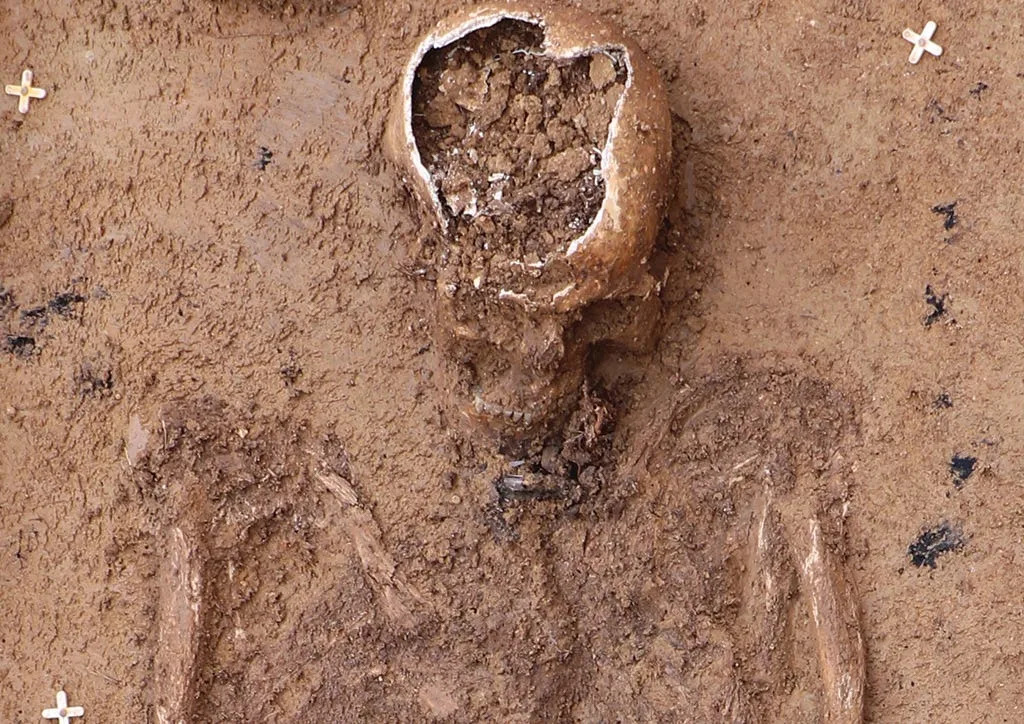
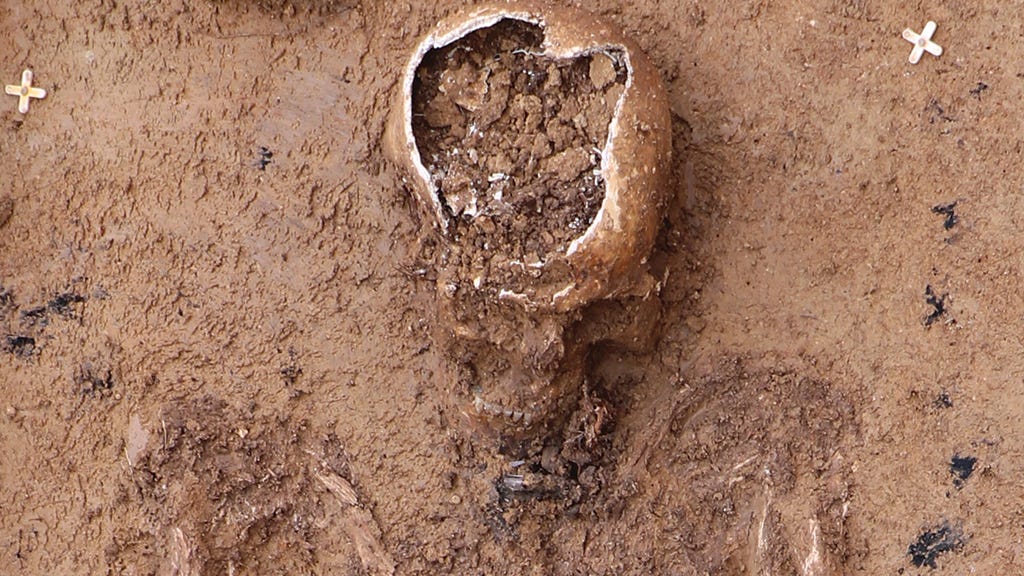
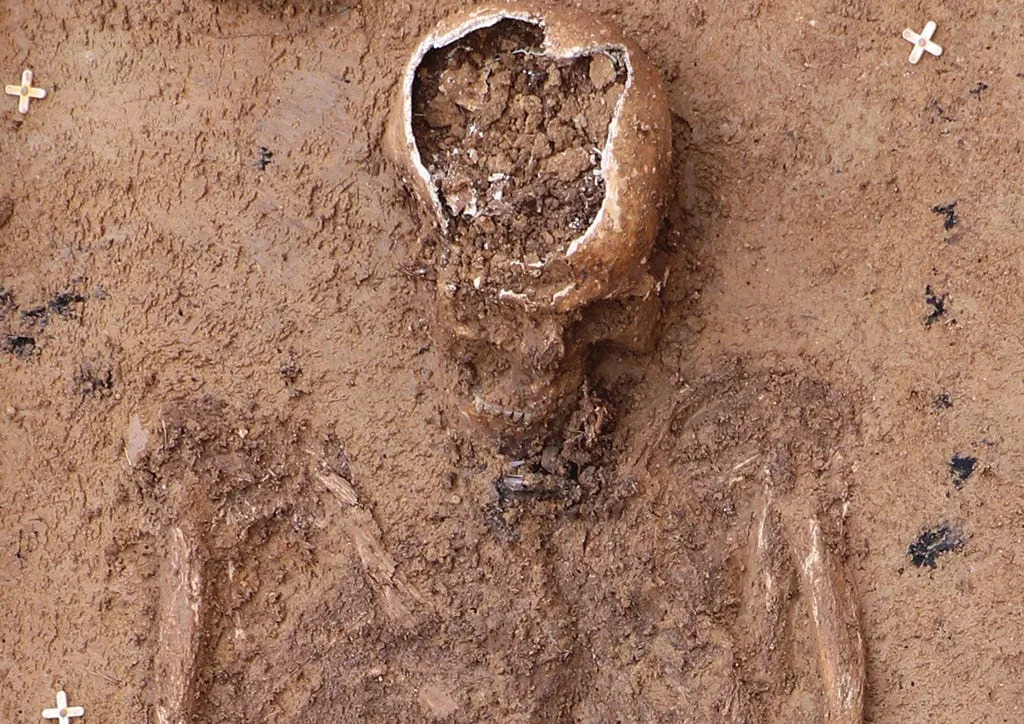
AT FIRST, THE skeleton in grave 134 seemed unremarkable.In 2018, archaeologists in Germany descended upon the ancient town of Nida, about a mile and a half outside Frankfurt. The archaeologists focused their attention on excavating a cemetery. Here they would look at more than 100 plots where people had been buried, often with objects.

So when the archaeologists came upon grave 134 and saw what appeared to be a necklace resting below the skeleton’s chin, they weren’t shocked or overly curious. The male, estimated to be 35 to 40 years old at the time of his death, had no observable injuries or abnormalities. In fact, he appeared to have been in otherwise good health.

But then the archaeologists took a closer look at the amulet from grave 134. The inch-long silver charm held a fragile, broken piece of foil that seemed to have writing on it. The amulet, it turned out, was a phylactery—and that 1,800-year-old trinket would alter the course of what we thought we knew about Christianity and European history.

At the time of the excavation, however, archaeologist Markus Scholz could only determine that the amulet contained a small piece of rolled-up foil with 18 lines of Latin written on it. Deciphering what it said would take years.

“[I]t quickly became clear that it would be impossible to physically unroll the scroll—which would have simply crumbled to pieces,” said Scholz, a professor at Goethe University in Frankfurt who was part of the excavation team. Scholz and his colleagues attempted to read the scroll using microscopes, and in 2020 they performed an x-ray analysis, where the team unrolled the foil segment by segment. But they still couldn’t make out the text.

Then in 2024, Scholz and the team tried computed tomography, which combines x-rays and computer processing to analyze cross-sections of an object. Incredibly, the resulting image revealed enough details for the team to make out what was inscribed on the foil. “I couldn’t believe my own eyes for a while,” Scholz said.

Their work wasn’t done, however. Some of the passages were easy to translate, but others had multiple meanings—leaving some elements open to interpretation. After years of debate, most scholars now agree that the lines, now known as the Frankfurt Silver Inscription, invoke Christ. One portion reads:

(In the name) of St. Titus.

Holy, holy, holy!

In the name of Jesus Christ, Son of God!

The lord of the world

resists to the best of his [ability]

all seizures/setbacks.

The god grants well-being

Admission.

This rescue device protects

the person who

surrenders to the will

of the Lord Jesus Christ, the Son of God,

since before Jesus Christ

bend all knees: the heavenly ones,

the earthly and

the subterranean, and every tongue

confess (to Jesus Christ).

The inscription has powerful implications, suggesting that Christianity had spread from the Roman Empire’s base in Italy much earlier than historians thought, into the heart of what we now know as Germany. The inscription also suggests that the man in grave 134 was a devout Christian—a dangerous thing to be at that time, when the Roman Empire often punished Christians with death.

Today, researchers are still trying to finesse the inscription’s meaning and learn who the man wearing the amulet was. Scholz recognizes the transparent serendipity that had been necessary for archaeologists to have found the amulet in the first place. “It remains an absolute stroke of luck,” Scholz said. “Many archaeological findings are generated more like a large jigsaw puzzle.”

That kind of serendipitous luck fuels many modern archaeological finds that have altered what we think we know about history. It’s not an uncommon story—farmers digging a well stumble upon China’s Terracotta Army; a man hunting for his lost chickens finds the underground city of Derinkuyu in Turkey; a construction crew discovers 51 decapitated Viking warriors near Weymouth in southern England.

And these auspicious finds are still happening regularly. Like the discovery within grave 134, the three below have rewritten our understanding of history, changed the fortunes of ordinary people, or solved centuries-old mysteries.

THE FARMER WHO STUMBLED UPON $2 MILLION WORTH OF CIVIL WAR GOLD

LOCATION: KENTUCKY / DATE: JUNE 2023

IN JUNE 2023, a farmer shot a shaky video from a Kentucky cornfield. “This is the most insane thing ever,” he pants while piling up gold coins in front of the camera.

Indeed, it was quite unbelievable: The farmer had found piles of Civil War–era gold coins hiding just under the surface of his field. There was no treasure chest, not even a can or cigar box to hold the loot. Just gold coins everywhere. Their quality was astonishing: more than 700 near-pristine coins dated between 1840 and 1863, including 18 prized 1863 gold Liberty Double Eagles. The Liberty Double Eagles were particularly valuable, especially in their condition: In a 2014 auction, just one Double Eagle fetched thousands of dollars. Numismatists have estimated that the total value of the treasure is more than $2 million.

The coins drew attention for their historical value too. Many wondered how so many pristine coins ended up strewn across a Kentucky field. Professional and amateur historians unraveled clues and developed theories. The fact that the coins were in near-mint condition suggested that they hadn’t been in circulation for long, if at all. And their owner was likely a Confederate; Southerners at that time during the war had few options for depositing money into banks and expecting to be able to retrieve it later. Many buried their fortunes.

However, some experts believe the coins were produced by the Philadelphia Mint, noting the perfect condition of the 1863 Gold Liberty Double Eagles and the lack of identifying marks—the latter a hallmark of coins minted there. Ryan McNutt, an associate professor at Georgia Southern University who focuses on conflict archaeology, believes that whoever had them “was potentially engaged in selling goods or trading goods with the U.S. government or military. That’s really the only way you’re going to get access to that kind of coinage.”

A secret operative with a stash of perfect gold coins—it’s the stuff of Hollywood and one of the greatest treasure finds in American history.

THE DENTIST WHO UNRAVELED A SECRET CODE IN A DA VINCI DRAWING

LOCATION: ENGLAND / DATE: MARCH 2025

LEONARDO DA VINCI’S Vitruvian Man is among history’s most famous works of art, as recognizable as the Mona Lisa. It also has held a secret that stumped artists and mathematicians for centuries—until a dentist came along.

Unlike the Mona Lisa, Vitruvian Man isn’t completely original. The work was inspired by the writings of the Roman architect Vitruvius in De architectura (On Architecture), where he contemplates the unique symmetry of the human body. Da Vinci’s Vitruvian Man shows a spread-eagled man with his arms and legs in two positions: feet closed and arms extended at 90-degree angles, like a tree, and angled out like an X. Outside the body, Da Vinci drew a circle and a square, showing how human anatomy could fit neatly within those incongruous shapes.

Most art historians believed those two shapes were the only ones present in Vitruvian Man. But within its clean lines was a secret dating back to Vitruvius, who suggested that the perfect proportions of the human form could be achieved by a geometric relationship. Vitruvius, however, kept the geometric relationship a tantalizing secret.

That is, until the summer of 2025, when Rory Mac Sweeney, a British dentist, took a long look at Vitruvian Man. He picked up on something oddly familiar in the way the figure’s legs were spread out: To him, the shape they made resembled a human mandible. His “aha moment” brought to mind what dentists call Bonwill’s triangle, where the ideal jawbone structure contains a perfect equilateral triangle formed by the incisors at the front of the mouth and the rear of the jawbones.

The shapes embedded within the artwork are positioned in a way that was, in true Vitruvian form, simple yet beautiful. Beyond the equilateral triangle, Mac Sweeney identified five more equilateral triangles nestled in Vitruvian Man’s body shape, with the figure’s navel acting as the focal point. The six equilateral triangles form a hexagon—a geometric shape that answers the centuries-old question about how Da Vinci was able to create the perfect human figure. The answer had been right there all along.

Explaining the stunning geometry to dentists and art historians alike, however, was more difficult. “Clinical dentistry focuses on immediate treatment concerns, not evolutionary geometry,” he said. “Art historians I approached were unfamiliar with craniofacial biomechanics.

“The enthusiasm I felt was matched by isolation in discussing it.”

Nevertheless, Mac Sweeney published an article in the Journal of Mathematics and the Arts offering his unique insight into Da Vinci’s cryptic puzzle. And art historians have taken notice, thanks to his dental knowledge and curious eye. For his part, Mac Sweeney doesn’t think his coming upon the hidden geometry of Vitruvian Man was luck. “Discovery feels like communion with nature’s underlying logic,” he reflected. “You’re not inventing connections; you’re recognizing patterns that were always present, waiting for the right perspective to render them visible.”

THE PLUMBER WHO PULLED A ROPE, REVEALING A LONG-BURIED TREASURE CHEST

LOCATION: AUSTRIA / DATE: NOVEMBER 2024

HOME RENOVATION PROJECTS can feel like a money sink. But an Austrian plumber actually made a fortune while working on a basement in a Viennese villa in the city’s Penzing district.

The plumber had arrived to work on a basement demolition when he spied a rope sticking out of the basement floor. Curious, he poked around the surrounding concrete, and then pulled on the cord. After a few unsuccessful attempts, the plumber dug with a shovel, yanked the rope again, and uncovered a rusty metal box covered in concrete.

What he uncovered was stunning: a treasure chest filled with 66 pounds of gold coins, each stamped with composer Wolfgang Mozart’s image and dating back before World War II. The haul is worth an estimated $2.7 million today.

“This is truly unbelievable,” the plumber told the German talk show Today. “I have been working on construction sites since I was 15. You occasionally find a coin or two, but a discovery like this is incredible.”

You Might Also Like

The Do’s and Don’ts of Using Painter’s Tape

The Best Portable BBQ Grills for Cooking Anywhere

Can a Smart Watch Prolong Your Life?