yahoo Press
This Iron-Toothed Sea Creature Found 18,000 Feet Down Has a Crowdsourced Name
Images
1 / 12
2 / 12

3 / 12

4 / 12

5 / 12

6 / 12
7 / 12
8 / 12
9 / 12

10 / 12

11 / 12

12 / 12
The post This Iron-Toothed Sea Creature Found 18,000 Feet Down Has a Crowdsourced Name appeared first on A-Z Animals.

In 2024, Japanese researchers discovered a new species of chiton in the Izu-Ogasawara Trench off the coast of Japan

The chiton was found at a depth of 5,500 meters.

Prompted by the popular YouTuber, Ze Frank, scientists studying the new species put a call out on social media seeking a name. They received more than 8,000 suggestions.

The name chosen was Ferreiraella populi, which means “of the people.”

It’s not uncommon for newly discovered species to make the news, especially when they are found 5,500 meters underwater. What is unusual, though, is when the naming of the species gets as much newsworthy notice as the discovery itself.

Thanks to YouTube and the power of crowdsourcing, that’s exactly what happened to this specialized resident of the deep.

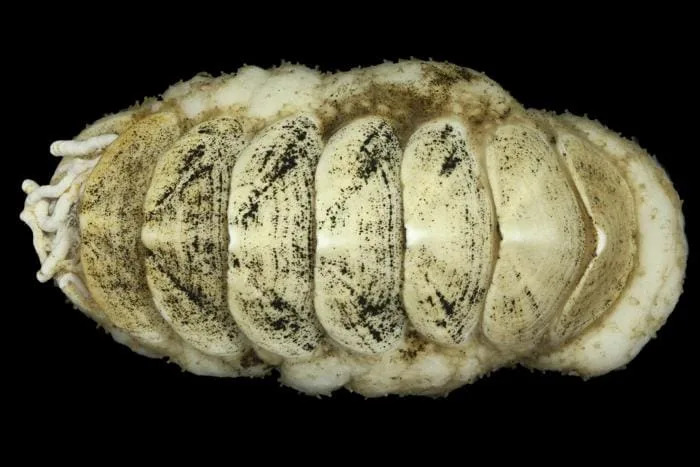
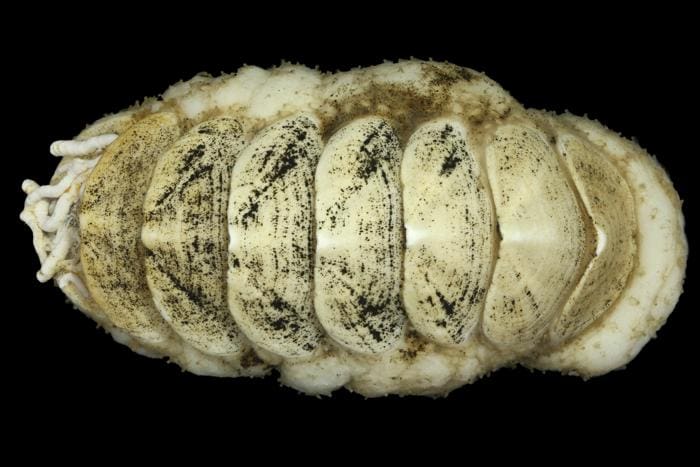
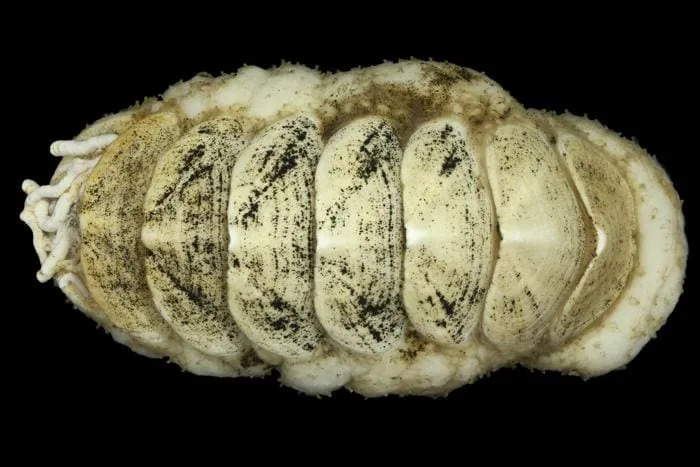
Meet the newest deep-sea chiton, Ferreiraella populi. The species was originally discovered in 2024 when Japanese researchers were exploring the Izu-Ogasawara Trench off the coast of Japan. They discovered a rare and specialized type of marine mollusk, called a chiton, that lives exclusively on sunken wood in the sea.

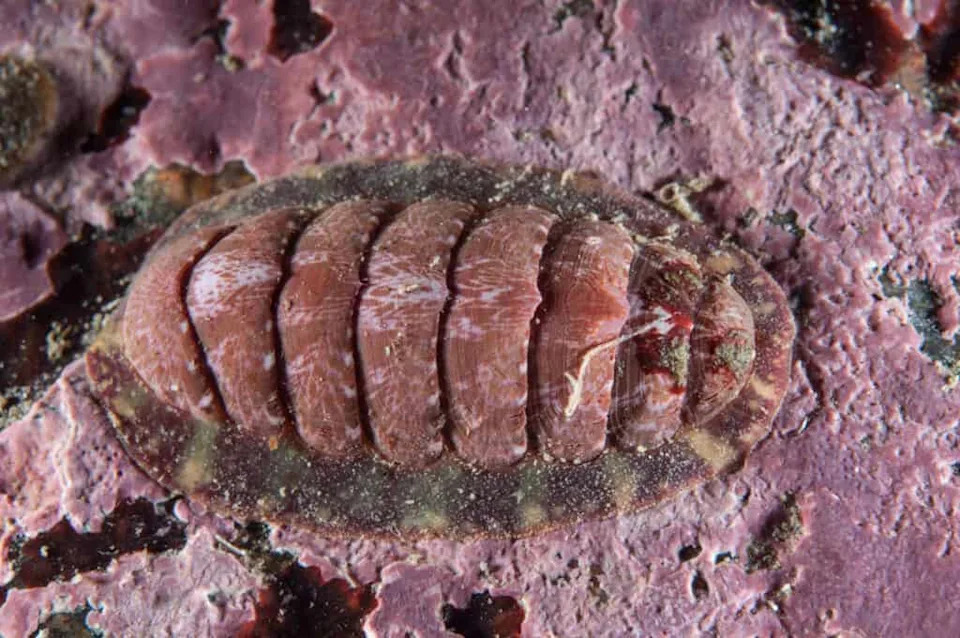
With eight separate shell plates, this type of mollusk is unique compared to other mollusk species that have a single, solid shell. The separate plates allow the chiton, the newest member of the genus Ferreiraella, to roll into a protective ball when threatened and to cling to the uneven surfaces of scattered pieces of wood on the sea floor.

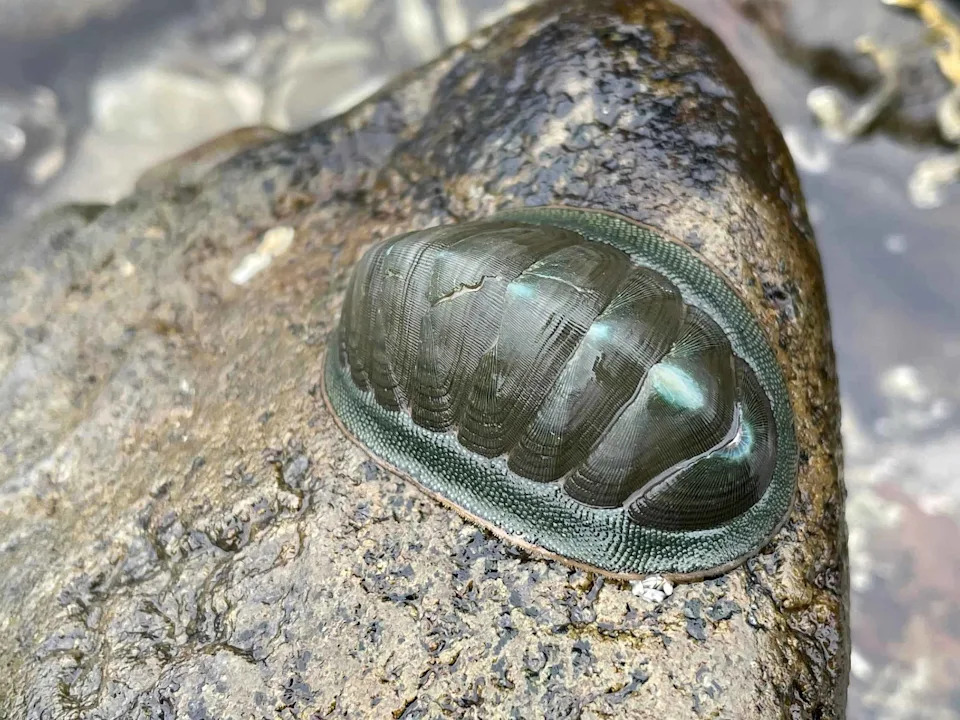
A typical mollusk has a hard shell that is one continuous piece. Chitons have shells divided into eight separate plates.

©Haireena/Shutterstock.com

In something that sounds like it came straight from a science fiction movie, the chiton also has a radula covered in iron–essentially a mineralized tooth tongue. This iron tongue allows the chiton to efficiently scrape up the organic matter it needs to survive.

Chitons can be found on coral reefs and in warm coastal waters, as well as in the absolute darkness of the sea floor. Certain species can survive at depths of up to 7,000 feet, tolerating the extreme conditions found there. As long as there is some wood for them to cling to, they can survive.

When the species was first seen, researchers operating a deep-sea submersible collected samples of it and took it to the research facilities at the Senckenberg Ocean Species Alliance (SOSA). There, scientists documented everything about the chiton that was collected from the sea floor. They determined that it was, in fact, a brand new species never before observed.

When a new species is discovered, it can often take 10 to 20 years for scientists to fully study it, publish their findings, and land on a formal name. The scientific name follows the process established by Carl Linnaeus in the 1750s, which is still followed today. The principle behind this process involves binomial nomenclature.

This means the species receives two official names. The first is the genus to which it belongs, in this case, Ferreiraella. The second name is chosen by the author(s) who first publish findings about the species in a scientific publication.

While the first name is strictly regulated, the second can be more creative. The only requirements are that it is novel, unique, and Latinized. In this chiton’s case, its second name is populi, which means “of the people.”

While the official name follows Linnaeus’s guidelines, the naming process was anything but typical. It took less than two years, and it was not the scientists who came up with the name.

The name was crowdsourced by social media users.

Ze Frank, a YouTuber focused on science topics, caught the attention of scientists when he featured the unnamed deep-sea chiton on an episode of his “True Facts” YouTube series. The episode was popular, and the idea for a public naming competition was born.

Through a partnership among the Senckenberg Ocean Species Alliance (SOSA), Pensoft Publishers, and Ze Frank, the public was formally asked to submit possible names for the newly discovered chiton. Within one week, the naming contest received more than 8,000 suggestions, all submitted via social media.

Chitons come in many colors and live in diverse areas of the world’s oceans, from shallow coral reefs to deep-sea floors at depths of 7,000 feet.

©RLS Photo/Shutterstock.com

The scientists who published their original findings ultimately chose the name from the thousands of entries. One of them was Prof. Dr. Julia Sigwart, co-chair of SOSA at the Senckenberg Research Institute and Natural History Museum Frankfurt.

According to Sigwart, “The name we chose, Ferreiraella populi, translates to ‘of the people.’ We were overwhelmed by the response and massive number of creative name suggestions.”

That is not to say the decision was easy.

Another strong contender was Ferreiraella stellacadens, which means “shooting star chiton.” It reflects the unique pattern on the chiton’s hard shell and is a nod to how quickly the chiton shot to fame on YouTube.

Another submission paid tribute to the chiton’s discovery off the coast of Japan. The name Ferreiraella ohmu is a nod to the popular chiton-like creature created by Studio Ghibli, the world-renowned Japanese animation studio.

But ultimately, Ferreiraella populi won the day. The name was coincidentally suggested by 11 different contributors during the contest.

Now that the chiton has an official name, it can more easily be referenced and relied upon in future research efforts focusing on this little-studied species. According to Sigwart, “The new species provides further evidence that deep-sea wood-fall ecosystems host highly specialized and still largely undiscovered communities.”

The original study, including notice of the public naming competition, was published in the Biodiversity Data Journal.

The post This Iron-Toothed Sea Creature Found 18,000 Feet Down Has a Crowdsourced Name appeared first on A-Z Animals.