yahoo Press
Two Wichita suburbs rejected new duplexes last year. Both consider future changes.
Images

1 / 10
2 / 10

3 / 10

4 / 10

5 / 10

6 / 10

7 / 10

8 / 10

9 / 10

10 / 10
After community pushback over more duplexes, two Wichita suburbs are looking at changing their standards for those homes to better fit their communities.

The proposed rezoning of a large property on Woodlawn and 55th in Derby faced backlash from the community and was ultimately rejected 6-1 by the City Council last October. The proposal would have allowed for a new 40-acre neighborhood with duplexes and single-family homes.

“In terms of why the City Council stated that they voted against it, it was too much duplex development in one concentrated location,” Scott Knebel, Derby’s city planner, told The Eagle. He said the message from the community was “we either don’t want development on this property at all, or we want it to be developed . . . on a five acre lot.”

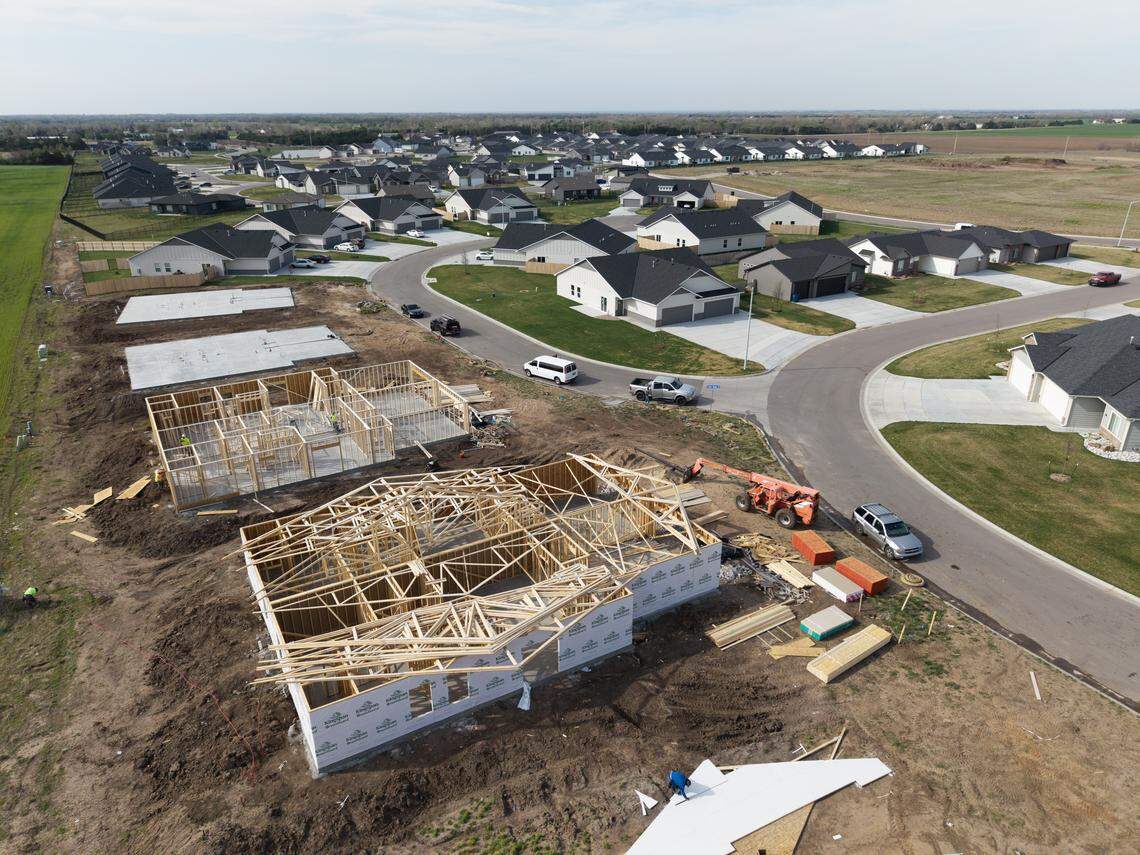
Possible changes for future duplexes in Derby include limiting the size of duplex developments to a certain number of blocks and requiring a variety of duplex designs to avoid repetition. Goddard is considering similar ideas for its 10-year comprehensive plan.

Derby plans an open house from 4:30 to 6:30 p.m. on Thursday, April 9, to allow the public to ask questions about and give feedback on the city’s proposed changes to duplex standards. The come-and-go event will be held at The Pavilion at Madison Avenue Central Park.

For decades, the common trend for developers was to re-zone an area to an R-2 district, which allows for single family and duplex homes. Developers would then build a block or two of duplexes within a larger neighborhood. In the past decade, however, Knebel said the trend in Derby and the Wichita area is to build neighborhoods with duplexes only.

There have been 211 permits for duplexes from 2017 to 2025. That accounts for 19.6% of all residential building permits in that time frame, according to data from the city.

Audrey Goff, who has lived in Derby for 11 years, was one of the community members who spoke against the rezoning at the October council meeting. She said in her time living in Derby, she has seen a lot of growth.

“(There’s been) a lot of new housing developments, a lot of new businesses,” Goff told The Eagle. “Not all of it is bad necessarily, but there’s been a lot of change for sure.”

Goff, who lives in north Derby near the proposed duplex neighborhood, said she found out about the rezoning proposal after seeing a sign on the side of the road. Her main concern was that the new development would be located in a flood plain.

“On the north side of Derby, there’s a lot of dense housing going in, and it’s also an area of town that struggles with water already,” Goff said. “There’s a lot of floodplain. There’s waterways that are kind of weaving in and out of the land, and we have noticed, with the developments around us, that our land is flooding.”

Goff said that although she knows her land is located on a flood plain, she has noticed more flooding since the new developments.

“Previously to this development, there was none of that . . . the creek that goes through our property was able to handle the water amounts, and it was not an issue at all,” Goff said.

Knebel addressed that concern in the City Council meeting.

“The development of the property, in accordance with accepted engineering standards, will not make adjacent properties more flood prone. However, it’s not going to improve the situation either,” he said.

The process of figuring out drainage at the new development would have occurred after the rezoning, if it had been approved, he said.

“At the time you do the zone change, you don’t have the solutions to usually any of the infrastructure extension, including the drainage. That gets decided through the platting process,” Knebel said. “That preliminary plat would have detailed engineering studies on drainage water extension, sanitary sewer extension, pavement, all of those things, and they would all get reviewed based on the city’s engineering criteria.”

Goff created a petition and went door to door in that area to get opinions on the proposed zoning and spoke at the City Council meeting.

“After (October’s rejection), that was kind of when the council gave us the direction that, ‘Hey, we’re looking to provide the development community more guidance on . . . building duplexes in Derby,’” Knebel said.

The planning commission will consider the proposed duplex regulations before they go up for the first read at the City Council on May 12 and then for second read and vote on May 27, Knebel said.

Goddard faced a similar situation, with the City Council rejecting a proposal that would have rezoned land on the northwest corner of 181st and 31st streets to R-2 to allow for single-family homes and duplexes.

“While the residents raised a variety of concerns, the most common theme was a perception that duplex-style development is often associated with lower construction quality and less craftsmanship than traditional single-family housing,” Craig Crossette, Goddard’s city administrator, told The Eagle via email. “That concern, more than any other, appeared to drive much of the community’s resistance.”

Crossette said the other major concern from the community was the duplex designs.

“Residents have pointed to examples where there are long rows of units with the same facade, colors, material combinations, and overall appearance, creating what some have described as an ‘army barracks’ look,” he said.

The motion to fail the rezoning passed 4-1, according to the meeting minutes.

Some community members at the October City Council meeting cited school overcrowding as another concern for the increase in duplexes, saying that the growth promoted by these homes led to growth in the school district.

Dane Baxa, Goddard Public Schools’ director of community relations, told The Eagle that the rate of new developments has not been a stressor to the schools.

“In fact, it has played a critical role in maintaining stable enrollment,” Baxa said via email. “Like many districts across Kansas, we are impacted by a significant declining birth rate. Without the growth in new housing, we would likely be experiencing enrollment declines similar to the vast majority of districts in our state.”

“While growth brings challenges that require thoughtful planning, overall it has been a positive for our district and our ability to serve students at a high level,” Baxa concluded.

Much like Derby, Crossette said that Goddard is looking at changing its standards to better respond to these concerns.

Currently, the city looks at new proposals on a case-by-case basis. But as the city develops its 10-year comprehensive plan, Crossette said that duplex design and density standards will be a main focus. A current draft caps duplexes at no more than 40% of an R-2 development and imposes design standards in order to “improve quality and reduce repetition.”

“The goal is to make sure duplex development fits more thoughtfully into the community and avoids the monotonous, ‘cookie-cutter’ appearance that has drawn criticism from residents in the past,” Crossette said.

The possible downside though, Crossette said, is that the mandates may mean higher rental rates.

Goddard has issued 200 building permits for duplexes in the last five years, Crossette said, and that growth is expected to continue. With the developments that have already been approved in that time frame, he said the city is projected to double in size.

“The city does not expect requests for a wider mix of housing types to slow,” he said.