yahoo Press
Inflation readings, oil volatility, and airline earnings: What to watch this week
Images
1 / 6

2 / 6

3 / 6

4 / 6

5 / 6

6 / 6
Despite a tumultuous trading week spurred by President Trump's national address on Wednesday night and further conflict in Iran, two of the three major US equity indexes closed out Thursday trading up on the week.

The S&P 500 (^GSPC) barely scraped into positive territory on Thursday to finish the week in the green by 1.6%, while the Dow (^DJI) ended Thursday trading down 0.1% but managed a 1.2% gain on the week. The two indexes are down 3.8% and 3.2%, respectively, on the year after paring steeper losses.

The tech-heavy Nasdaq Composite (^IXIC) finished Friday on a gain of 0.2% to close the week up 2.2% on the stretch.

Calendar highlights

Readings on consumer spending and inflation are set to headline the week, with February's Personal Consumption Expenditures (PCE) index and March's Consumer Price Index (CPI) coming on Thursday and Friday, respectively.

On the economic calendar, investors will also get a sense of market vibes on Friday from the University of Michigan's April preliminary readings on sentiment, current conditions, and expectations for what's to come on Friday.

Headlining the corporate calendar will be results on Wednesday from Delta Air Lines (DAL), set to be a key read on how the Iran war — and the subsequent surge in jet fuel pricing — is impacting the airline industry, which is highly exposed to swings in the price of oil.

Levi Strauss (LEVI) and Constellation Brands (STZ) will also report, in two readings on how consumer spending is evolving through the war.

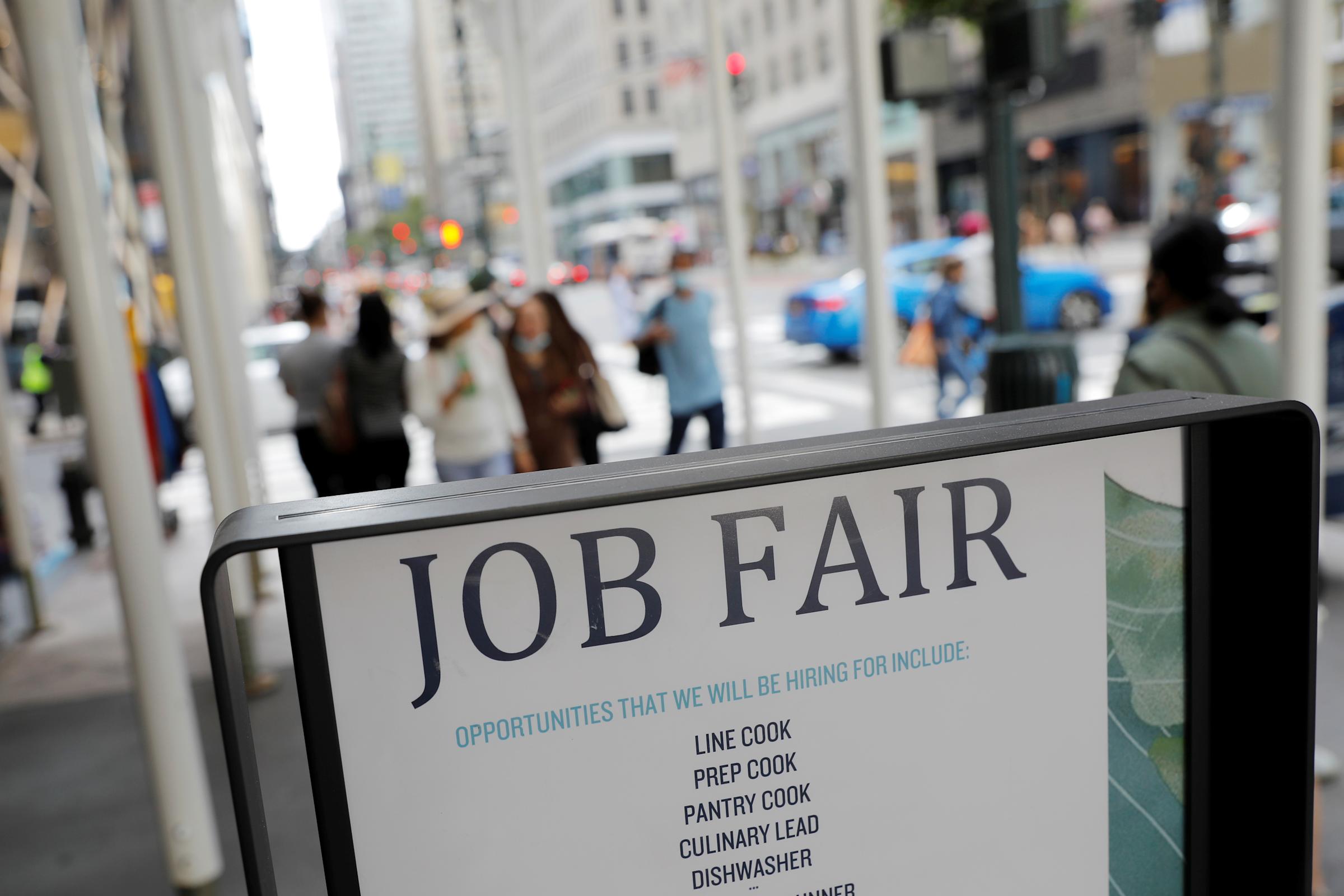
Friday's March jobs report showed the US economy added 178,000 nonfarm payrolls on the month, a surprising turnaround from the previous month's loss of 92,000 jobs — and a stark overshoot of expectations, as economists were looking for 65,000 jobs added in March.

The reading also marks 10 months of whipsawing reports that have swung from positive to negative and back again with each passing month. Averaging January's addition of 160,000 jobs, February's loss of 133,000, and now March's add of 178,000, the US has, so far, averaged an additional 68,000 jobs per month, roughly in line with what economists have consistently predicted.

"The takeaway is balance," Gina Bolvin, president of Bolvin Wealth Management Group, said in emailed commentary. "Stronger hiring reduces the urgency for rate cuts, but it doesn’t change the broader cooling trend."

Even so, the market is likely to take this reading as a sign of movement in the right direction.

"While there are always some caveats with the jobs numbers, we didn’t see enough warts on this report to negate the overall rather favorable message," Michael Feroli, chief US economist at JPMorgan Chase, wrote in a client note on Friday.

"This gives us a little more confidence that economic growth can weather the ongoing energy price shock without too much enduring damage."

As investors attempt to take stock of the economic effects of war in the Middle East, Thursday's PCE report and Friday's March CPI numbers are set to be the first real reads on the trickle-down effects of heightened commodity prices on US inflation.

"Disruption in the Strait of Hormuz has landed with tariff pass-through still in motion and inflation on track for its sixth year above target," Andy Schneider, senior US economist at BNP Paribas, wrote in a recent client note. "We think the first stage of oil price pass-through will have arrived in March."

US gasoline prices at the pump crossed $4 per gallon nationally last week, according to AAA, while headline inflation has steadily ticked up, "helping push consumer confidence further downwards from already low levels," said Goldman Sachs analyst Ben Shumway.

That said, Goldman US economist Manuel Abecasis sees limited risk, given the current state of the US economy, for the war's price increases to significantly impact the more critical core measures on both CPI and PCE.

"Both the size and breadth of the current supply shock so far are less concerning than prior episodes that caused inflation problems," Abecasis said.

As we wrote up top, Delta's (DAL) quarterly results on Wednesday are likely to provide another key read on the price increases facing consumers — the third "unofficial" inflation barometer of the week.

Underpinning all of this, of course, is the more than 50% rise in both international and US benchmark oil futures since the war began five weeks ago.

While oil had pulled back in the days before President Trump spoke Wednesday night, at one point crossing back below the key $100 level, the president's comments — including threats to bomb Iran "back to the stone ages" — sent oil skyrocketing firmly above $100.

"Markets are no longer trading the hope of de-escalation, they are trading the probability of escalation," Capital.com analyst Daniela Hathorn wrote in emailed commentary. "Trump’s speech may have been designed to reassure domestically, but for investors it raises the stakes."

Signs had emerged earlier in the week that both sides of the conflict may be willing to look for an off-ramp. Trump told reporters he was looking for US involvement to wrap up within two to three weeks, and Iranian President Masoud Pezeshkian said Iran has "the necessary will to end this war."

Even so, markets are pricing in further escalation, especially after Trump's comments Wednesday night. Traffic through the Strait of Hormuz, the world's most critical energy shipping chokepoint, still remains near zero, and alternative supply routes can only fill so much of the 15 million-or-so barrel deficit.

"For nearly four weeks, markets have shown remarkable resilience in the face of disruption, supported by a combination of pre-war surplus, crude-on-water, and policy barrels that provided a temporary buffer and kept prices contained," Paola Rodriguez-Masiu, chief oil analyst at Rystad Energy, said in a recent client note. "That phase is now ending."

Economic and earnings calendar

Economic data: ISM services index, March (54.9 expected, 56.1 previously); ISM services, prices paid, March (66.0 expected, 63.0 previously); ISM services, new orders, March (57.5 expected, 58.6 previously); ISM services, employment, March (51.8 previously)

Earnings calendar: Blue Moon Metals (BMM)

Economic data: ADP weekly employment change, week ended Mar. 21 (10,000+ previously); Durable goods orders, February preliminary reading (-1% expected, +0.0% previously); NY Fed 1-year inflation expectations, March (+3% previously)

Earnings calendar: Levi Strauss & Co. (LEVI), The Greenbrier Companies (GBX)

Economic data: MBA mortgage applications, week ended Apr. 3 (-10.4% previously); FOMC meeting minutes, meeting ended Mar. 18

Earnings calendar: Delta Air Lines (DAL), Constellation Brands (STZ), RPM International (RPM), Applied Digital (APLD), PriceSmart (PSMT)

Economic data: Personal income, February (+0.3% expected, +0.4% previously); Personal spending, February (+0.5% expected, +0.4% previously); PCE price index, month-on-month, February (+0.4% expected, +0.3% previously); PCE price index, year-on-year, February (+2.8% expected, +2.8% previously); Core PCE price index, month-on-month, February (+0.4% expected, +0.4% previously); Core PCE price index, year-on-year, February (+3% expected, +3.1% previously); Initial jobless claims, week ended Apr. 4 (+210,000 expected, +202,000 previously); Continuing claims, week ended Mar. 28 (+1.841 million previously); GDP annualized, quarter-on-quarter, fourth quarter (+0.7% expected, +0.7% previously)

Earnings calendar: WD-40 Company (WDFC), Neogen Corporation (NEOG), BlackBerry, (BB) The Simply Good Foods Company (SMPL)

Friday

Economic data: CPI, month-on-month, March (+1% expected, +0.3% previously); Core CPI, month-on-month, March (+0.3% expected, +0.2% previously); CPI, year-on-year, March (+3.4% expected, +2.4% previously); Core CPI, year-on-year, March (+2.7% expected, +2.5% previously); Real average hourly earnings, year-on-year, March (+1.3% previously); Real average weekly earnings, year-on-year, March (+1.6% previously); Factory orders, February (-0.2% expected, +0.1% previously); University of Michigan sentiment, April preliminary reading (52 expected, 53.3 previously); U. Mich. current conditions, April preliminary reading (55.8 previously); U. Mich. expectations, April preliminary reading (51.7 previously); U. Mich. 1-year inflation, April preliminary reading (+3.8% previously); U. Mich. 5-10year inflation, April preliminary reading (+3.2% previously); Durable goods orders, February final reading (+0.0% previously)

Earnings calendar: Lotus Technology (LOT)

Click here for in-depth analysis of the latest stock market news and events moving stock prices

Read the latest financial and business news from Yahoo Finance