yahoo Press
Is Intuitive Machines A Moonshot Stock for the New Space Economy?
Images
1 / 4
2 / 4

3 / 4

4 / 4
Intuitive Machines (LUNR) reported 2025 revenue of $210.1M (down 7.9% year-over-year), a $943M backlog, and gross margin expansion to 19%, while guiding for 2026 revenue of $900M to $1B with positive adjusted EBITDA; the company also secured a $180.4M NASA CLPS task order in March for its fifth lunar mission using the larger Nova-D lander. Rocket Lab (RKLB) generated $601.8M in 2025 revenue (up 38%), maintains a $1.85B backlog, and achieves 44.3% gross margin, trading at a higher valuation with $38.74B market cap versus Intuitive Machines at $5.14B.

SpaceX’s confidential IPO filing and NASA’s successful Artemis II crewed lunar mission are reigniting investor appetite for space economy plays, creating a tailwind for lunar infrastructure companies like Intuitive Machines to convert their growing backlogs into revenue growth.

A recent study identified one single habit that doubled Americans’ retirement savings and moved retirement from dream, to reality. Read more here.

Yesterday, SpaceX reportedly confidentially filed for an IPO with the SEC, targeting a potential $1.75 trillion valuation in what could become the largest listing ever. The same day, NASA’s Artemis II launched successfully from Kennedy Space Center -- the first crewed mission beyond low Earth orbit since 1972 -- sending four astronauts on a 10-day lunar flyby aboard the SLS rocket and Orion spacecraft.

Space stocks suddenly feel electric again. The renewed momentum has investors thinking Intuitive Machines (NASDAQ:LUNR) could be the next moonshot play in the emerging lunar economy. Yet as it could just as easily implode on the launch pad, let’s examine the numbers.

These twin events -- SpaceX’s filing and Artemis II’s liftoff -- signal that the new space economy has moved from concept to concrete progress. SpaceX’s IPO filing opens the door for retail investors to own a slice of reusable rockets, Starlink satellites, and deep-space ambitions. Artemis II validates government-commercial partnerships that fund everything from landers to surface operations. Together, they lift the entire sector.

Read: Data Shows One Habit Doubles American’s Savings And Boosts Retirement

Most Americans drastically underestimate how much they need to retire and overestimate how prepared they are. But data shows that people with one habit have more than double the savings of those who don’t.

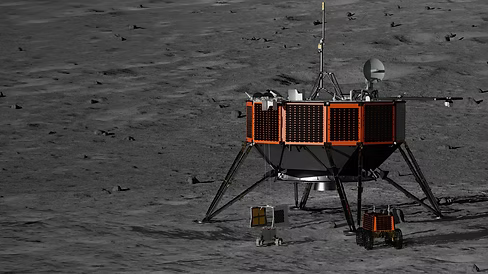
Intuitive Machines, which specializes in lunar landers and infrastructure, sits squarely in that flywheel. The question is whether its financial trajectory matches the hype.

The space company delivered mixed 2025 results but laid out an aggressive 2026 plan. According to the company’s earnings release last month, full-year 2025 revenue totaled $210.1 million, down 7.9% year-over-year, while fourth quarter revenue came in at $44.8 million -- missing estimates of $53.81 million. Yet gross margin expanded to 19%, and free cash flow use narrowed to $56 million, an $11.7 million improvement from the prior year. The company ended February with a combined backlog of $943 million.

Management now guides for 2026 revenue of $900 million to $1 billion and positive adjusted EBITDA. That represents roughly a fourfold jump from 2025 levels. Two catalysts stand out. First, the company closed an $800 million Lanteris acquisition in Q1 and completed the KinetX deal, both expanding defense and national-security exposure. Second, NASA awarded Intuitive Machines a $180.4 million CLPS task order on March 24 for its fifth lunar payload mission -- this time using the larger Nova-D lander to deliver seven payloads, including an Australian rover and Honeybee Robotics tech, to the lunar South Pole. In short, backlog conversion of 60% to 65% could drive the bulk of next year’s growth.

Intuitive Machines does not operate in isolation. Compare it side-by-side with Rocket Lab, another pure-play space stock:

Metric

Intuitive Machines

Rocket Lab

2025 Revenue

$210.1 million (down 7.9% year-over-year)

$601.8 million (up 38% year-over-year)

Gross Margin (recent)

19% (Q4 2025)

44.3% (non-GAAP, full-year 2025)

Backlog

$943 million (as of February 2026)

$1.85 billion (as of year-end 2025)

Market Cap

Approximately $5.14 billion

Approximately $38.74 billion

2026 Outlook

Targets $900 million to $1 billion revenue and positive adjusted EBITDA

Expects steady conversion from its larger backlog with continued launch cadence growth

Granted, Intuitive Machines trades at a forward price-to-sales multiple that looks far more reasonable once 2026 guidance materializes -- roughly 3.4 times expected revenue versus Rocket Lab's higher multiple on its mature base. That said, risks remain plain.

The company still burns cash, posted an $83.91 million net loss in 2025, and carries a trailing loss of $0.73 per share. Space missions face delays, technical glitches, and competition from bigger players also loom. No matter how you slice it, Intuitive Machines remains a speculative name whose 2026 targets must be hit for the stock to deliver.

In short, Intuitive Machines offers retail investors a focused bet on the lunar economy with credible 2026 revenue guidance, a swelling backlog, and fresh NASA wins. If management converts even two-thirds of that $943 million pipeline while margins continue to expand, the stock could reward patient shareholders handsomely.

That said, current losses and execution risk mean this remains a high-volatility holding. Savvy investors should consider a small, diversified position alongside more established names like Rocket Lab -- and watch the next earnings report for confirmation that the ramp has begun. Space is heating up. Intuitive Machines will give you a seat on the lander.

Most Americans drastically underestimate how much they need to retire and overestimate how prepared they are. But data shows that people with one habit have more than double the savings of those who don’t.

And no, it’s got nothing to do with increasing your income, savings, clipping coupons, or even cutting back on your lifestyle. It’s much more straightforward (and powerful) than any of that. Frankly, it’s shocking more people don’t adopt the habit given how easy it is.