yahoo Press
Tech stocks today: Micron stock falls after blowout earnings report, Nvidia wraps up GTC event
Images
1 / 7

2 / 7

3 / 7

4 / 7

5 / 7

6 / 7

7 / 7
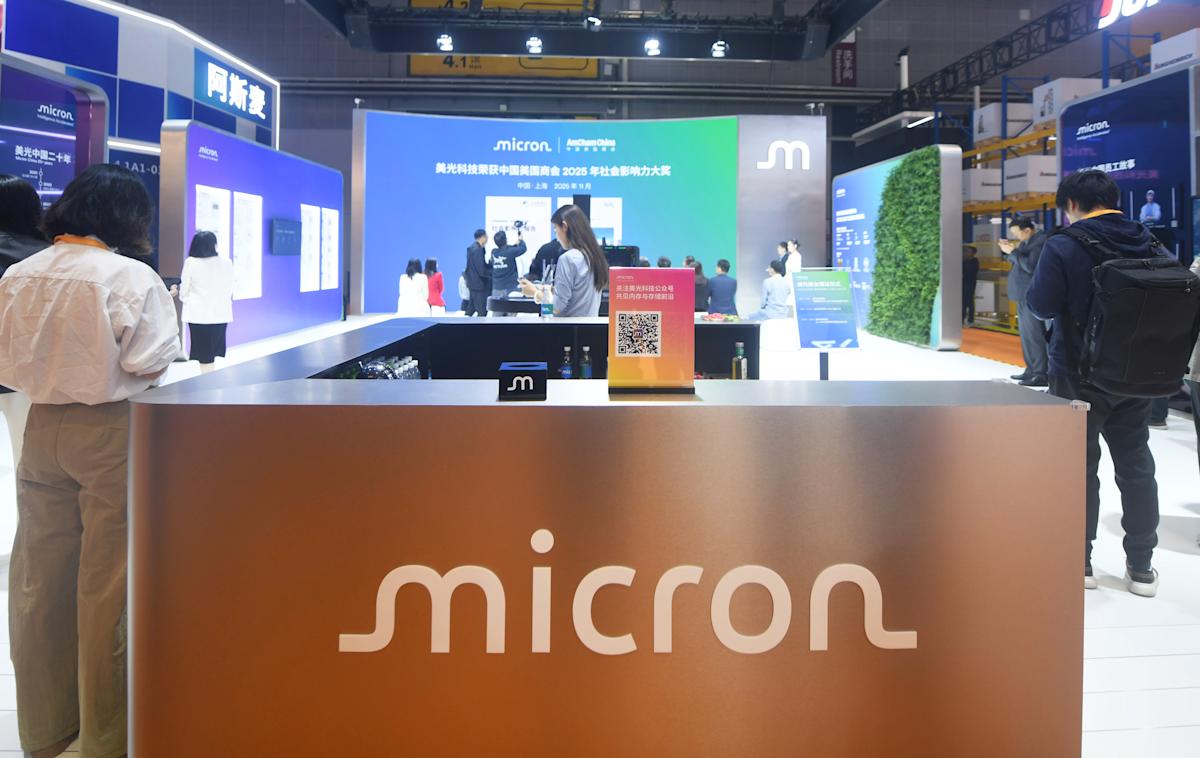
Nvidia’s (NVDA) developer conference is wrapping up on Thursday. On Monday, CEO Jensen Huang unveiled the company’s all-new Nvidia Groq 3 chip, an AI chip for space, and the NemoClaw platform for AI agents. Huang said Nvidia received chip purchase orders for China and forecast that AI chip sales would surpass $1 trillion through 2027, raising expectations from a previous outlook of $500 billion in demand through 2026. That was followed on Tuesday by Microsoft’s (MSFT) announcement that it plans to shake up the company’s AI organization, centralizing its commercial and consumer Copilot teams under the new executive vice president of Copilot, Jacob Andreou. On Wednesday afternoon, Micron announced its Q2 earnings, beating expectations on the top and bottom lines and providing an upbeat Q3 outlook as memory chip demand soars amid the AI build-out. OpenAI (OPAI.PVT) said on Thursday that it is acquiring Astral, a company that develops tools to help working with the popular Python coding language, as the AI giant looks to boost its Codex AI coding tool’s capabilities. According to OpenAI, the deal will see the Astral team join its Codex group and will integrate Astral’s technology into Codex. “Our goal with Codex is to move beyond AI that simply generates code and toward systems that can participate in the entire development workflow —helping plan changes, modify codebases, run tools, verify results, and maintain software over time. Astral’s developer tools sit directly in that workflow,” OpenAI said in a statement. “By integrating these systems with Codex after closing, we will enable AI agents to work more directly with the tools developers already rely on every day.” The companies didn’t disclose the terms of the deal. OpenAI is working to catch up to rival Anthropic’s popular Claude Code AI coding tool. Micron (MU) stock fell more than 4% in early trading Thursday, despite posting better-than-anticipated second quarter earnings after the bell on Wednesday. The company also provided strong guidance for the current quarter, topping Wall Street estimates. According to William Blair analyst Sebastien Naji, the market reaction is likely the result of fears that Micron won’t be able to continue its torrid growth rate. Micron stock is up more than 342% over the last 12 months and 58% year-to-date. For Q2, the company reported earnings per share (EPS) of $12.20 on revenue of $23.86 billion. That amounts to an EPS increase of 682% year-over-year and a revenue jump of 196%. Wall Street was anticipating EPS of $9.00 on revenue of $19.7 billion year over year. Micron also said it expects Q3 revenue above analysts’ estimates. Despite the initial market reaction, Naji, in a note to investors, wrote that Micron stock is trading at a price-to-earnings multiple of 6 times William Blair’s 2026 estimates calendar 2026 estimate—below its historical multiple. Read more here. Figma (FIG) stock continued to slide, adding to losses of around 8% on Wednesday, after Alphabet’s (GOOG, GOOGL) Google Labs updated its Stitch design platform that directly competes with Figma’s and Adobe’s (ADBE) design tools. Google introduced voice capabilities to Stitch, which it says allows anyone to “vibe design” user interfaces. Google says designers can receive design critiques and give Stitch commands, such as “show me this screen in different color palettes,” and it will carry them out. The new AI-native design canvas also features an agent-friendly markdown file that allows users to export or import their design rules to or from other design and coding tools. It also lets users interact with prototypes and click “Play” to quickly preview their app’s flow. Figma stock fell 1.5% on Thursday morning, while Adobe fell 0.4%. Google stock also fell 1% amid broad market selling. In another big move in the robotaxi space, Rivian (RIVN) will supply Uber (UBER) with up to 50,000 fully autonomous robotaxis in exchange for up to $1.25 billion in funding. Uber and its fleet partners will purchase 10,000 Rivian R2 robotaxis, with an option to purchase 40,000 more in 2030. Initial deployments will start in San Francisco and Miami in 2028, with plans to scale to 25 cities by 2031. Uber’s $1.25 billion investment is subject to certain autonomous milestones, though an initial $300 million investment has been committed, subject to regulatory approval. Rivian stock surged in early trading. Read more here. Micron (MU) reported its second quarter earnings after the closing bell on Wednesday, beating expectations on the top and bottom lines and providing Q3 guidance well above estimates, as the AI market continues to drive massive demand for memory chips around the world. For the quarter, Micron reported earnings per share (EPS) of $12.20 on revenue of $23.86 billion. Wall Street was anticipating EPS of $9.00 on revenue of $19.7 billion, year over year. Memory, or RAM, is an integral component of data center servers for both GPU-based systems by Nvidia (NVDA) and CPU-based systems by the likes of Intel (INTC) and AMD (AMD). The explosion in AI training and inferencing and the broader push into agentic AI is driving a dearth of available memory supplies, raising prices and impacting the cost of consumer and enterprise electronics. In February, market research firm Gartner said the memory shortage will cause PC shipments to drop 10.4% in 2026 and smartphone shipments to decline 8.4%. Read more here Nvidia’s (NVDA) chips are known for their general-purpose use. They can train and run AI models, power robots, and serve as the backbone of self-driving cars. And while the company’s offerings are still the industry standard, upstart chip firm’s like Cerebras and Groq have begun designing and rolling out processors geared specifically toward running AI models, creating a potential threat to Nvidia’s formidable AI moat. CEO Jensen Huang and company answered those concerns at the company’s GTC event on Monday with a slew of announcements meant to prove Nvidia is the inferencing leader to beat, including the debut of its Groq 3 chip and rack system. “They are evolving in a big way,” TECHnalysis Research founder and chief analyst Bob O’Donnell told Yahoo Finance. Read more here: Arizona Attorney General Kris Mayes filed criminal charges against Kalshi on Tuesday, accusing the prediction market operator of “illegal gambling” without a license and “election wagering.” This is the first time Kalshi has faced criminal charges — marking an escalation in its legal troubles — though several states have filed civil lawsuits against the company. "Kalshi may brand itself as a 'prediction market,' but what it's actually doing is running an illegal gambling operation and taking bets on Arizona elections, both of which violate Arizona law," Mayes said. "No company gets to decide for itself which laws to follow." A Kalshi spokesperson denied the charges and told the New York Times that they are “meritless.” Kalshi also preemptively sued Arizona’s Department of Gaming on March 12. Scrutiny of prediction markets has intensified alongside the industry’s explosive growth since the Supreme Court struck down a federal ban on sports betting in 2018. According to the blockchain security firm CertiK, trading on prediction markets quadrupled from $15.8 billion in 2024 to about $63.5 billion in 2025, with most of the volume coalescing in Kalshi, Polymarket, and Opinion. (Disclosure: Yahoo Finance has a partnership with Polymarket.) BMW (BMW.DE) officially unveiled its new i3 EV on Wednesday, a sedan loaded with the automaker’s sport-oriented DNA and a Tesla-fighting 440 miles of estimated range. The new i3, the second model built on BMW’s next-gen Neue Klasse platform, is longer, wider, and taller than the outgoing 3 Series and previews the design of the upcoming gas-powered 3 Series, the standard bearer in the class. BMW is claiming 900 km of range on Europe’s WLTP cycle, translating to an EPA-estimated 440 miles on a single charge, with charging capability that can add around 250 miles in just 10 minutes. Tesla’s Model 3 Premium has 363 EPA-estimated miles of range, with the Performance coming in lower at 309 miles Read more here. Samsung Electronics (005930.KS) and Advanced Micro Devices (AMD) have signed a memorandum of understanding to expand their strategic partnership on memory chip supplies as global chipmakers race to lock in long-term supply partnerships for advanced memory. Reuters reports: Read more here. Nvidia (NVDA) CEO Jensen Huang said that the company currently has purchase orders for chips destined for China and is firing up the supply chain to meet that demand during a press Q&A at Nvidia’s GTC event on Tuesday. The news comes after the Financial Times reported that the company was stopping production of its H200 chips for the Chinese market and instead shifting to produce Vera Rubin processors for the rest of the world. Nvidia has been at the center of a tug-of-war between the US and China over whether the US government should allow the country’s most sought-after chip to power AI platforms in China that could end up benefiting that country’s military. Huang successfully lobbied the Trump administration to allow Nvidia’s H200 chips to flow to China, saying that it was better for the country to be reliant on US technology rather than pushing it to develop its own high-powered processors. But China has balked at the idea, telling companies to use homegrown chips instead. Nvidia has said it still hasn’t begun shipping its products into the country. Nvidia (NVDA) CEO Jensen Huang said his projection that the company has line of sight for $1 trillion in revenue through 2027 only applies to sales of its Grace Blackwell and Vera Rubin chips, not the others he debuted during his keynote on Monday. The $1 trillion figure, he explained, was meant to serve as an apples-to-apples comparison to his prior projection, back in October, that the company had a throughline to $500 billion in revenue by the end of 2026. But, he said, adding the anticipated revenue from its new Vera CPU, Groq 3, and new storage racks will push that amount beyond $1 trillion. Nvidia generated $215.9 billion in its fiscal 2026, which ended Jan. 25, a 65% year-over-year increase. The company ‘s Groq 3 and Vera chips are designed to assist with AI inferencing, or running AI, and agentic AI. Both inferencing and agentic AI are becoming increasingly important across the AI industry as more users begin using the technology and putting AI agents to work in both enterprise and consumer settings. Microsoft (MSFT) CEO Satya Nadella on Tuesday announced changes within the company’s AI organization that will bring its Copilot efforts more directly under his control within a new group. In a memo to staff, Nadella said Jacob Andreou will be named executive vice president of Copilot, reporting directly to Nadella. Under Andreou, this group will be focused on the Copilot experience across consumer and commercial, driving design, product, growth, and engineering, Nadella said in his note. Andreou had previously reported to Mustafa Suleyman, CEO of Microsoft AI. Suleyman said Tuesday in a memo that these changes will allow him to “focus all my energy on our Superintelligence efforts and be able to deliver world class models for Microsoft over the next 5 years.” “Progress at the AI model layer is more critical than ever to our success as a company over the next decade and is foundational to everything we build above it,” Nadella said. “We are doubling down on our superintelligence mission with the talent and compute to build models that have real product impact, in terms of evals, COGS reduction, as well as advancing the frontier when it comes to meeting enterprise needs and achieving the next set of research breakthroughs.” Earlier this month, Microsoft announced a new Copilot tier that will include access to Anthropic’s Claude alongside the latest generation of OpenAI models. Microsoft stock is down about 17% year to date. Nvidia (NVDA) announced on Monday that Uber (UBER) will begin rolling out a fleet of Level 4 autonomous vehicles in Los Angeles and San Francisco in 2027 as part of both companies’ broader self-driving efforts. The firms previously announced their intent to deploy 100,000 vehicles running on Nvidia’s Drive Hyperion self-driving platform during Nvidia’s GTC event in Washington, D.C., in October. But the latest news, unveiled at GTC in San Jose, Calif., provides a timeline for when and where vehicles will eventually hit the road. According to Nvidia, the service will eventually move beyond California to include 28 cities across four continents. In addition to Uber, Nvidia said Lyft (LYFT), Estonia-based Bolt, and Singapore’s Grab are also using its systems to power their own self-driving capabilities. Nvidia (NVDA) is moving further into AI software with the launch of its NemoClaw stack for the OpenClaw agent platform. The service gives companies that use OpenClaw privacy and security controls that Nvidia says make self-evolving autonomous agents “more trustworthy, scalable, and accessible to the world.” OpenClaw, which debuted as Clawd in November 2025 before being renamed Moltbot and finally OpenClaw in January, has taken off thanks to its ability to run AI agents powered by different AI models on users’ machines via apps like WhatsApp, Discord, Slack, and others. It can perform a litany of different tasks via your computer on your behalf using your existing data. But the fact that it can control a laptop or desktop and has access to your personal data raises certain privacy and security concerns. Nvidia’s NemoClaw is meant to address those issues. While OpenClaw can run on both Mac and Windows systems, Nvidia is positioning its own GeForce RTX platforms as the computers of choice for the service. That includes its RTX Pro-powered workstations, DGX Station, and DGX Spark mini desktop. Read more here. Nvidia (NVDA) kicked off its GTC event in San Jose, Calif., on Monday, debuting a number of chips and platforms ranging from its all-new Nvidia Groq 3 language processing unit (LPU) to its massive Vera central processing unit (CPU) rack, designed to go head-to-head with offerings from Intel (INTC) and AMD (AMD). All totaled, Nvidia said it’s rolling out five massive server racks, each serving different purposes inside AI data centers. The biggest announcement of the lot, though, is the Nvidia Groq 3 chip. Nvidia announced it had entered into an agreement to license technology from Groq and hired founder Jonathan Ross, president Sunny Madra, and other members of the Groq team as part of a $20 billion deal in December.Groq’s processors focus on AI inferencing, or running AI models. It’s what happens when you type something into OpenAI’s (OPAI.PVT) ChatGPT, Anthropic’s (ANTH.PVT) Claude, or Google’s (GOOG, GOOGL) Gemini and get a response. Nvidia’s graphics processing units (GPUs) are multipurpose and can both train and run AI models, but as the AI market moves toward running models, ensuring the company has a dedicated inferencing chip has become paramount. That’s where Groq 3 comes in. Yahoo Finance’s Dan Howley reports from on the ground at the GTC event in San Jose, Calif., that Nvidia (NVDA) is taking its AI chips to the next frontier: space. The company revealed its Vera Rubin Space Module, saying the platform is designed for orbital data centers, geospatial intelligence, and autonomous space operations. Read more here. Nvidia CEO Jensen Huang said the company now sees AI chip demand reaching $1 trillion through 2027. That’s a massive increase from the $500 billion high-confidence demand and order backlog for Blackwell and Rubin chips that Nvidia projected last year through 2026. “In fact, we are going to be short,” Huang added. “I am certain computing demand will be much higher than that.” CEO Jensen Huang touted Nvidia’s (NVDA) relationships with cloud service providers, such as Google (GOOG), Microsoft (MSFT), Amazon (AMZN), and Oracle (ORCL), saying the AI company is “bringing customers to them.” Huang argued that Nvidia is driving down data-processing costs by increasing scale and speed. “Moore's Law has run out of steam; we need a new approach,” Huang said. “Accelerated computing allows us to take these giant leaps forward, and as you will see later, because we continue to optimize the algorithms … and because our reach is so large and our installed base is so large, we can reduce the computing cost, increasing the scale, increasing the speed for everybody, continuously.” Hyperscalers account for roughly 50% of Nvidia’s data center revenue, which totaled $62.3 billion in the fourth quarter. Nvidia CEO Jensen Huang began his annual keynote address at a quarter after 2 p.m. ET on Monday. As my colleague Dan Howley noted in his preview of the event, Huang’s leather-jacket-clad keynotes are usually littered with a litany of product launches and updates, and we’ll likely see the same at this year’s event. Huang is expected to speak for about two hours. We’ll be following along and posting updates. You can watch the speech live below. Nebius (NBIS) stock soared 14% after the AI cloud company announced it struck a new long-term AI infrastructure supply agreement with Meta (META). Nebius will provide Meta with $12 billion worth of neocloud capacity as part of its deployment of Nvidia's Vera Rubin platform, starting in 2027. Meta has also committed to purchasing additional compute capacity up to a total of $15 billion over a five-year period. Last week, Nvidia disclosed a $2 billion investment in Nebius to deploy more than 5 gigawatts of data center capacity by the end of 2030. Meta stock rose 2.6% on the Nebius news, as well as rumors that it's planning sweeping layoffs that could affect up to 20% of the company as it looks to offset high artificial intelligence costs. The date and extent of the layoffs have yet to be finalized, according to Reuters, but it could mark Meta's largest restructuring since late 2022 and early 2023.