yahoo Press
SpaceX plan for 1 million orbiting AI data centers could ruin astronomy, scientists say
Images
1 / 11
2 / 11

3 / 11

4 / 11

5 / 11

6 / 11
7 / 11
8 / 11

9 / 11

10 / 11

11 / 11
When you buy through links on our articles, Future and its syndication partners may earn a commission.

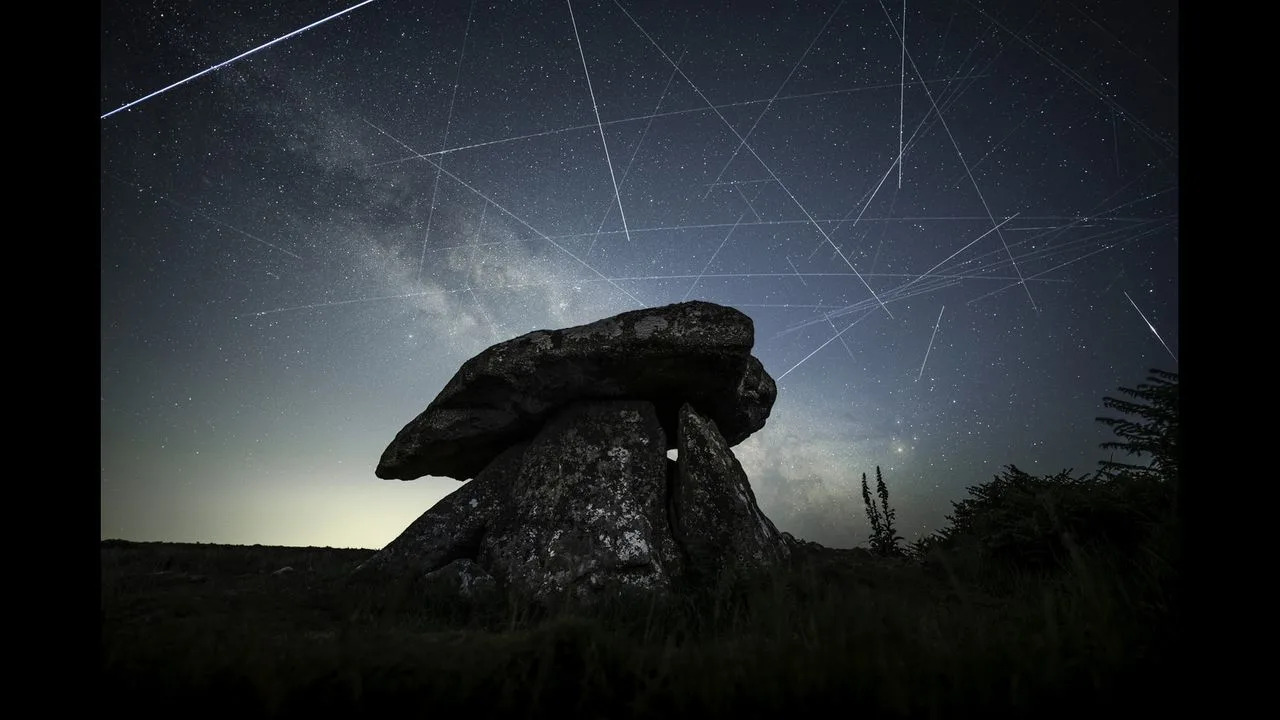
SpaceX's plan to launch one million orbiting data centers to space worries astronomers,who say the satellite streaks caused by the proposed constellation would severely impair observations.

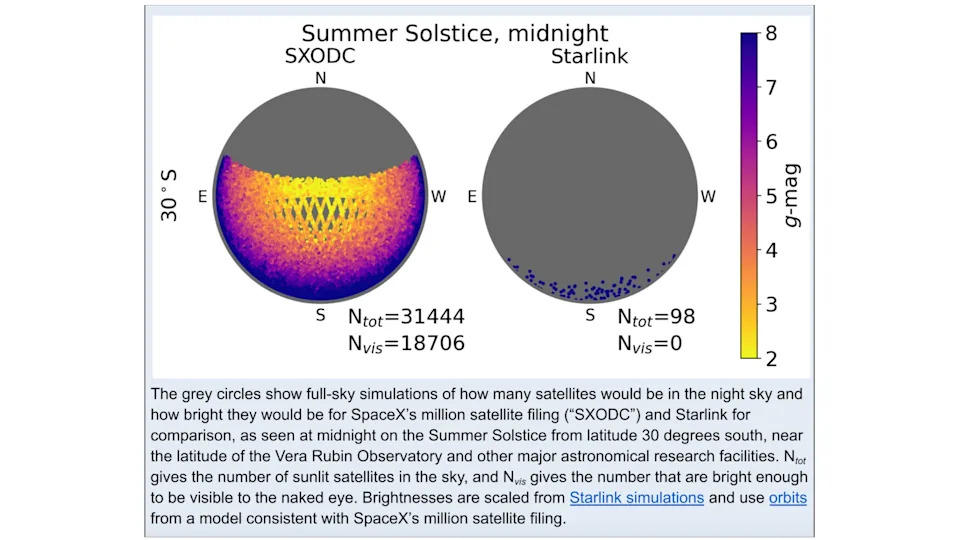
Just as astronomers began to learn how to coexist with broadband megaconstellations in low Earth orbit (LEO), such as SpaceX's Starlink, a new threat has emerged, causing significant concerns. Elon Musk's envisioned constellation of one million orbital data centers would result in possibly tens of thousands of moving objects as bright as stars that are visible in the night sky at any given moment, even to the naked eye, according to astronomer and dark sky consultant John Barentine.

Barentine spoke to Space.com on behalf of a group of astronomers who are raising objections against SpaceX's application to launch the constellation, which the company filed with the U.S. Federal Communications Commission (FCC) on Jan. 30.

Starlink currently consists of around 10,000 satellites. Those spacecraft are visible to the naked eye only shortly after launch, because they dim as they raise their orbital altitude. The Starlinks still leave streaks in telescope images, but SpaceX has, after consultations with the astronomy community, managed to reduce the satellites' brightness by using less reflective materials and tilting reflective components like solar panels away from Earth. The brightness of newer Starlink satellites dropped to just above the limit recommended by the International Astronomical Union to prevent interference with astronomical observations. SpaceX's new data-center plan, however, threatens to thwart this progress, according to Barentine.

"It really feels like it's undermining what we have achieved in the last few years, which wasn't ideal for astronomy, but was a far cry from what we feared in 2019 when the Starlink program began," he told Space.com. "We felt we were heading in the right direction that was reasonably sustainable. And this feels like a complete reversal of that."

According to some estimates, each of the orbiting data centers could be up to 330 feet (100 meters) long, circling Earth at altitudes between 310 miles and 1,243 miles (500 to 2000 kilometers) pole to pole with a constant exposure to sunlight.

"The other constellations that we have dealt with so far are mostly at lower altitudes and in lower-inclination orbits," Barentine said. "That means the satellites spend most of their time in Earth's shadow. We really don't see them very much in the middle of the night, or they are not that bright. But the data centers will be in high-inclination orbits and will be fully illuminated by sunlight even as seen from the ground at midnight."

Barentine described the proposal as a "vastly different prospect" compared to all other existing and planned constellations.

"This is a challenge unlike any we have encountered thus far in this new era of commercial space," he said.

The development comes just as the astronomical world brings online some of the most powerful sky-observing machines of all time, designed to push the limits of the human understanding of the universe. These big ground-based scopes, including the $10 billion Vera Rubin Observatory, opened last year, or the $2 billion Extremely Large Telescope currently under construction in Chile, will have their observations severely obstructed by those satellites.

"We could schedule our observations so that we aren't looking in the direction of the satellite when it's passing or close the shutter in front of our cameras and reopen it later on," said Barentine. "But at some point, the amount of time the shutter is closed starts degrading your observations. And I worry that, with more than a million objects, the shutter would be closed more than it would be open."

In addition, Barentine and his colleagues estimate that, with the expected rate of replacement of the constellation's satellites with newer technology, one old spacecraft would be burning up in Earth's atmosphere every three minutes. This mass incineration of metal would result in a steep increase in concentrations of potentially dangerous pollutants such as aluminum oxide and lithium in the upper atmosphere, which could lead to ozone depletion and temperature changes.

Currently, about three old satellites or used rocket bodies perish in the atmosphere every day. Further air pollution would come from the frequent rocket launches needed to deploy and maintain the constellation. The project would also increase the risk of space debris strikes on Earth, the astronomers say.

The researchers are even more concerned about the development because the FCC put the application on a fast-track path, meaning SpaceX won't need to conduct an environmental impact assessment of the project.

Barentine explained that, while in the past applicants had to prove that a development would not cause significant environmental harm, the fast-track process means it is now up to those objecting to a development to conduct those frequently time-consuming analyses to prove their case.

"The presumption now is that the application should be approved and that it should be up to the people who might object to prove that there's a problem of some kind," said Barentine. "The fact that they have fast-tracked this application, which has potentially tremendous effects not only for astronomy but for the environment too, and to do so without engaging in a full environmental review, is worrisome."

The objectors had only until March 6 to submit their documentation, putting further pressure on the astronomers, according to Barentine.

SpaceX didn't respond to Space.com's request for comment.