Press
Why did US and Israel attack Iran and how long could the war last?
Images
1 / 12

2 / 12
3 / 12
4 / 12
5 / 12
6 / 12
7 / 12

8 / 12

9 / 12

10 / 12

11 / 12

12 / 12
Conflict has spread across the Middle East after Iran's Supreme Leader, Ayatollah Ali Khamenei, was killed during strikes launched by the US and Israel on Saturday, which were followed by a call from US President Donald Trump for Iranians to overthrow the government.

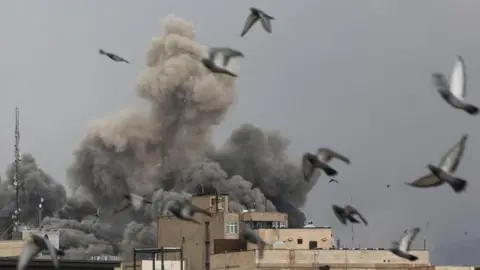
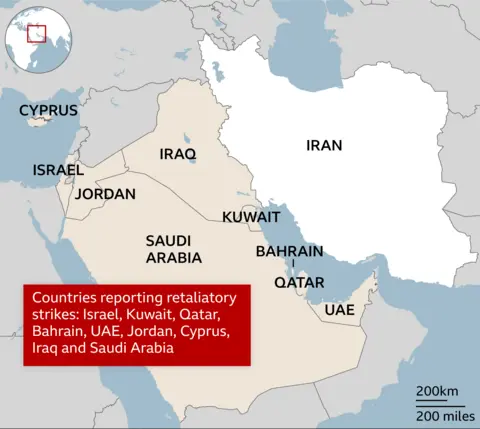
Iran has responded by launching missiles and drones across the region, targeting Israel, Bahrain, Kuwait, Qatar, the United Arab Emirates, Jordan, Saudi Arabia, Cyprus and ships passing through the Strait of Hormuz.

Lebanon's Iran-backed Shia Muslim militia group Hezbollah has joined the fighting, launching rockets into Israel from its bases in Lebanon. Israel responded with strikes on Hezbollah targets in Lebanon.

Here is how the US and Israel's war with Iran has unfolded, how it has impacted the region and how long it could last.

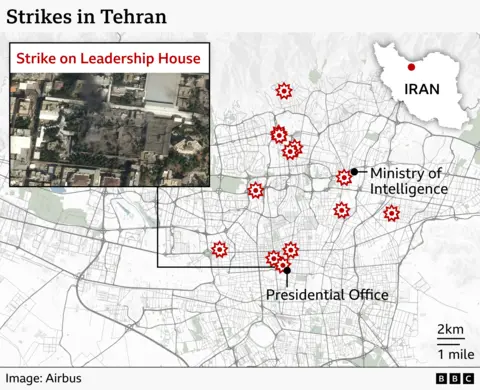
The US and Israel launched widespread strikes on Saturday targeting Iran's missile infrastructure, military sites and senior leaders.

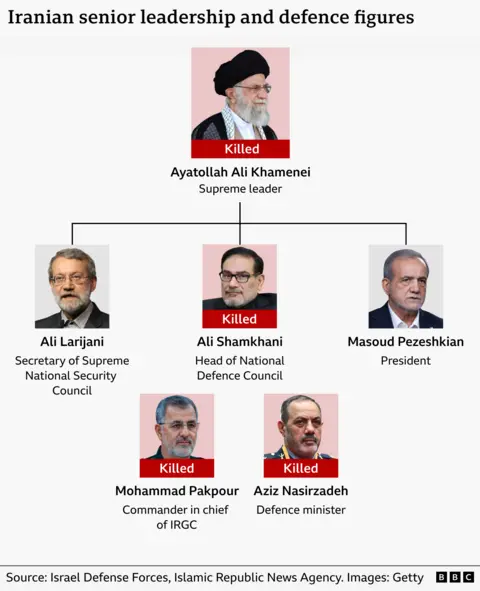
Khamenei, who had led Iran since 1989, was killed when his Tehran compound was flattened during the first wave of strikes.

The Israel Defense Forces (IDF) says that dozens of senior Iranian political figures and leaders within the powerful Islamic Revolution Guard Corps (IRGC) were also killed, including Defence Council secretary Ali Shamkhani, Defence Minister Brig Gen Aziz Nasirzadeh and IRGC commander Gen Mohammad Pakpour.

The IRGC has since named a new commander-in-chief, Ahmad Vahidi.

As of Monday, the Iranian Red Crescent said 555 people in 130 locations had been killed in Iran. According to Iranian officials, more than 150 people, including children, were killed in a strike on a school in southern Iran close to an IRGC base.

Internet connectivity in Iran has been almost entirely restricted and its airspace has been closed.

Iran's military continued to have the capacity to launch retaliatory attacks.

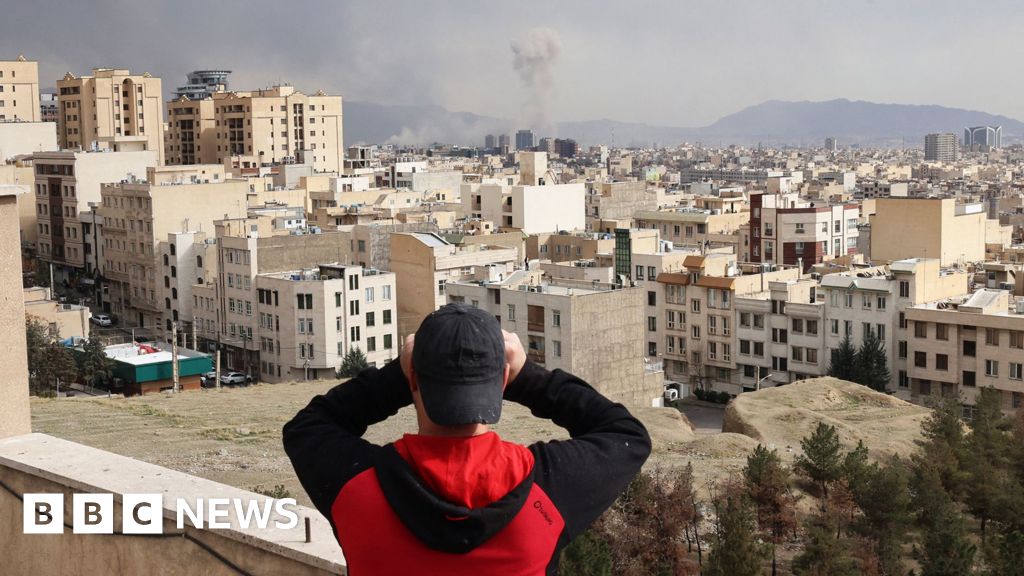
The US and Israel carried out more strikes on Sunday, hitting the capital and elsewhere. Trump said nine Iranian naval ships had been sunk and Iran's naval headquarters destroyed.

Trump has said the aim of the operation is to "ensure that Iran does not obtain a nuclear weapon".

"We're going to destroy their missiles and raze their missile industry to the ground. It will be totally again obliterated," he said in an eight-minute video posted on Truth Social on Saturday morning.

He also warned Iran's armed forces to lay down their weapons in return for "complete immunity" or "face certain death".

Trump urged Iranian people to prepare to overthrow the clerical establishment: "When we are finished, take over your government. It will be yours to take. This will be probably your only chance for generations."

The massive military operation - which the US has dubbed Operation Epic Fury - comes after weeks of threats from Trump that he would order military action if Iran did not agree to a new deal over its nuclear programme.

Iran has repeatedly said its nuclear activities are entirely peaceful.

The US military Central Command said they wanted to "dismantle the Iranian regime's security apparatus, prioritising locations that posed an imminent threat".

Earlier, Israeli Prime Minister Benjamin Netanyahu said Israel and the US had launched the "operation to remove the existential threat posed by the terrorist regime in Iran".

Iran has described the attacks as "unprovoked, illegal and illegitimate", and has carried out widespread attacks across the region in response.

Iran has launched ballistic missiles and drones at Israel, several Middle Eastern countries with links to the US, a British military base in Cyprus and ships off the Iranian coast.

The IRGC said it had targeted Israeli government and military sites in Tel Aviv and elsewhere, while nine people were killed when a residential area in Beit Shemesh was hit.

The UK Ministry of Defence (MoD) has confirmed a drone had struck the British Akrotiri base in Cyprus. No one was killed or injured in the attack but the MoD said some people were being moved off the RAF base.

Qatar, Bahrain, Jordan, the United Arab Emirates and Kuwait - all home to US military bases - have been targeted, as have Oman and Saudi Arabia.

More strikes were heard across the Gulf on Monday, including in the cities of Dubai, Doha and Manama. Iran's military said it had used 15 cruise missiles in attacks on a US airbase in Kuwait and vessels in the Indian ocean.

Civilian sites, including hotels in Dubai, have been struck as well as military installations.

The US and Arab allies issued a joint statement condemning Iran's attacks on the Gulf states, saying "the targeting of civilians and of countries not engaged in hostilities is reckless and destabilising behaviour".

On Monday, three American jets were shot down over Kuwait in what the US military said appeared to be a friendly fire incident. The pilots survived.

Over the weekend, the US military confirmed three soldiers had been killed and five more injured. CBS News, the BBC's US news partner, said theyhad been killed during operations launched from Kuwait.

The US military confirmed a fourth death on Monday without providing further details.

A new front in the conflict opened on Monday when Hezbollah attacked Israel, prompting the IDF to strike targets in the capital Beirut and in southern Lebanon on Monday.

The armed group is allied to Iran's government and said it was seeking to avenge Khamenei's assassination.

Lebanese officials say dozens have been killed or injured in the strikes so far, while Israel urged people living in 50 villages to evacuate in anticipation of further operations which could last "several days".

Instability in the Middle East has begun to impact the global economy, particularly because of the targeting of the Gulf's critical energy industry.

Qatar's state-run energy firm said it had halted liquefied natural gas production because of Iranian attacks, causing a 50% spike in gas prices on Monday.

Iranian drones attacked the Ras Tanura refinery in Saudi Arabia, causing a partial shutdown, the country's energy ministry said on Monday.

Iran warned vessels not to pass through the Strait of Hormuz, a major shipping channel through which about 20% of the world's oil and gas is shipped.

There has been a 10% surge in the global price of oil - sparking fears of petrol prices rising and wider knock-on effects for the international economy.

Iran has said it will appoint a new supreme leader swiftly. A transitional leadership council has been formed to run the country temporarily, consisting of: President Masoud Pezeshkian, judiciary chief Gholamhossein Mohseni Ejei and senior cleric Alireza Arafi.

The formal selection of a new supreme leader is decided by 88 senior clerics known as the Assembly of Experts.

Under the country's constitution, these clerics must select the new supreme leader as soon as possible, but this may prove difficult for safety reasons while the country is under attack.

On Saturday, Trump said the attacks on Iran would "continue, uninterrupted throughout the week or as long as necessary", but has since suggested a longer time frame.

The US president told the New York Times on Sunday that the US and Israel could maintain operations at the same tempo for four to five weeks.

He told CNN on Monday: "I don't want to see it go on too long. I always thought it would be four weeks. And we're a little ahead of schedule."

On Saturday, Netanyahu said "this campaign will continue as long as it is needed".

Thousands of flights have been grounded to and from the region, in one of the most serious disruptions to global travel since the Covid-19 pandemic.

Dubai-based airline Emirates temporarily suspended its operations to and from Dubai - but said it would resume operating a "limited number of flights" on Monday night. Low cost carrier flydubai said the same.

Dubai Airports announced that a "limited resumption of operations" will begin on Monday evening from the region's two main hubs – Dubai International and Dubai World Central.

No flights are so far taking off or landing from Doha, as Qatari airspace remains closed.

Virgin Atlantic axed two flights to Heathrow on Monday - one from each of Dubai, UAE and Riyadh, Saudi Arabia - while others were rerouted.

British Airways has cancelled flights to Tel Aviv and Bahrain and said it was "closely monitoring the situation."

Wizz Air has suspended flights until 7 March to Israel, Dubai and Abu Dhabi, Amman and Saudi Arabia.

Kuwait's aviation authority said it was halting all flights to Iran until further notice, according to state media.

Lufthansa, Air India and Turkish Airlines have also announced cancellations.

Some countries in the region - including Iraq and Jordan - have also closed their airspace.

With additional reporting by Robert Greenall, Hafsa Khalil, Gabriela Pomeroy and BBC Persian.

Simon Rourke tells of his "terrifying experience" as a guest at a Dubai hotel hit by a missile.

Two people were killed and 14 injured, with the suspected gunman, identified by some media outlets, also shot dead.

Authorities say the gunman, who was killed by police, fatally shot at least three people and injured 14 others.

Richard Pugh and Hannah Norman are unable to travel amid the fighting in the Middle East.

The majority of flights to key Middle Eastern hubs have been cancelled for Monday as the conflict continues.