buzzfeed Press
10 Priceless Objects From History That Seemingly Vanished Into Thin Air, And Historians Have No Idea What Happened To Them
Images
1 / 17

2 / 17

3 / 17

4 / 17

5 / 17

6 / 17

7 / 17

8 / 17

9 / 17

10 / 17

11 / 17

12 / 17

13 / 17

14 / 17

15 / 17

16 / 17

17 / 17
As a Writer at BuzzFeed, I write and curate quizzes, listicles, and articles about everything from pop culture and history to food and fashion.

The estimated worth of the collection was 50,000 euros at the time, amounting to $5 million today. At first people could not believe that the theft happened, considering that Dublin Castle was one of the best-guarded corners of the city.

Sir Arthur Vicars believed that a man named Francis Shackleton was behind the theft. Francis was the younger brother of the arctic explorer Ernest Shackleton, and he had a position in Vicars' office. It was said that Francis had money troubles, which could have posed as a motive to steal the expensive gems. However, he had an alibi: he was not in Dublin when Sir Arthur Vicars realized they were missing.

One theory posed the possibility that Irish nationalists had stolen them in an anti-colonial heist to go against the British monarchy. However, there was little to no evidence confirming this.

The final fate of the jewels is unknown.

When the Germans evacuated from Krakow, it was believed that they took the paintings with them. The Polish representative at the Allies Commission for the Retrieval of Works of Arts located the stolen paintings and claimed them. But they never found the Portrait of a Young Man, along with 843 other artifacts.

An author, Lynn H. Nicholas, stated in her book that if the painting were to reappear, it would be worth around $217 million in 2026.

The whereabouts of this iconic renaissance painting are still unknown.

It is also said that Ivan had them translated from their original languages into Russian. After Ivan the Terrible died, the library simply disappeared. Some believe it was destroyed in a fire, while others say that the library survived and that Ivan placed a curse on it so that whoever found the library would lose their sight.

None of these legends have been confirmed. Ever since then, there have been multiple attempts to find the library beneath the Kremlin. None have been successful so far, and the whereabouts of the library and the books within remain unknown.

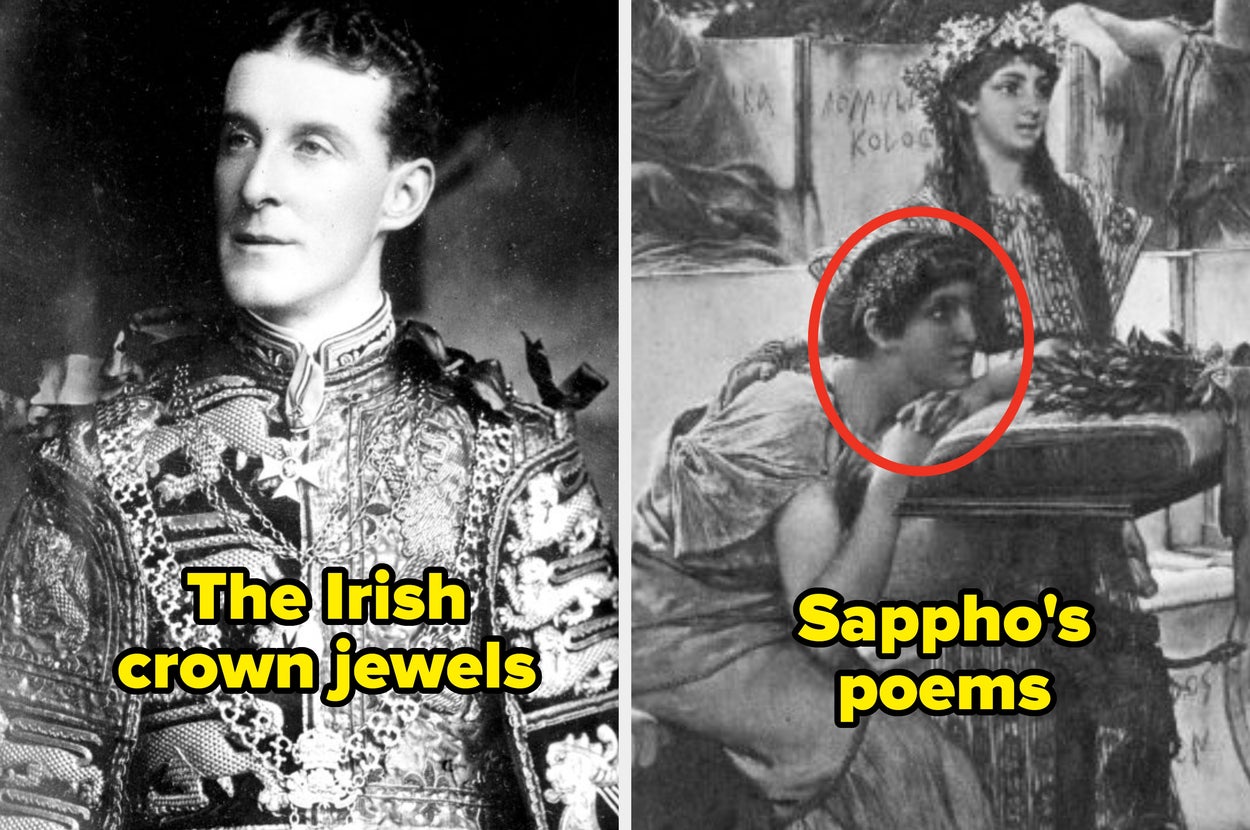
Scholars claim that the 4th-century Greek and Latin Church authorities arranged for the destruction of her work as a result of her sexuality.

Even though her love life was infamous, her work was greatly admired in the Middle Ages. Some other scholars believe that the failure to preserve her poetry had a fairly simple reason—the medieval copyists couldn't understand the language. Sappho wrote in an ancient and old-fashioned Greek that was not widely understood in the early Middle Ages. This could have prevented the complete preservation of her poems.

The last panels showed the death of Harold Godwinson, the Anglo-Saxon king, and his troops fleeing after their defeat at Hastings. No one knows how much longer the original tapestry was or what it showed. Most experts believe that the final scene was eight to 10 feet long, depicting the scene of William's coronation on Christmas day in 1066.

While the original final piece of tapestry is not yet found, a team of embroiderers in Alderney, a small island off the coast of Normandy, have recreated the entire tapestry and fitted the final scene in it.

In 70 A.D., after a months-long siege, the Roman troops stormed Jerusalem and fought against the Jewish revolt. When the city fell and the Second temple was burned, the Roman soldiers seized its sacred treasures. However, the Ark of the Covenant was not there. The Ark was not destroyed in the siege; it had disappeared centuries ago.

In January 1946, the Mejiro police gave the swords to a man identified as Sgt. Coldy Bimore of the Foreign Liquidations Commission. After this, the fate and current location of the Honjō Masamune are unknown.

The Spanish captured Montezuma and held him captive. They tried to besiege the Aztecs; however, their position in the Aztec city soon became vulnerable, and they looked to make their escape in early July 1520.

The Spanish took every piece of gold, silver, and gemstone they could find and tried to escape. However, the Spanish army was entirely wiped out that night after the alarm was raised. Montezume was killed that night, although some believe that his own people stoned him to death for allowing the Spanish to enter their lands.