yahoo Press
Why do these WW2 beach relics exist?
Images
1 / 12
2 / 12

3 / 12

4 / 12
5 / 12

6 / 12
7 / 12
8 / 12
9 / 12

10 / 12

11 / 12

12 / 12
Have you ever walked along a beach and wondered about the reason behind the large concrete blocks or bits of rusting metal emerging from the shingle?

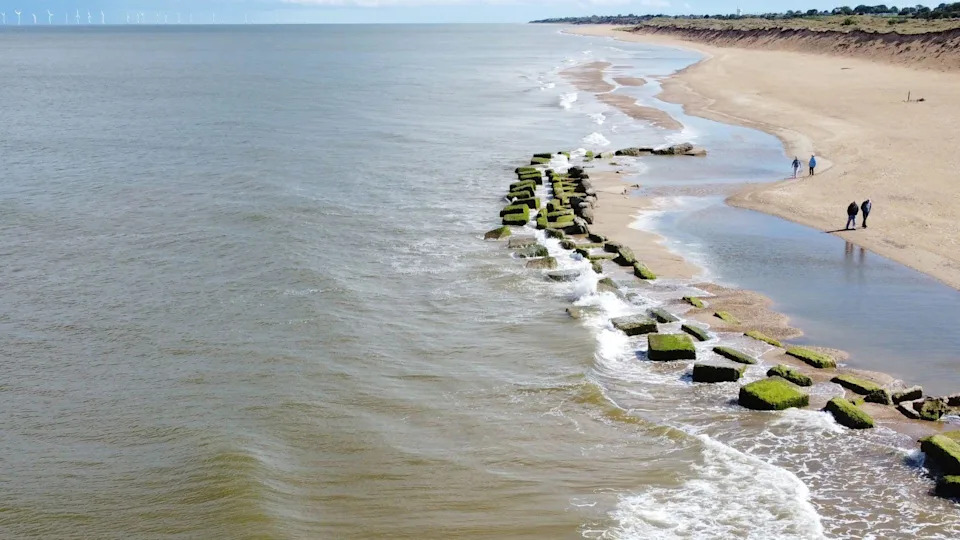
Recent storms and shifting sands have exposed various World War Two sea defences at sites in Norfolk and Suffolk.

Today, the East Anglian coast is a largely peaceful sight, but from summer 1940 it was a place of frenzied construction.

"It was frantic throughout July, August and September in 1940, as they constructed defences as fast as they could to block an invasion all along the UK coast," said Dave Thurlow, who works at the RSPB reserve north of Sizewell in Suffolk.

Very little had been done to build defences around the United Kingdom until after the British Expeditionary Force was forced to evacuate from the beaches of Dunkirk.

"The German victory in France had been so swift and so decisive," said the military historian and author.

"At the time, no-one could believe that Hitler didn't have plans to invade England."

"Lots of builders did very well out of it," said Andrew Fakes, at Winterton-on-Sea, further up the coast in Norfolk.

"They built a lot of pillboxes and there was a huge amount of barbed wire.

"There were tall scaffold posts with mines attached and that was all to defend a big gun placement, which had a 1909 vintage ex-naval gun pointing out to sea."

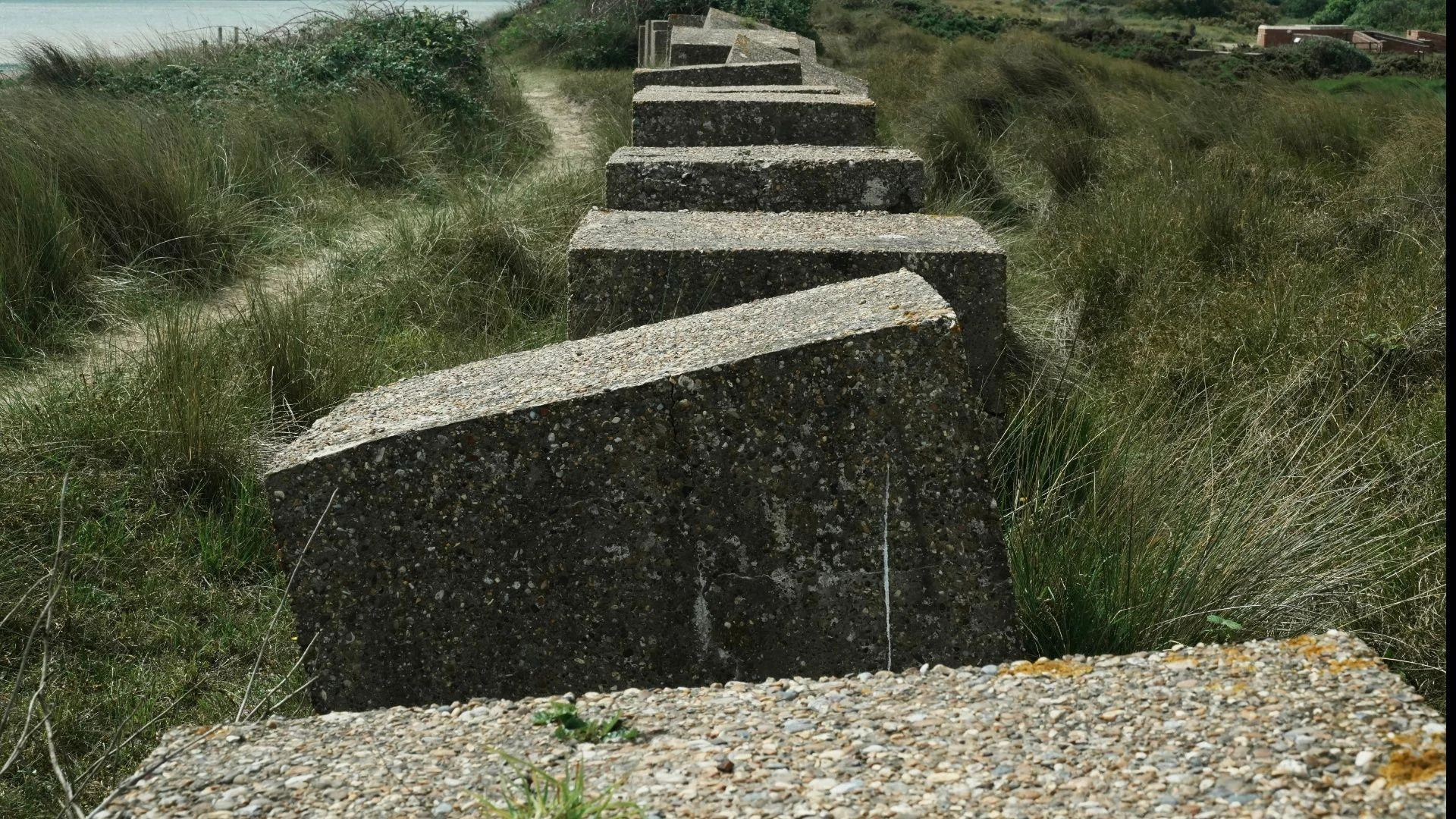
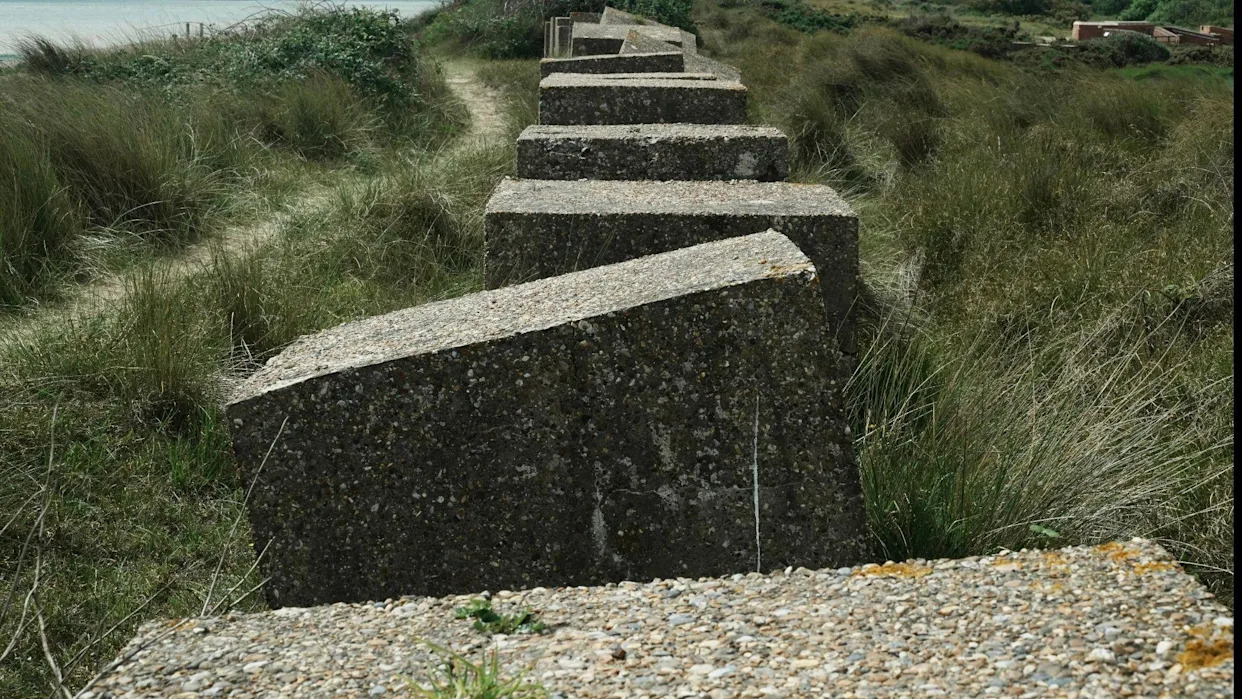
Work on the anti-tank defences - rows of huge concrete blocks intended to slow down advancing tanks - began in 1940, built by the Royal Engineers and the Pioneer Corps.

Some of the soldiers - including a Pte Wilkes - carved their initials into the blocks as they worked.

"My father always spoke very badly about the Pioneer Corps, apparently they weren't particularly efficient," said Fakes, who is the president of Great Yarmouth Local History and Archaeological Society.

Meanwhile, back at Minsmere, the first thing the authorities did to impede a possible invasion was to open a sluice gate.

It flooded the marsh with seawater.

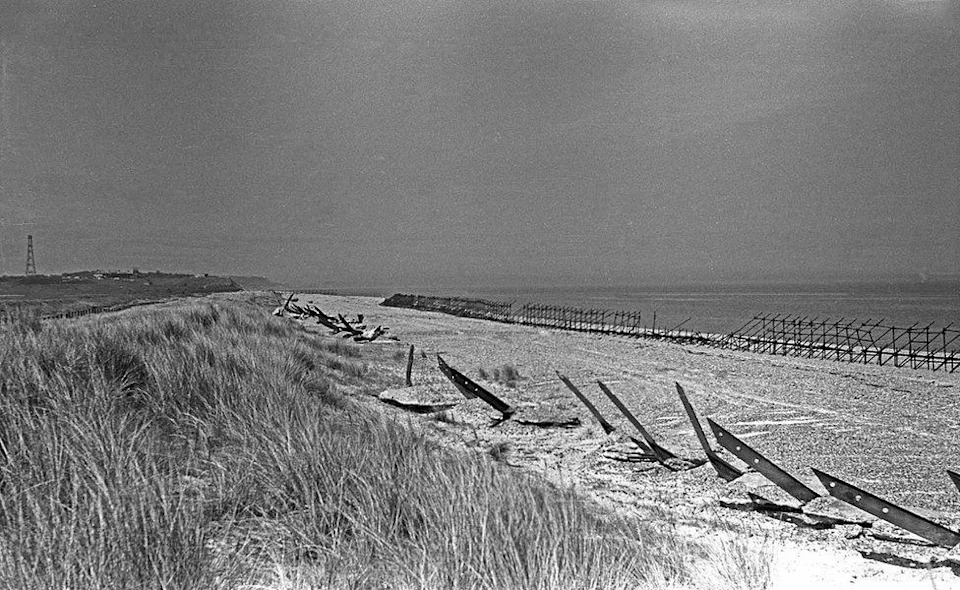
Next began the construction of anti-tank defences, trenches and so-called "dragon's teeth".

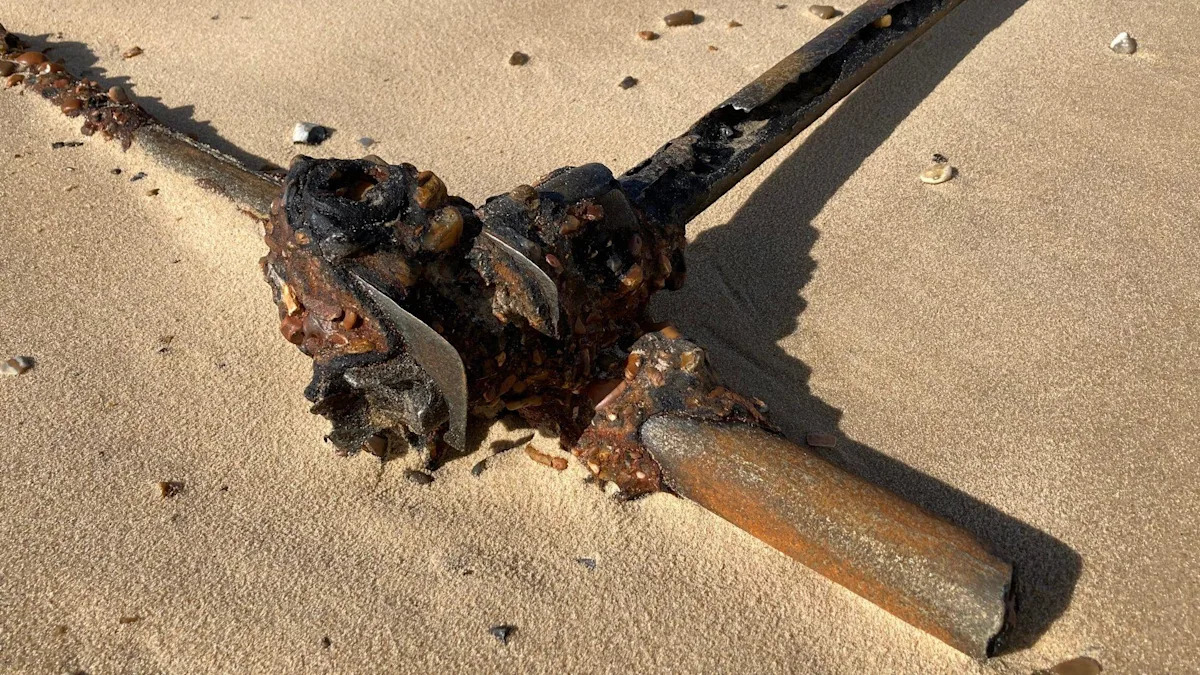
"These were steel girders set into concrete and put into into the sea at low water, designed to rip the bottom off invasion barges," Thurlow explained.

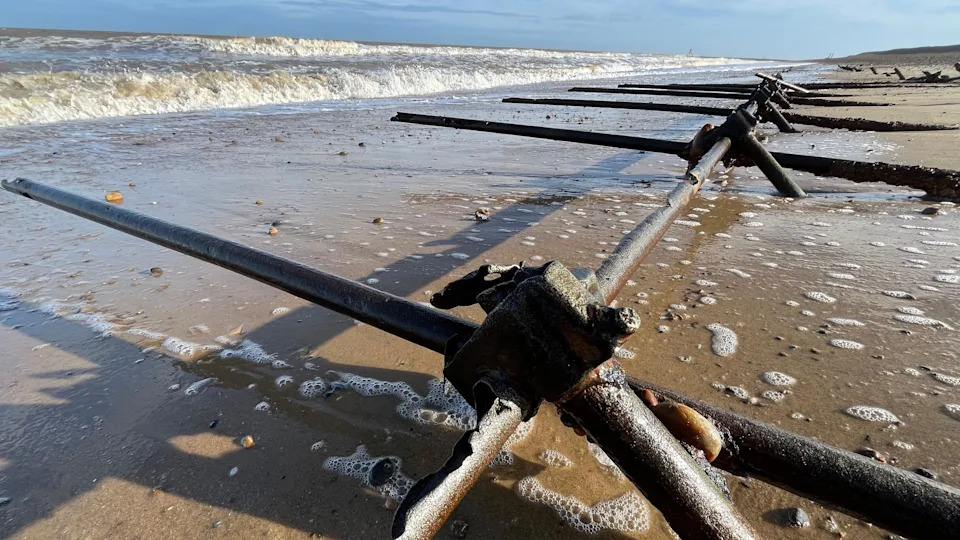
The last line of the beach defences was a row of 9ft (2.7m) scaffolding poles, connected and stabilised by horizontal poles.

They were sited just above high water and were intended to slow down the landing barges if they arrived at high water, or to prevent tanks from gaining enough speed to run through the barrier at low tide.

The remains of this scaffolding can still be seen at Minsmere, if the conditions are right.

Thurlow said: "Sections of it were left in isolated bits of beaches like here, and occasionally during winter storms, after surge tides, you can see the fragmentary remains of it."

The defences were typically exposed for two or three weeks before the shingle hid them once again, he explained.

This is not the first time Minsmere's World War Two history has been unearthed.

A similar thing happened in 2013 and again in 2022, before the tides and the wind covered the scaffolding once again.

Dr Sophie Day, senior research associate at the University of East Anglia's School of Environmental Sciences, said the east Suffolk coast has "a highly dynamic frontage and soft geology of the shore and cliffs".

"Coastal change is driven by factors including wave action - climate change and sea level rise will have an impact on this, accelerating natural sediment transport and erosion processes," she said.

Meanwhile, a report from the Royal Meteorological Society in 2024, said the UK's climate has become steadily wetter since the 1980, but does not appear to have become windier or stormier.

These defences - and the remains of the dragon's teeth - are "exceedingly rare" survivors from that time, Thurlow adds.

Along the 17-mile (27km) stretch of the Suffolk coast from Benacre to the Martello Tower at Aldeburgh, 7,153 anti-tank blocks, 4,886 large dragon's teeth and 1,886 smaller dragon's teeth were constructed, he said.

In addition, more than 4,500 mushroom mines were laid and 140 of the small fortified block houses called pillboxes were built, as well as 20 machine-gun pill boxes.

"We were talking a colossal construction programme... a whole national effort to construct those defences," said Thurlow.

"It was made possible because the British Expeditionary Force had experiences of construction defences during the Phony War in France - and of course there were loads of civilian contractors with their cement mixers and cranes."

Fakes said the British high command doubted the Germans would launch their main invasion along the East Anglian coast, but feared "a diversionary raid up here".

"I think we weren't in a huge amount of danger, but nobody knew that at the time," he said.

By July 1940, nearly 1.5 million men had joined the Home Guard as Britain's last line of defence, bolstered by a tiny top-secret resistance army.

Both men see these remains of an increasingly distant conflict as a crucial part of British history.

"As memory fades, it's important to remember what that generation went through during those terrible years of the Second World War - and potentially what would have happened had Germany invaded," said Thurlow.

Do you have a story suggestion for Suffolk? Contact us below.

Follow Suffolk news on BBC Sounds, Facebook, Instagram and X.

'My farmer dad was part of Churchill's Secret Army'

WW2 Home Guard soldiers were not 'old duffers', says historian

Storms unearth sand-filled World War Two pillbox

World War Two defences emerge from UK beach

RSPB Minsmere

Great Yarmouth Local History and Archaeological Society