yahoo Press
Greek debt crisis still haunts efforts to contain growing wildfire threat
Images
1 / 20
2 / 20

3 / 20

4 / 20
5 / 20
6 / 20
7 / 20
8 / 20
9 / 20

10 / 20
11 / 20
12 / 20
13 / 20
14 / 20
15 / 20
16 / 20
17 / 20
18 / 20

19 / 20

20 / 20
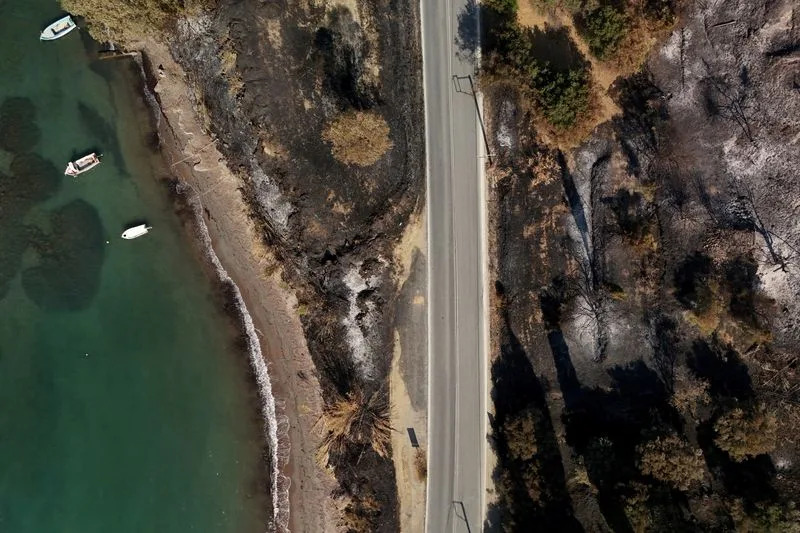
By Edward McAllister and Deborah Kyvrikosaios PENTELI, Greece, June 24 (Reuters) - As night falls over Mount Penteli and the streetlights of greater Athens wink in the valley below, a team of three from Greece's forestry service carry out what they say is a near-impossible task: scouting hills that surround the capital for wildfires. Unlike most summer evenings, this one in early June was still and cool and there was no sign of flames - rare relief for a unit of fewer than 30 people overseeing one of the most fire-prone areas in Europe. "Wouldn't it be nice if the entire summer could continue like this?" said forester Zoi Ntina, surveying hillsides that have seen no rain in weeks. "But we still have a long road ahead." As Greece braces itself for another hot summer, forestry service officials say understaffing is hobbling efforts to prevent fires or deal with their aftermath, just as the ripples of climate change spread: by razing forests, a steep rise in fires over the past decade has already increased soil erosion, desertification and flooding, experts say. REVIVING BURNED LAND AFTER DECADES OF NEGLECT Since 2000, nearly 2.5 million acres of land have burned in Greece, government figures show, mostly as a result of carelessness, arson or accidental events such as power lines breaking. Tourist resorts and densely packed residential areas are increasingly affected. Meanwhile, the ranks of the forestry service have shrunk, in part owing to the austerity programme that followed a sovereign debt crisis last decade. The number of staff dealing with fire prevention and mitigation has more than halved since the year 2000 to fewer than 3,000 today, government figures show. “In the last decades we have been through a period of complete abandonment," said Vangelis Gountoufas, director general of forests in Greece's environment ministry. The government now recognises the problem, he said. After more than two decades without permanent hires, the forestry service has added some 300 staff since 2024. Hundreds of millions of euros in European Union funds have also paid for thousands more firefighters, vehicles and drones this decade, as Greece tries to catch up. "It is not always easy to fill within two or three years a gap made over two decades," said Stathis Stathopoulos, who runs the forestry service at the ministry. "Anyone who says that they have the magic wand to eliminate fire as a phenomenon is probably not telling the truth." WILDFIRES CHANGE GREECE'S LANDSCAPE Mount Penteli, which towers over Athens' northern suburbs, used to be covered in forest. But population expansion and its location along a wind tunnel have made it especially vulnerable. Today, after decades of repeated fires, it is largely treeless, its flanks dotted with blackened pines that creak when northerly gales whip off the Aegean Sea. Scientists say repeated burning means the forest can no longer regrow naturally, and the government has begun a replanting scheme. It is an uphill task. In the Attica region surrounding Athens, blazes destroyed 37% of forests and grasslands from 2017-2024, according to data from the National Observatory of Athens. "The change due to climate change is really rapid. So the key word is adaptation," said Nikos Georgiadis from the environmental campaign group WWF, which is overseeing a project outside Athens that includes planting more fire-resistant trees. The fire threat has become part of daily life in the region. As summer begins, residents are required by law to clear their plots of flammable debris. Road verges that weeks ago were thick with wildflowers have been cut to stubble. Teams with chainsaws clear thick brush and low branches. Ntina's crew of 27 spend their days and nights checking storm drains and erosion-prevention schemes, and fire spotting. "It's almost impossible to be everywhere, to be able to stay on top of everything, including the paperwork accumulating on our desks," she said. IMPACTS OF DEFORESTATION ALREADY FELT Around Mount Penteli, a dozen or so water tanks intended to be used by firefighters are in visible disrepair, burned out from past fires. The lack of trees has made the area vulnerable to flooding. In April, heavy rain rushed down a bald ravine near Kallitechnoupoli, washing away part of a road that provides the villagers' main escape route in the event of fire. Ilias Liamis grew up there in the 1970s and 80s, when his family home was surrounded by wooded hills. On his property today, a few pine and olive trees remain, bent double by decades of windstorms. His childhood memories of a country idyll are now overshadowed by more recent events: a low-flying plane dumping seawater across his property during a blaze; embers flickering on the hillside at night, like the campfires of an invading army. "It was something terrifying," he said, motioning to the chastened landscape. "The new generation are so willing to fight for something better in the future. But sometimes I think it's impossible." (Writing by Edward McAllister; Editing by Kevin Liffey)