yahoo Press
Opinion - Between the eagle and the dragon: Brazil’s dangerous dependence on China
Images
1 / 7
2 / 7

3 / 7

4 / 7
5 / 7

6 / 7

7 / 7
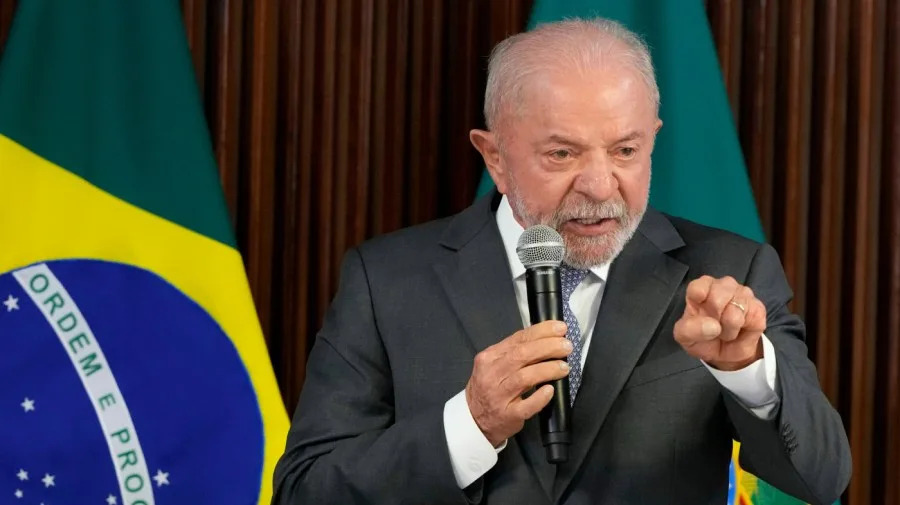
Brazilian President Luiz Inacio Lula da Silva has intensified his confrontation with the U.S. and his reliance on Communist China — a strategy that could seriously jeopardize Brazil’s economy, security, and sovereignty.

In recent days, Lula has sharpened his rhetoric against the U.S. and called Secretary of State Marco Rubio a “frustrated Latin American” and a “mortal enemy.” The leftist leader’s response follows the U.S. announcement of 25 percent tariffs due to unfair trade practices and the designation of the Brazilian criminal gangs Primeiro Comando da Capital and Comando Vermelho as terrorist organizations.

Lula has unleashed an undiplomatic and unfiltered rhetoric that is not good for either country. Brazil is one of the world’s largest economies, and the U.S. is its second-most important trading partner. In 2023, U.S. exports of goods and services to Brazil totaled $37.9 billion, while imports from Brazil amounted to $36.9 billion, a total trade value of $74.8 billion that year.

In his efforts to distance himself from the dollar and the U.S., Lula has increased his dependence on China. This week, Brazil said it would soon announce the issuance of so-called panda bonds, using yuan as currency. Brazil already sells most of its iron ore, soybeans and oil to Beijing, but now it also wants to borrow using Chinese yuan, limiting its financial freedom to sell to countries other than the communist power.

This rapprochement with China is not only in the economic sphere. Earlier this year, Brazil received, with arms wide open, the military hospital ship Silk Road Ark, owned by the People’s Liberation Army Navy. Members of the naval forces of both countries conducted a joint maritime exercise on search and rescue. China also made a demonstration of a combat and rescue operation.

Lula has been critical of so-called savage capitalism and social injustices. However, Brazil and China are now being questioned for business practices similar to modern slavery at a car factory construction site. Authorities report that 163 Chinese citizens were brought to Brazil illegally to work on the construction site of a BYD plant.

Brazil and China are moving forward to deepen their partnership in space-related matters by progressing with the construction of the Joint Radio Astronomy Technology Laboratory. The project involves the participation of a state-owned defense company known as the China Electronics Technology Group Corporation.

The two nations are also advancing the construction of South America’s largest radio telescope, known as “BINGO.” But China is not an innocent space explorer, but rather a dangerous adversary seeking to improve military capabilities in the U.S. area of influence.

In the telecommunications sector, Brazil continues to move forward with Huawei. The controversial telecommunication company has been accused of espionage by several European countries and the U.S. In 2024, then-Sen. Rubio warned that “Huawei has exposed the U.S. to potential nuclear command interference and stolen technology from at least six U.S. companies.”

Lula has also shown little commitment to combating drug trafficking and was left out of the “Shield of the Americas” initiative, promoted by the U.S. and a dozen Latin American nations to fight against organized crime and address security threats. And the president of Brazil has openly opposed designating gangs like Primeiro Comando da Capital and Comando Vermelho as terrorist organizations.

Lula is concentrating too much power in China’s hands — creating a dependency regarding telecommunications, space security, trade and now bonds that leave Brazilian finances vulnerable to China’s economic fluctuations.

Brazil needs to change course under leadership that puts the country first, rather than partisan ideological agendas. Confrontation with the U.S. is both futile and unnecessary, but dependency on Beijing puts Brazil’s economy at risk and endangers the security of the Americas.

Arturo McFields is an exiled journalist, former Nicaraguan ambassador to the Organization of American States, and a former member of the Norwegian Peace Corps. He is an alumnus of the National Defense University’s Security and Defense Seminar and the Harvard Leadership course.

Copyright 2026 Nexstar Media, Inc. All rights reserved. This material may not be published, broadcast, rewritten, or redistributed.

For the latest news, weather, sports, and streaming video, head to The Hill.