Press
How Trump’s White House ballroom plan has doubled in size and cost
Images
1 / 13

2 / 13

3 / 13
4 / 13
5 / 13

6 / 13
7 / 13

8 / 13
9 / 13
10 / 13
11 / 13
12 / 13
13 / 13
In the year since US President Donald Trump announced plans to build a new ballroom at the White House, the proposals have grown to include a rooftop "drone port", an underground hospital and "top secret" military facilities - and the estimated price has doubled to $400m (£300m).

Despite promises from Trump that the project wouldn't cost US taxpayers any money, Republicans have requested additional funds from Congress for security around the complex - at a time when Americans are struggling with rising living costs linked to the Iran war.

The president indicated from the outset that the new ballroom is needed to "accommodate people for grand parties, State Visits", and more recently said it is "vital for National Security".

BBC Verify has examined how the biggest change to the White House in decades has transformed over the past year.

On 6 June last year, Trump announced on his social media platform Truth Social that he had inspected the site where a new ballroom would be built, promising it would "go up quickly" and would be "very much in keeping with the magnificent White House itself".

"These are the 'fun' projects I do while thinking about the World Economy, the United States, China, Russia, and lots of other Countries, places, and events," he added.

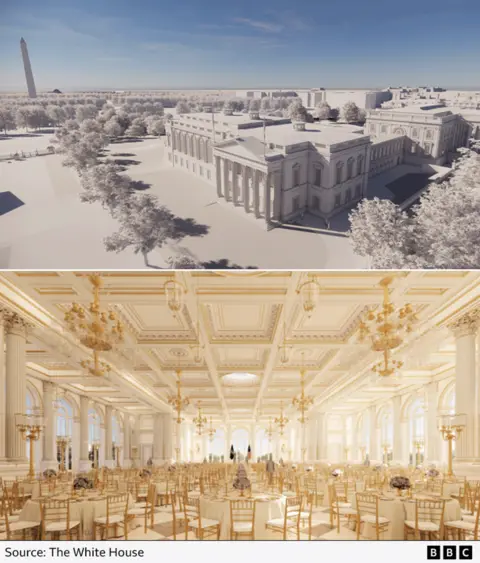
The following month his administration revealed plans for a new "White House State Ballroom" to be built where the "small, heavily changed, and reconstructed East Wing currently sits", adding that its "theme and architectural heritage will be almost identical" to the historic main building.

The statement said the ballroom promised to be a "much-needed and exquisite addition of approximately 90,000 total square feet of ornately designed and carefully crafted space". It added that the structure would be able to seat 650 people, a "significant increase" on the 200-seated capacity of the East Room in the main residence.

The East Room is the primary space in the White House for official ceremonies and events and was used to host King Charles' state banquet in April. But larger events in recent years, such as French President Emmanuel Macron's state dinner in 2022 that had more than 300 guests, have been hosted in temporary tent structures built on the White House's south lawn.

The administration said the ballroom's construction would start later that year and be completed "long before" the end of Trump's second term in January 2029.

Trump later told reporters the ballroom "won't interfere with the current building… It'll be near it but not touching it and pays total respect to the existing building".

But when Trump posted on Truth Social in October that "ground has been broken" at the White House, he said the East Wing, which had housed dozens of rooms including the First Lady's office, was "being fully modernized" as part of the building process.

After the diggers moved in, the entire East Wing - which had stood for more than 120 years - and the hallway connecting it to the main White House building were flattened within a couple of days.

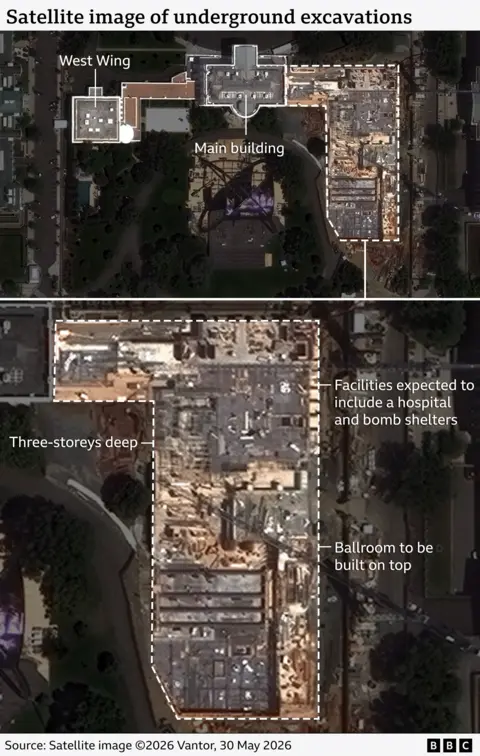
The public plans for the building have changed dramatically since then. The latest iteration, revealed by Trump on Truth Social in April, suggests the site could now feature bomb shelters, an underground state-of-the-art hospital and medical facilities, "top secret" military facilities, and a rooftop drone landing space.

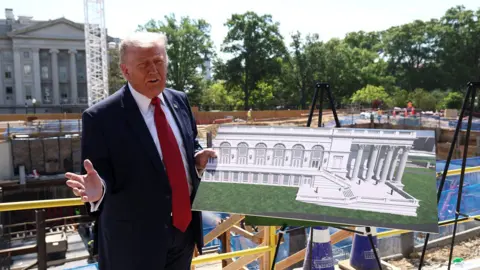
A recent satellite image shows the extent of the excavations for the underground section, which the president has said will be three-storeys deep.

Trump has increasingly mentioned the security features of the ballroom - with at least 10 posts on Truth Social mentioning it so far this year, as opposed to zero last year.

His emphasis on the issue ramped up after the assassination attempt at the White House Correspondents' Association dinner in April.

"It's much more secure... It's drone proof, it's [got] bulletproof glass. We need the ballroom. That's why Secret Service, that's why the military are demanding it," he said in a press conference at the White House immediately after the shooting.

Trump says the roof of the new ballroom will be missile-proof, and recently shared an AI-generated image of a "DronePort" that he claims will "safe-guard Washington DC long into the future".

BBC Verify asked the White House how the plans and purpose of the ballroom had changed since it was first announced - it said they hadn't.

Trump has repeatedly claimed the ballroom, which was originally expected to cost $200m (£150m), will be built at "zero cost" to taxpayers because it will be funded by himself and through private donations.

But in May, Republicans requested funding for a $1bn (£745m) security package which reportedly included $220m (£165m) tied to the new ballroom specifically.

It was rejected by Congress and eventually dropped, but a separate $400m Republican-backed security bill linked to the ballroom is ongoing. Senator Lindsey Graham, the bill's co-sponsor, has said this would be paid for by charges on goods and travellers entering the US.

The White House initially said that the Secret Service "will provide the necessary security enhancements and modifications" but it did not share further details.

The direct construction cost estimates have also doubled over the last year.

BBC Verify has identified and analysed 35 Truth Social posts by Trump about the ballroom since June 2025, some of which mention costs varying from $200m, to $300, and most recently $400m.

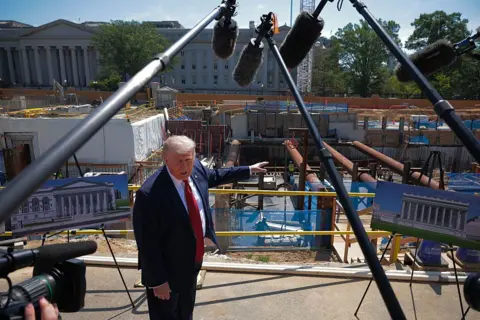
Speaking to reporters outside the construction site in May, Trump said: "We're right on budget, we're right on plan, the only budget change would be that we doubled the size at the request of the military."

BBC Verify asked the US Department of Defense about what exactly it has requested but has not received a response.

Trump was also asked about the request for taxpayer funding linked to ballroom in May, and said that the funds are "for projects having to do with safety in a certain section of the White House grounds. That's not all for the ballroom".

When the project began in October, the Trump administration released a list of donors which included dozens of companies such as Amazon, Google and Meta, and several billionaire investors - although no further details have been provided.

BBC Verify asked the White House for an updated breakdown of how much will be paid for by the president, by donors, and by taxpayers - but it said it had no further details to add.

Questions have also been raised about whether the administration is legally allowed to complete the construction.

The US National Trust for Historic Preservation filed a lawsuit to stop the construction, saying "no president is legally allowed to tear down portions of the White House without any review whatsoever".

The Trump administration has pushed back against the concerns by highlighting White House construction projects undertaken by previous administrations.

Some significant renovations have been carried out by previous presidents, but the ballroom proposal is the most extensive change in more than 70 years.

"Harry Truman oversaw a massive White House renovation in the late 1940s and early 1950s, but this happened because the White House was structurally unsound and falling apart, so there was little opposition to the project," says Dr Matthew Dallek, a political historian and professor at George Washington University.

A federal judge did temporarily block construction following the National Trust for Historic Preservation's challenge - but this ruling was appealed by the Trump administration and building work was allowed to resume until a hearing in June.

Graphics by Mesut Ersoz.

What do you want BBC Verify to investigate?

The lower chamber of Congress passed a measure that seeks to halt further military action, in a vote seen as largely symbolic.

If confirmed by the Senate, Trump's former personal lawyer would become the administration's number one prosecutor.

In the 215-208 vote, four Republicans joined Democrats to pass the measure, which is largely symbolic.

The bill to fund immigration agencies has been delayed by opposition to Trump's
'anti-weaponisation fund'.

Israel's PM laughed off reports of friction, but he has tested the patience of other US presidents.