yahoo Press
Farmer Frustrations With Trump Spell Trouble for Iowa Republicans
Images
1 / 9
2 / 9

3 / 9

4 / 9
5 / 9
6 / 9
7 / 9
8 / 9
9 / 9
(Bloomberg) -- After years in the political wilderness, Iowa Democrats are feeling a new sensation — hope.

Most Read from Bloomberg

US Says Deals With Iran for Safe Hormuz Transit Are Prohibited

Berkshire Hathaway to Buy Taylor Morrison for $6.8 Billion

Strait of Hormuz Ship Transits Are Rising Thanks to US Help

A Rare ‘Super’ El Niño Is Looking More Likely. Here’s What to Expect

Americans Injured in Iranian Missile Strike on Kuwaiti Air Base

Once seen as a bellwether, the Midwestern state of 3.2 million people has over the past decade served as a microcosm for national politics, lurching to the right as President Donald Trump solidified his grasp on White and rural voters. But Democrats see an opportunity to reverse those trends, buoyed by broad dissatisfaction with the economy and a group of well-liked, centrist candidates expected to prevail in Tuesday’s party primaries.

Trump’s aggressive tariff agenda has turbocharged voter frustrations with the state’s heavily agricultural economy, squeezing the fertilizer supply chain. The Iran war has driven up fuel prices. The president’s recent trip to China didn’t yield specific guarantees of new row crop purchases. Sweeping policy changes in education and healthcare alienated some Iowans, while longtime Republican incumbents are retiring.

Now, Iowa is poised to play a decisive role in the Democratic wave positioned to crash over November’s midterm elections. The governor’s race is moving in their favor. And as Democrats look to recapture the US House and the Senate, the state provides them ample pickup opportunities. Currently, Republicans control Iowa’s entire congressional delegation, but up to three of the state’s four House seats are seen as competitive, as well as an open US Senate seat.

Dave Loebsack, a former Democratic congressman who served from 2007 until 2021, insists that victory is within reach.

“Not a lot of the MAGA people will fall away from him,” he said of Trump and the president’s most loyal supporters. “But quite honestly, in some of these elections in Iowa and around the country, you don’t need that many to fall off.”

Prairie Populism

Looking to win back voters who have fled the party, Democrats running in Iowa are emphasizing pragmatic policy making and their local roots.

“Three things that are very important in my life are hunting, fishing and going to church. I think that is something that resonates for a lot of Iowans,” said state auditor Rob Sand — currently the only Democrat in a statewide elected office — who is running unopposed for the party’s nomination for governor.

Iowa is more white and rural than much of the country, and Democrats there acknowledge it’s important for them to tread lightly around culture war issues.

It seems to be working for Sand — likely to face Randy Feenstra, a Republican congressman representing Sioux City — who is seen as the Democrats’ strongest gubernatorial candidate in more than a decade. The Cook Political Report recently moved the contest from “lean Republican” into “toss-up” status, noting Sand’s enormous cash advantage. He ended 2025 with $13.2 million on hand, compared with Feenstra’s $3.2 million.Feenstra pointed out that Trump won Iowa three times in a row. “I think people still support him and believe in him and it’s just a matter of seeing the results happen over the next six months," he said.

Senate Showdown

The two state lawmakers running in a competitive Democratic primary for the state’s open Senate seat are also striving for authenticity with small town voters.

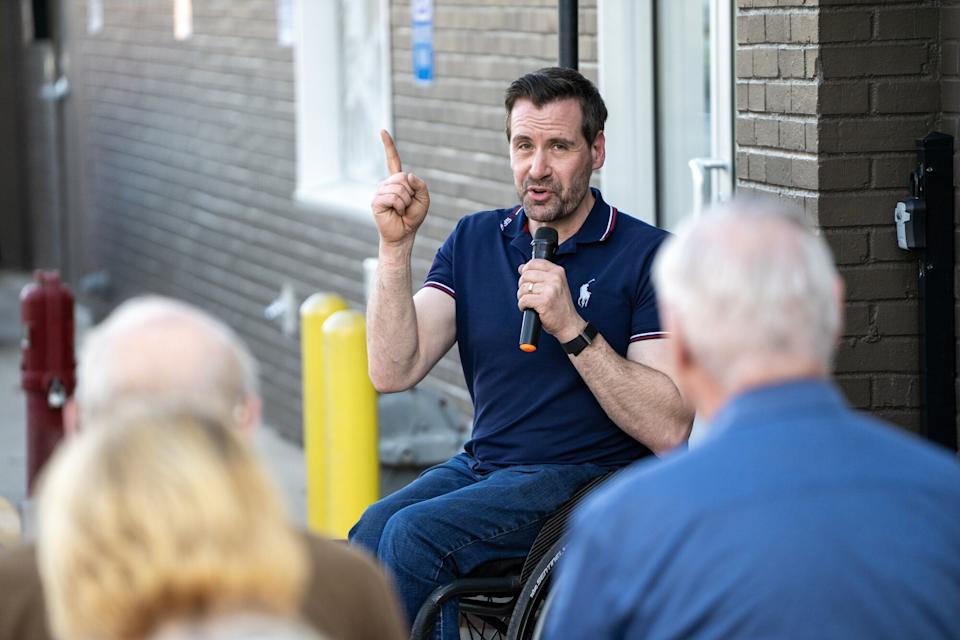
Josh Turek, a 47-year-old state representative born with spina bifida, played for the US men’s wheelchair basketball team at four Paralympic Games before getting into politics. He likes to invoke former Senator Tom Harkin — a chief sponsor of the Americans with Disabilities Act — when touting his focus on “common sense, prairie populism.”

As he navigated a hilly Cedar Rapids neighborhood in his wheelchair recently, Turek said that he would fight for a living wage, affordable housing, heathcare and public education — all while rooting out corruption. He stressed that he represents a Republican-leaning district in the state House as evidence he can bridge divides.

“This is not a red state,” Turek argued. “This is a common-sense state that has masqueraded as more red than we are.”

Since Republicans took over the state legislature in 2017, they have advanced a conservative agenda that includes abortion restrictions, an expansive school choice program and curbs on bathrooms used by transgender students.

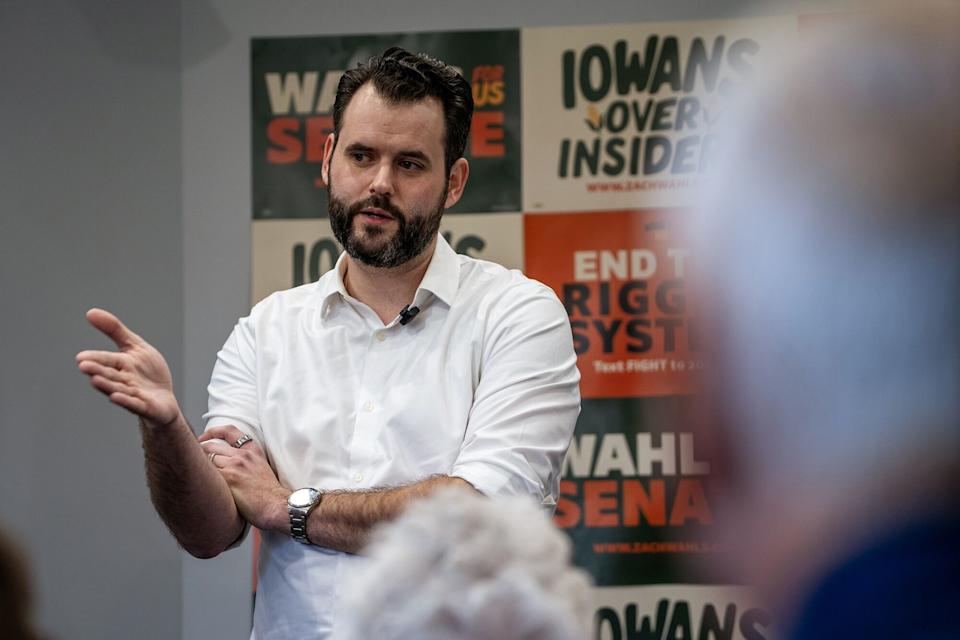
Turek’s primary opponent is hitting similar notes. Zach Wahls, 34, is a state senator who gained national attention with a 2011 speech at the Iowa Capitol referencing his two mothers as he opposed an effort to ban gay marriage. He has promised to oppose Senate Democratic Leader Chuck Schumer and to only serve two terms in the chamber.

“We need to have an economy that works for Iowans, not just the people at the very top,” he said during a recent speech at a library in Newton, Iowa, talking about strengthening Social Security, reversing Medicaid cuts and improving health care access.

The winner of the June 2 primary will face Representative Ashley Hinson, a former television journalist representing Cedar Rapids. She is considered a strong contender to hold the Senate seat for Republicans, but party strategists acknowledge it will be a competitive race.

Republican Roadmap

Despite the unfavorable dynamics, Republican Party of Iowa chairman Jeff Kaufmann said he still likes his party’s chances this fall.

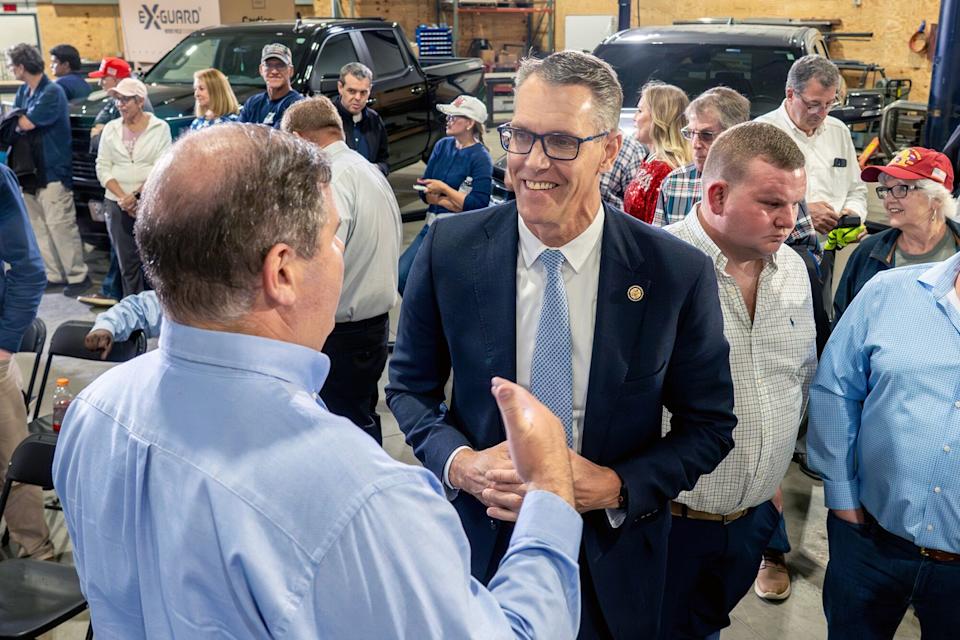
“I’m not trying to dodge the fact that the tariffs hurt. What I am trying to tell you is we get it, our farmers get it,” Kaufmann said. “My job is to keep the Trump voters voting for us and keep reminding people that things take time.” Republicans point to their 200,000-voter registration advantage and Trump's enduring popularity in the state.Yet in a sign that this year is going to be challenging, Vice President JD Vance recently visited Iowa to campaign for Zach Nunn, one of two Republican House members viewed as highly vulnerable. And Trump on Friday publicly endorsed Feenstra in the GOP primary for governor, writing in a social media post that the congressman “has delivered strong results for the Hawkeye state.”A third seat will be open as Hinson — who also earned a Trump endorsement earlier this year — runs for Senate, giving Democrats another opportunity.

Potential Democratic presidential hopefuls are also paying attention to the midterms, with former Transportation Secretary Pete Buttigieg and Senator Ruben Gallego endorsing Turek and Kentucky Governor Andy Beshear planning to campaign for Sand. That’s despite Iowa Democrats losing their first-in-the-nation caucus position after a calamitous election in 2020.

Republicans expect that holding the House seats will require a battle, but they say they are ready to defend them. Kaufmann said they have substantial resources and that Trump plans to come to the state to help. GOP officials have also expressed confidence Hinson can win her Senate race despite a spending onslaught. The Democrats’ Senate Majority PAC recently announced an initial $13.4 million television ad reservation against her.

Hinson said she is the right candidate because she understands what Iowans are going through.

“I’ve been out there traveling the entire state, listening to Iowa farmers, listening to our minivan-driving moms about what they’re facing every single day,” she said. “Nobody can fix those problems better than a minivan-driving mom herself.”

Farmer Frustrations

Iowans have spent the past year struggling to manage Trump’s trade policies and the question of whether they see results before Election Day is likely to drive the results.

Iowa is the nation’s second-largest producer of soybeans, after Illinois, and the crop has become a sticking point in the trade war between the US and China. US-China flows were halted for months and some Chinese buyers turned to South American producers. According to Agriculture Department data, US soy exports to China dropped to $3.1 billion last year from $12.6 billion in 2024 — before Trump took office. Thus far in 2026, exports have ticked up slightly from last year to $3.4 billion.

Conditions improved after Trump and China’s Xi Jinping met last October and secured a deal that included a 12-million metric ton soybean pledge. But even the White House has conceded that additional sales negotiated during a follow-up summit in May may not be realized before the midterms, while Beijing has so far declined to publicly confirm additional upcoming purchases.

Trump’s war with Iran and the restrictions on the Strait of Hormuz — a key shipping lane in the Middle East — has also sent fertilizer prices surging just as planting season is beginning. The World Bank projects prices to rise by nearly a third this year, pushing costs to their highest level since 2022, when Russia launched its full-scale invasion of Ukraine.Meanwhile, the average farm diesel price in Iowa was $4.65 a gallon, up from $2.73 a year prior, according to the USDA.

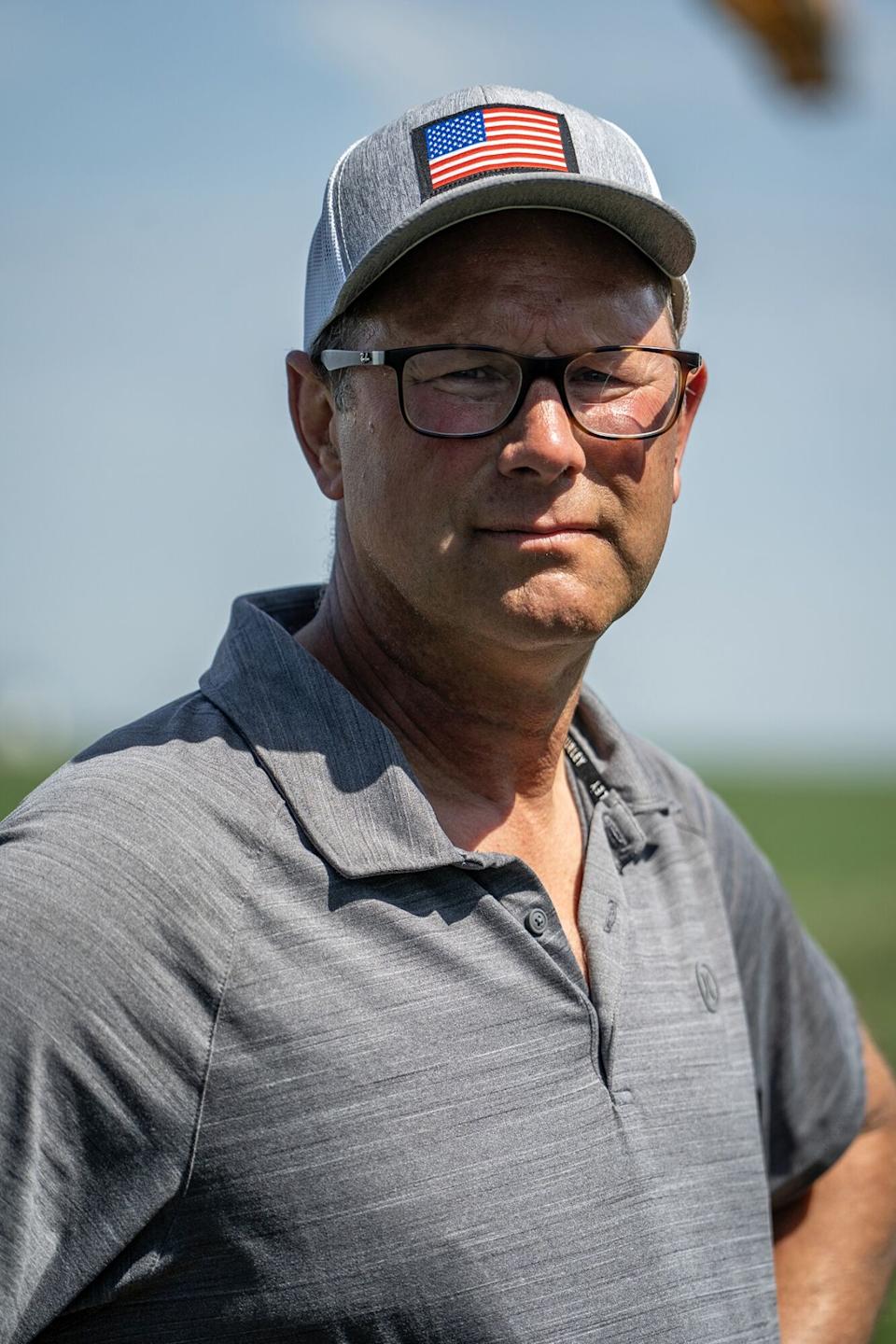
Stu Swanson, who tends his family’s corn and soybean farm and chairs the Iowa Corn Growers Association, said he expected Trump’s trade agenda to help the agriculture sector. Instead, he has operated his farm in Galt at a loss for the last two years. Now, Swanson, 58 and a registered Republican who voted for Trump in 2020 and 2016, said he is not sure how he’ll vote this fall.

“Would guess I’m going to vote some kind of split ticket come November,” he said.

As the stresses mount, Wendy Johnson, 50, a farmer in Charles City says she recalls the 1980s farm crisis, when inflation, high interest rates and collapsed exports drove families out of agriculture.

“Really what happened is we just had no control over anything, like no control over prices. We had no control what the federal government was doing,” said Johnson, an independent who typically votes for Democrats. “It feels like that again.”

Most Read from Bloomberg Businessweek

What It Takes to Get a Job at Anthropic

It’s Such a Mess Shopping for Reasonably Priced Menswear

How Barnes & Noble Became Private Equity’s Most Radical Retail Experiment

The Life and Grisly Death of a Sports Memorabilia Forger

Grocery Shoppers Are In For a Summer of Pain

©2026 Bloomberg L.P.