yahoo Press
China Leads Economic Shift to Industrial ‘Doping,’ OECD Says
Images
1 / 6
2 / 6

3 / 6

4 / 6
5 / 6
6 / 6
(Bloomberg) -- Industrial subsidies are reshaping the global economy with China standing out as a provider of state support that risks harmful distortions, according to new data from the OECD.

Most Read from Bloomberg

US Says Deals With Iran for Safe Hormuz Transit Are Prohibited

Berkshire Hathaway to Buy Taylor Morrison for $6.8 Billion

A Rare ‘Super’ El Niño Is Looking More Likely. Here’s What to Expect

Strait of Hormuz Ship Transits Are Rising Thanks to US Help

Pro-Trump Outsider Wins Colombia Vote, Sets Up Heated Runoff

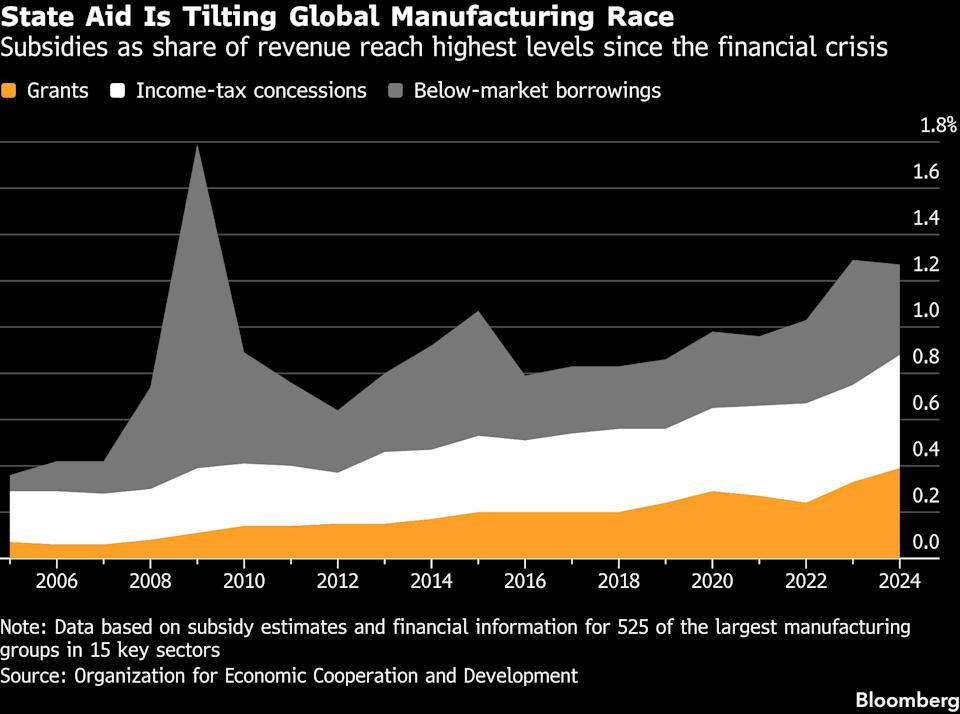
Government aid for the world’s largest manufacturing groups in 15 key sectors reached levels in 2023 and 2024 not seen since the global financial crisis, marking a structural change, the Paris-based organization said Monday.

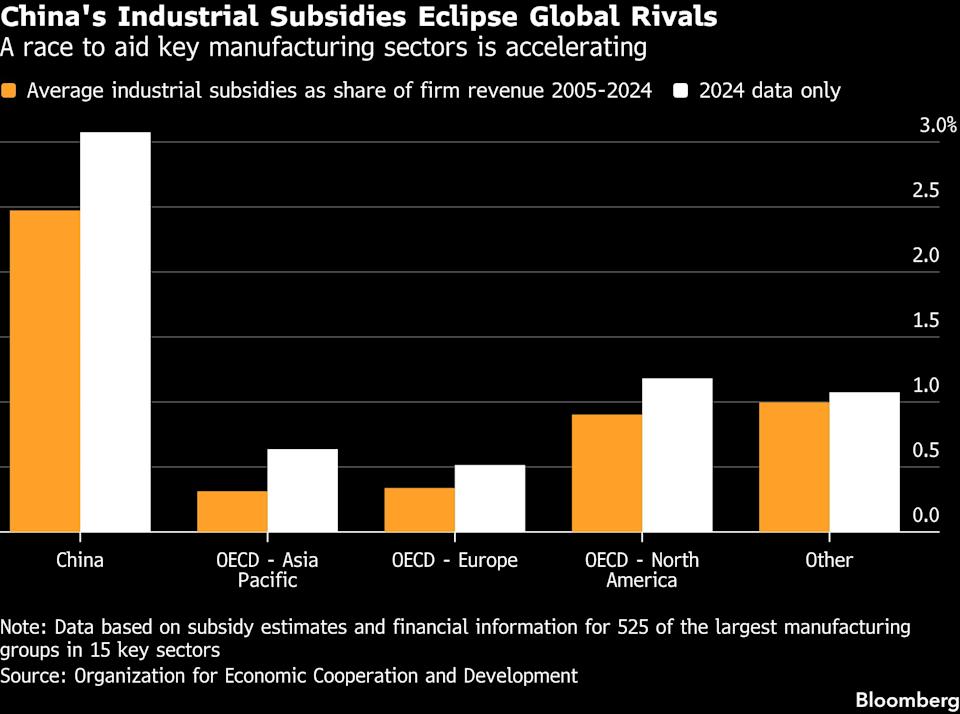
China is a standout in the database that the OECD made public on Monday, with firms based there receiving three to eight times more government support than member-countries of the organization. That’s considerably more than other large OECD non-members such as Brazil and India.

The research provides a novel insight into the use of subsidies that are helping fuel tensions and tariffs between China and major economies.

At the heart of President Donald Trump’s complaints against Beijing is an unlevel playing field in global industries like autos — concerns that officials in the European Union are voicing more loudly as its carmakers struggle to hold market share against Chinese rivals including BYD Co. and Chery Automobile Co.

Clouding the subsidy debate for years have been a lack of transparency and incomplete disclosure to organizations like the World Trade Organization.

According top a 2025 report from the US Trade Representative’s office, “since joining the WTO more than 20 years ago, China has not yet submitted to the WTO a complete notification of subsidies maintained by the federal government.”

The OECD’s initiative aims to help shed light on the controversial subject by showing amounts that firms actually receive based on studying company filings to track grants, tax concessions and cut-rate lending. In 2024, total subsidies for the sectors tracked in the database reached $108 billion.

“Industrial subsidies are growing around the world, but for decades we have lacked a reliable, comprehensive and comparable picture of what governments are actually providing and what firms are actually receiving,” OECD Secretary General Mathias Cormann said at a presentation in Paris. “Subsidies are not just a fiscal issue, they are reshaping global markets.”

Renewable energy equipment, semiconductors and heavy industries receive the most support. China again leads the way with average subsidies for semiconductors reaching nearly 10% of firm revenue in 2021 and 2022, while the global average is just over 2%.

What Bloomberg Economics Says...

“The OECD data confirms that governments are increasingly using industrial policy to shape economic activity in selected sectors. The key question is whether these interventions can deliver on their transformative goals — or whether they ultimately lead to wasted resources and greater protectionism.”

—Antonio Barroso, senior geoeconomics analyst. For more, click here

The OECD said its analysis shows state aid is changing the world economy with around 22% of market share gains for firms between 2005 and 2023 attributable to subsidies. For Chinese firms, it said that measure is almost 60%.

The organization also said that subsidies did not increase productivity and profitability, suggesting that support will have deterred investment.

“Just like doping in sports, there is therefore a risk that subsidies result in less productive players winning unfairly at the expense of more innovative and efficient ones,” the OECD said. “This could eventually impose long-term costs on the global economy in the form of less innovation, product quality, and competition, even as consumers benefit in the short-term from the lower prices.”

--With assistance from Nick Heubeck.

(Updates with BE comment after 10th paragraph)

Most Read from Bloomberg Businessweek

What It Takes to Get a Job at Anthropic

It’s Such a Mess Shopping for Reasonably Priced Menswear

Valve, the Anticorporate Hero of the Games Industry, Has Its Antitrust Moment

How Barnes & Noble Became Private Equity’s Most Radical Retail Experiment

The Life and Grisly Death of a Sports Memorabilia Forger

©2026 Bloomberg L.P.