yahoo Press
The Latest: US-China summit ends with Xi and Trump claiming progress but differences remain
Images
1 / 10
2 / 10

3 / 10

4 / 10
5 / 10
6 / 10
7 / 10
8 / 10

9 / 10

10 / 10
U.S. President Donald Trump departed Beijing on Friday following a final meeting with Chinese President Xi Jinping. The leaders said they made progress in stabilizing U.S.-China relations, but deep differences remained after two days of meetings and meals.

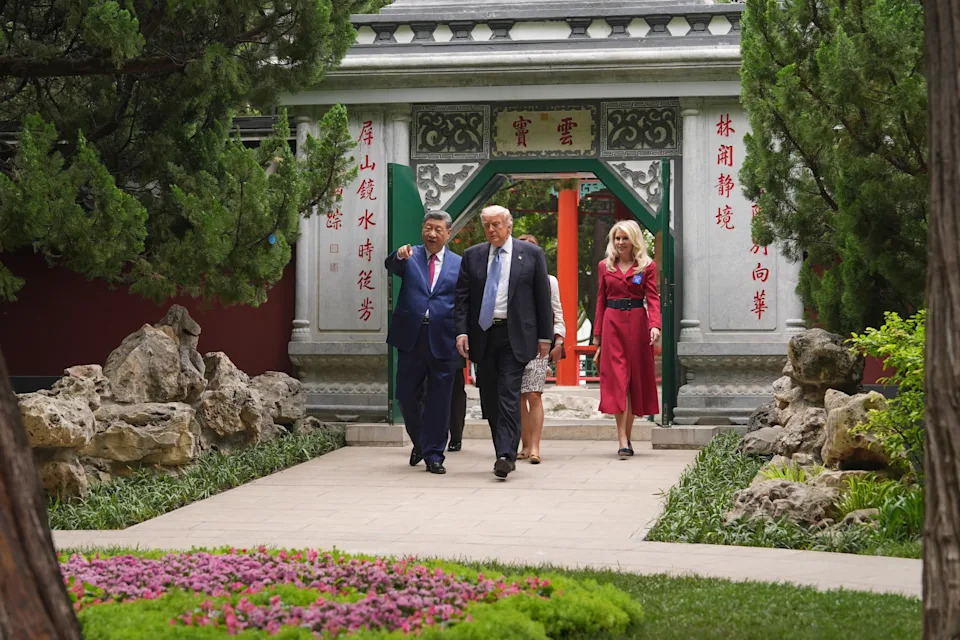
On Friday they walked the grounds of Zhongnanhai, Xi's official residence, and had a working tea and lunch. During a series of meetings and events Thursday, the two discussed divisive issues such as the Iran war, trade, technology and Taiwan.

China has shown little public interest in getting more involved in solving the war in Iran. Xi also suggested differences over Taiwan could put his country and the U.S. on the path toward conflict. Threats of each side imposing steep tariffs also still loom.

Trump said Xi told him China wants to help negotiate an end to the war and a reopening of the Strait of Hormuz. China is the largest buyer of Iranian oil and Trump hopes Xi will use that leverage to prod Iran into a deal on U.S. terms. Trump also said Xi assured him that China wouldn’t provide Iran with military equipment.

Trump has taken a decidedly rosy outlook on the U.S.-China relationship during this trip. But that has collided with some difficult truths about the thorniest issues between the two superpowers including Taiwan, the Iran war and trade.

In a summit marked by fanfare and flattery, Xi warned Trump that differences over Taiwan, a self-governed island claimed by Beijing as its own territory, could bring the U.S. and China into clashes or conflict. Trump authorized an $11 billion arms package for Taiwan in December, but has not moved forward with delivery. Secretary of State Marco Rubio warned later on Thursday it would be “a terrible mistake” for China to take Taiwan by force.

Trump also focused on trade and deals for China to buy more agricultural products and passenger planes, setting up a board to address their differences and avoid a repeat of the trade war ignited last year after Trump’s tariff hikes.

Here is the latest:

Trump said Xi would consider the case of Ezra Jin Mingri of the Zion Church, who has been detained since October.

On Monday, Grace Jin Drexel, the pastor’s daughter, asked Trump to help bring back her father and other jailed activists on his trip to Beijing.

“We really plead the president will continue to raise the political prisoners, like my father, and like many of the family members here today, and bring them home,” she said. “We just would love for him to just be part of the family and, like, eat nice food with us and watch movies with us, and just, like, have a have, just live normal lives again.”

The Kremlin said Thursday that President Vladimir Putin is set to visit China shortly.

Asked about a report that Putin is coming to China next Wednesday, Kremlin spokesman Dmitry Peskov said that the visit indeed will take place “very soon,” adding that Moscow and Beijing will announce its date.

Asked to comment on President Donald Trump’s visit to China, Peskov emphasized the importance of contacts between the world’s two biggest economies, adding that Russia expects to get firsthand information from China about its talks with the U.S. when Putin visits Beijing.

President Donald Trump says he’s not yet made a determination on whether a major U.S. sale of arms to Taiwan can move forward, following his three-day visit to China.

Speaking to reporters as he flew back on Air Force One on Friday, Trump said he’d not decided on the sale, but added, “I will make a determination.”

The Trump administration has authorized the sale but it has yet to move forward. China opposes the deal and has suggested that Washington’s relationship with the self-governing island is the key factor in China-U.S. relations.

Activist Jimmy Lai, a prominent critic of Beijing, was sentenced to 20 years in prison under a national security law in February in Hong Kong. His family and supporters hope Trump could help free the 78-year-old, who has spent over five years in custody.

“He told me that would be a tough one,” Trump said, referring to Xi.

Lai’s daughter Claire told The Associated Press that she was so grateful to Trump for the commitment shown to his father’s release.

“He has earned his reputation as liberating the unjustly detained and I am confident he and his administration will be the ones to free my father,” she said.

She said this is an opportunity for Xi to do “the only just and honorable thing” for a man who has given so much to Hong Kong and show a gesture of goodwill to the rest of the world.

Trump wants the three countries to sign a pact that would cap the number of nuclear warheads each one has in its arsenal.

China has previously been cool to entering such a pact. Beijing’s arsenal, according to Pentagon estimates, exceeds more than 600 operational nuclear warheads and is far from parity with the U.S. and Russia, which each are estimated to have more than 5,000 nuclear warheads.

But Trump suggested Xi was receptive to the idea when he raised it in their private talks.

“I got a very a positive response,” Trump said. “This is the beginning.”

The last nuclear arms pact, known as the New START treaty, between Russia and the United States expired in February, removing any caps on the two largest atomic arsenals for the first time in more than a half-century.

George Chen, a partner at The Asia Group consultancy, said the summit felt like a political reality show at times and unfolded almost exactly as scripted, but it delivered symbolism, clarity and a roadmap for the months ahead.

Chen noted both sides have highlighted what they care about most: For Xi, Taiwan. For Trump, deals.

“The readouts from Beijing and the White House differ in tone and emphasis, but neither side contradicted the other’s account. That alone reflects a rare moment of mutual respect,” he said.

While the list of concrete deliverables remained limited for now, Chen said the most important development might be Xi and Trump having spent extended time together again.

“Personal rapport between leaders can shape the tone of an entire bilateral relationship,” he said.

However, Taiwan could feel uneasy after Xi warned the U.S. over it. Taipei will be watching closely for signs of Trump’s responses, he added.

Elon Musk said his son is learning Chinese. The message in a public post on X Thursday quickly drew attention on Chinese social media and began to trend.

But what the state media outlets omitted was who Elon Musk responding to. He replied to Teacher Li, or Li Ying, whose X account posts news and videos submitted from users about uncensored news in China and has some two million followers.

Li himself noted the irony that Musk’s response to him was now trending on Weibo, which is managed by censors. He shared on Friday that many of the accounts that originally wrote up Musk’s comments have now deleted the posts.

A search on Weibo and local media showed that while the topic was still searchable, some websites had indeed deleted their coverage.

Jensen Huang is trying all of Beijing’s delicacies, the good and others which may be more of an acquired taste.

Huang was spotted by the public and local media at No. 69 Fangzhuanchang Noodles, for a bowl of “zhiangmian” -- a Beijing specialty that features noodles covered in a thick soybean-paste sauce mixed with vegetables and meat.

“It’s so good,” he said, as he dug into the bowl.

But it’s the “douzhi’er,” a fermented mung bean drink that’s slightly sour and gray-green in color, that made the Nvidia CEO wince. Videos of his reaction were trending on Weibo Friday afternoon. Huang then quickly reached for a sweet drink from Chinese beverage chain Mixue Bingcheng.

———

This post has been updated to reflect that douzhi’er is made with fermented mung beans and not soybeans.

China said the two leaders agreed to a new vision for dealing with their relationship issues: “a constructive China-U.S. relationship of strategic stability.”

The Chinese Foreign Ministry said the framework would shape ties for at least three years — the rest of Trump’s term — and would focus on cooperation, competition within proper limits, and managing differences.

The idea is “to keep the relationship on an even keel,” said Helena Legarda of the Mercator Institute for China Studies in Berlin.

George Chen, a partner at The Asia Group consultancy, said it can be seen as progress from the Biden era, which framed the relationship as a strategic competition.

Schoolchildren dressed in some of Air Force One’s light blue and white colors waved American and Chinese flags in a coordinated movement as the U.S. president arrived to board the plane.

“Farewell, farewell,” they chanted. “Warm farewell!”

Chinese Foreign Minister Wang Yi saw a smiling Trump off at the airport.

Trump turned at the top of the stairs and pumped his fist and waved before entering the aircraft.

He didn’t speak again before departing for home.

Trump has boarded Air Force One for his flight out of China.

Trump and Xi both said they made progress in stabilizing U.S.-China relations. But deep differences persist.

The leaders spent a lot of time together the past two days.

They met for about two hours at the Great Hall of the People, toured the Temple of Heaven and attended a banquet on Thursday. On Friday they walked the grounds of Zhongnanhai and had a working tea and lunch.

China has nonetheless shown little public interest in getting more involved in solving the war in Iran.

Xi also suggested differences over Taiwan could put his country and the U.S. on the path toward conflict.

Threats of each side imposing steep tariffs also still loom.

While little has been announced about any potential deals as Trump and Xi held a closed-door lunch in Zhongnanhai on Friday, Xi spoke of a positive turn between the two countries.

“This visit is a historic and landmark visit. Together, we affirmed the new position of a constructive, strategic and stable China-U.S. relationship,” the Chinese president said, according to a readout from CCTV.

“The visit is also beneficial to promoting mutual understanding, deepening trust in each other, and increasing the well-being of the people of both countries,” Xi said.

The Chinese leader said both countries should carry out the “important consensus” reached during Trump’s visit and keep the relationship on the right track.

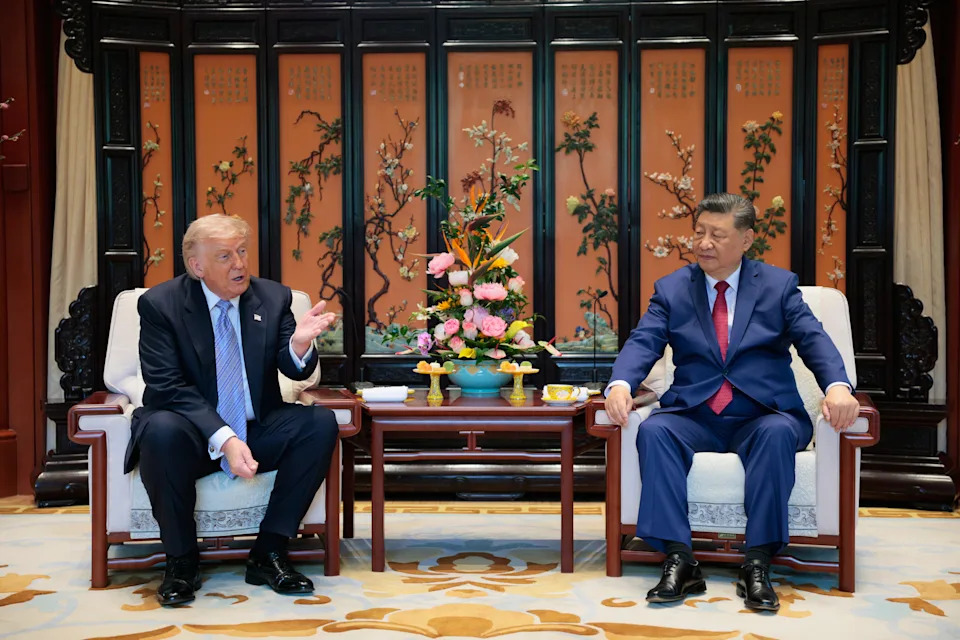
Trump and Xi feasted on Chinese delicacies in the Chun’ou Zhai building in Xi’s presidential Zhongnanhai compound Friday.

The name of the historic building translates to “Spring Lotus Roots” and the structure carries farm-related significance: Emperor Qianlong in the 18th century would go there to admire the ancient Chinese “Five Cattle” painting every year after the imperial sacrifice to the god of agriculture.

The two leaders on Thursday also visited the Temple of Heaven, another venue with deep agrarian symbolism

as the imperial site for rituals for agricultural prosperity.

Trump has been expected to announce business deals with China in areas such as agricultural purchases, beef exports and aviation but no concrete announcements have been made yet.

Taiwan Minister of Foreign Affairs Lin Chia-lung thanked the U.S. on Friday for the support expressed by Secretary of State Marco Rubio the previous day.

Lin thanked the U.S. for “its continued support and valuing of peace and stability in the Taiwan Strait.”

Rubio told NBC News on Thursday that U.S. policy toward Taiwan remains unchanged and it would be a “terrible mistake” for China to take Taiwan by force.

The U.S. is Taiwan’s biggest unofficial supporter and main supplier of arms for the island’s defense.

“As a responsible member of the international community, Taiwan will continue to strengthen its self-defense capabilities,” Lin said.

While folks outside their closed lunch chowed down on McDonalds, the menu for Trump and Xi was far more formal.

The two leaders had minced codfish in seafood soup, crispy and stir-fried lobster balls and pan-seared beef fillet stuffed with morel mushrooms, according to the White House.

They also ate kung pao chicken and scallops, braised seasonal greens, bamboo shoots, mushrooms and beans, as well as stewed beef in a bun and steamed pork and shrimp dumplings.

Dessert was chocolate brownies and fruits and ice cream. Coffee and tea also was served.

After lunch, Trump is not expected to make any more public appearances before heading to the airport to fly back to Washington.

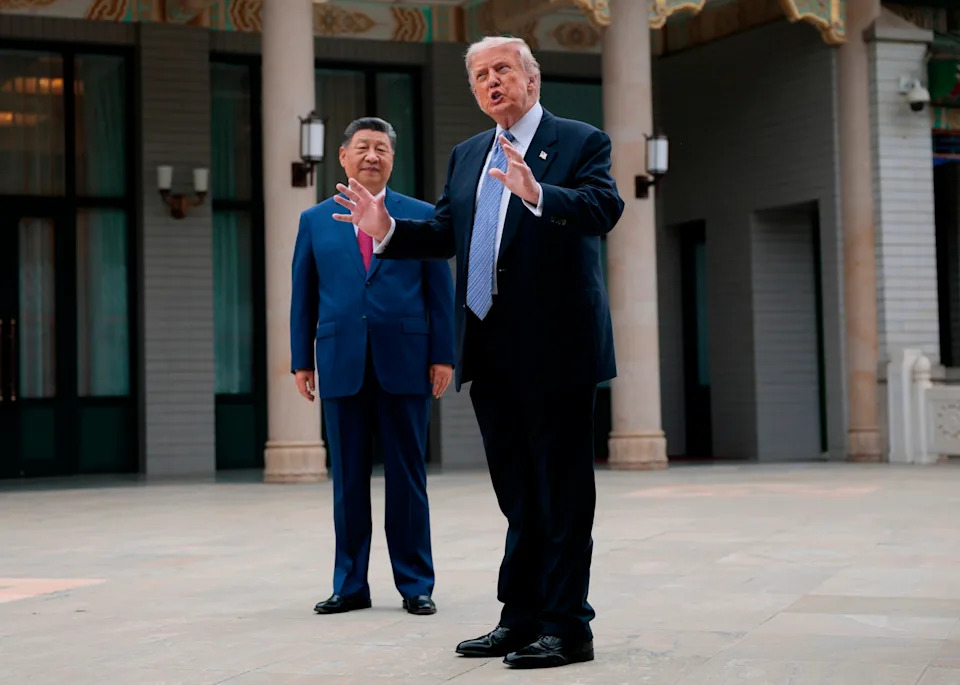
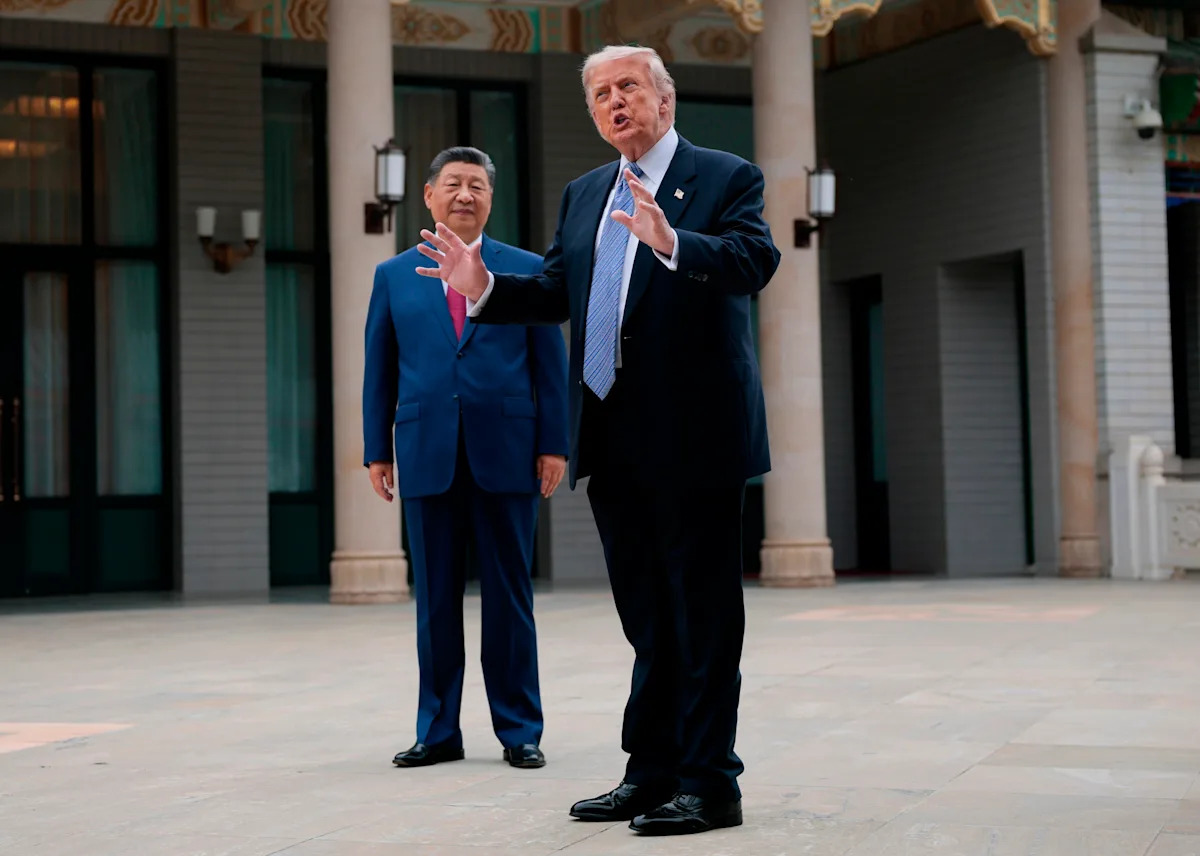
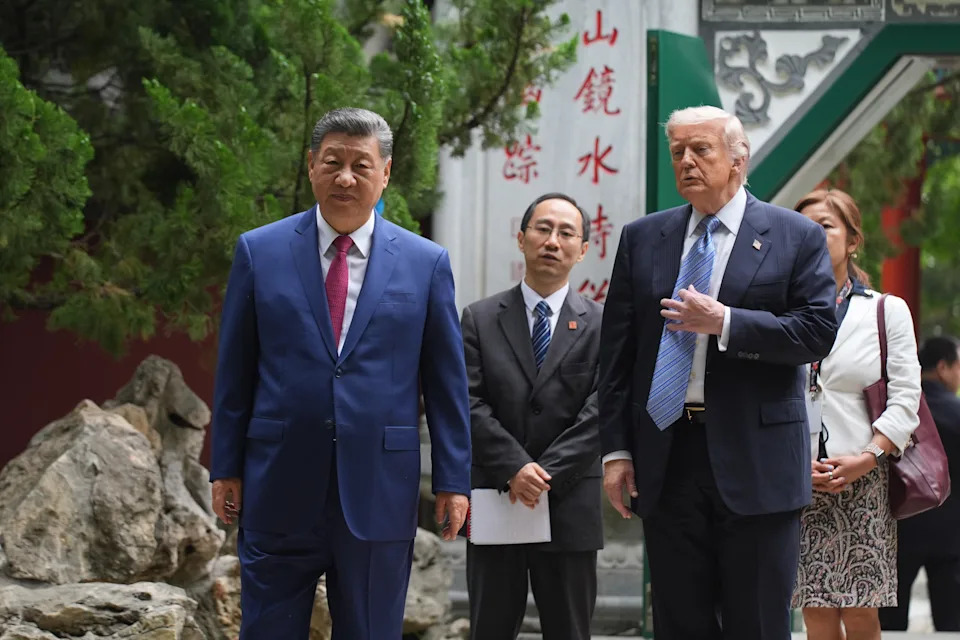
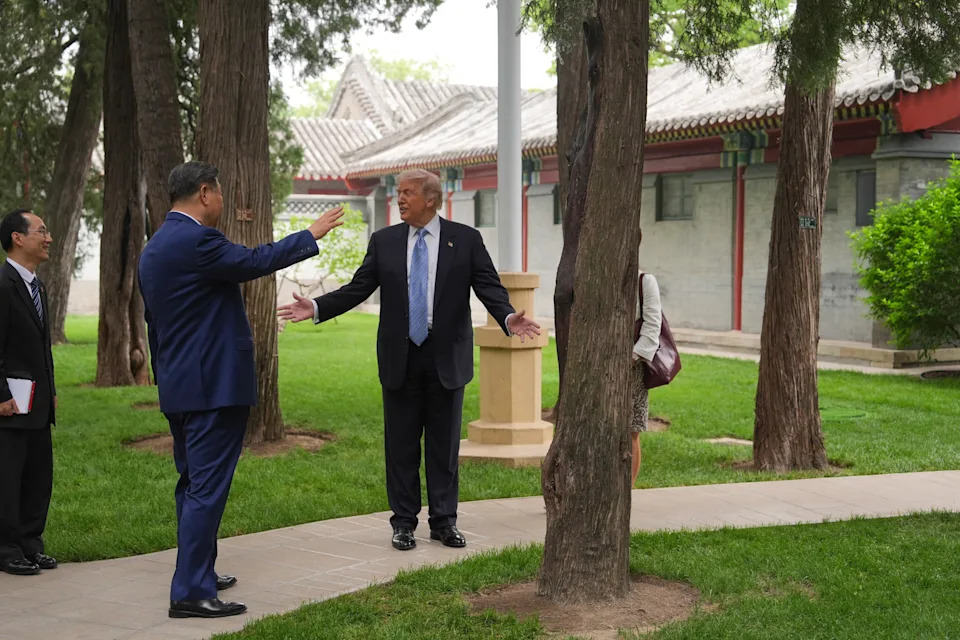
Before their closed-door lunch, Xi gave Trump a tour of Zhongnanhai, the former imperial gardens and now the seat of power.

“Zhongnanhai is where the CPC Central Committee and the State Council work, and it is also where I work and live,” Xi said. “After the founding of New China, Chinese leaders including Mao Zedong, Zhou Enlai and others all lived here.”

In the highly manicured garden, the two men walked with their interpreters as they admired the greenery.

“All these trees are 200 to 300 years old. There’s a big one that’s about 400 years old,” Xi said as he pointed out specific trees to Trump, who expressed his admiration.

“There’s even one that’s 1,000 years old. It’s somewhere else,” Xi said.

Xi said he invited Trump to the quarters in response to the hospitality Trump showed by inviting him to Mar-A-Lago in 2017.

As Trump ate lunch inside Xi’s residence, the folks outside chowed down on McDonald’s.

The fast-food restaurant with the golden arches is one of Trump’s favorites. His White House chief of staff, Susie Wiles, recently said he eats McDonald’s every day.

Trump did a stint working out of a McDonald’s drive-thru window during his 2024 reelection campaign and more recently had a McDonald’s order delivered to the door of the Oval Office during an event contrived to highlight the elimination of taxes on tips to service industry workers.

Outside Xi’s residence, U.S. Embassy and White House staff ate their McDonald’s lunches in the parking lot.

Bags of McDonald’s food also were delivered to members of the White House press pool as they waited in vans for Trump to depart for the airport and the long trip back to Washington.

The U.S. president did something highly unusual for him over days of meetings with Xi: he held his tongue in front of the media.

Trump relishes taking reporters’ questions, often doing so nearly every day back home.

But Xi, like most members of senior Chinese leadership, refrains from press conferences.

In what might have been deference to Xi, Trump didn’t answer questions when reporters asked them while the pair toured the Temple of Heaven on Thursday.

And he didn’t do so again on Friday while walking with Xi at Zhongnanhai.

Trump’s relative silence even extended to posting on his social media site, where he was not as active as usual during his three-day Beijing swing.

The White House so far hasn’t released details of any deals struck during Trump’s summit with Xi in Beijing.

Trump told Fox News about soybeans, airplanes and oil in an interview that followed his two-hour sit-down with Xi on Thursday.

Meeting with Xi again on Friday, Trump praised the visit as “incredible.”

He said “a lot of good has come of it,” including “some fantastic trade deals” that are “great for both countries.”

“We feel very similar about (how) we want it to end,” the president said of the U.S. and Israel’s war in Iran. “We don’t want them to have a nuclear weapon.”

Trump added of both sides and the Strait of Hormuz, which Iran has effectively closed, “We want the straits open.”

He said of the conflict in Iran, “We want them to get it ended because it’s a crazy thing there. A little bit crazy. And it’s no good, it can’t happen.”

Trump and China’s leader had a working tea before heading into a closed-door lunch.

Trump and Xi spent about 10 minutes walking Zhongnanhai’s gardens.

“These are the most beautiful roses anyone has ever seen,” Trump remarked while walking past green columns and archways.

Trump said the pair had struck “fantastic trade deals” without providing details.

Xi said he would send rose seeds to Trump.

Trump tore up the lawn around the White House Rose Garden last year to make room for a patio space reminiscent of his Mar-a-Lago club in Florida.

Trump also has said he would like more roses there, recently complaining that the White House’s garden “didn’t have too many roses.”

The White House shared the list of participants for the meetings.

Trump is joined by David Purdue, the U.S. ambassador to China; Secretary of State Marco Rubio; Treasury Secretary Scott Bessent; Defense Secretary Pete Hegseth and U.S. Trade Representative Jamieson Greer.

Xi is joined by Xie Feng, China’s ambassador to the United States; Cai Qi, a director of the Central Committee of the Communist Party of China; Foreign Affairs Minister Wang Yi; Deputy Foreign Affairs Minister Ma Zhaoxu and He Lifeng, vice premier of the State Council.

China reiterated a call to reopen the Strait of Hormuz in a bilateral meeting with the U.S. and called for a diplomatic solution to the Iran war.

“Now that the door for dialogue has been opened, then it shouldn’t be shut again,” China’s Ministry of Foreign Affairs said in a statement Friday, adding that the solution should “take into account the concerns of all parties on the Iran nuclear issue.”

“Shipping routes should be reopened as soon as possible,” the ministry said.

Trump has demanded a rollback of Iran’s nuclear program as a condition to end the war.

The ministry did not say if China would help negotiate an end to the war, as Trump told Sean Hannity of Fox News in an interview.

Instead, the ministry promoted a four-point peace proposal from Xi, which is light on specifics but mentions upholding national sovereignty and international law.