yahoo Press
The Memo: Trump’s frustration on Iran boils over in attacks against media
Images
1 / 7

2 / 7

3 / 7
4 / 7

5 / 7

6 / 7

7 / 7
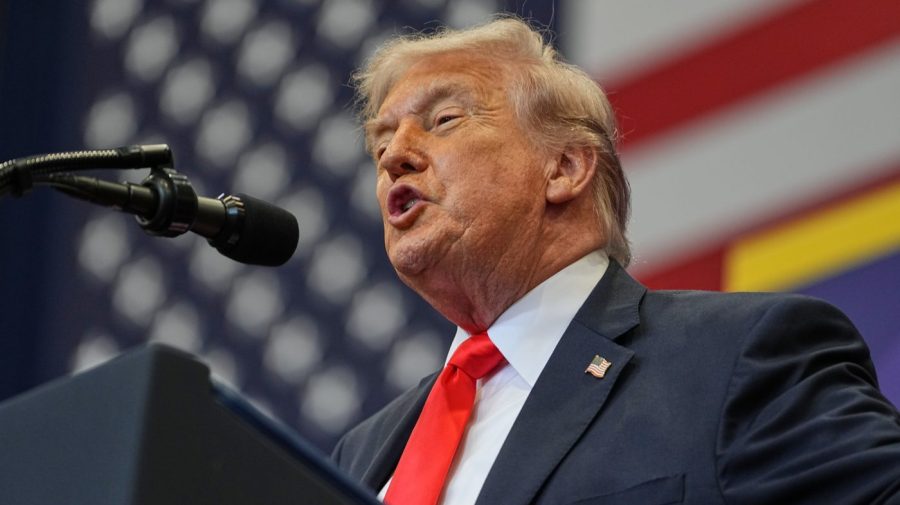
President Trump’s frustration with media coverage of the war on Iran boiled over Thursday when he alleged that reporting from The New York Times was “seditious” and called CNN “stupid” and “the enemy.”

Verbal fusillades against the media are commonplace for Trump, but the unusually intense Thursday attack seemed emblematic of his frustration with a conflict that is not going well.

The price of oil has shot up, propelling costs at the pump for Americans to new highs. The national average gas price on Friday, according to AAA, was $4.39, up more than 30 cents in the last week alone. Before the war, the average price was just below $3.

A poll released by The Washington Post on Friday indicated that 61 percent of Americans — including almost 1 in 5 Republicans — see the war in Iran as a “mistake.”

The cost of the war so far to American taxpayers is at least $25 billion, according to the Pentagon, and the short-term economic impact is multitudes higher.

Meanwhile, the leadership of the Islamic Republic, though battered by thousands of military strikes, remains defiant.

The media has reported on all this — to Trump’s clear displeasure.

“If you see CNN, you think they [Iran] are winning the war,” he complained in the Oval Office on Thursday. “If you read The New York Times, it’s actually seditious, in my opinion. You read The New York Times, you actually think they’re winning the war. I read some of these columnists, but it all starts with the top. It’s a terrible thing.”

In more hospitable precincts of the media, Trump insists that victory has already been achieved and that an even greater triumph is at hand.

In a phone interview Thursday afternoon on Newsmax, the president was asked by host Greta Van Susteren, “Haven’t you already won?”

“We’ve already won, but I want to win by a bigger margin,” Trump responded.

That’s clearly not how it is seen by others.

Trump’s insistence that regime change has already been achieved in Tehran is implausible given that the former supreme leader who was killed on the first day of the war, Ayatollah Ali Khamenei, has been succeeded by his son Mojtaba Khamenei, a close ally of the Islamic Revolutionary Guard Corps.

Iran still retains its stock of highly enriched uranium, even if further damage has been done to the nuclear sites that Trump had previously claimed were “obliterated” in air strikes last year.

Meanwhile, Iran’s most potent lever in the conflict has been its ability to force the de facto closure of the Strait of Hormuz — a transit channel, under normal circumstances, for around one-fifth of the world’s oil. Trump has retaliated by imposing an additional American blockade on vessels going to and from Iranian ports, but this has produced no breakthrough so far.

Trump has repeatedly lashed out against the media as things have gone awry.

On Air Force One in mid-March, he called an ABC News journalist a “very obnoxious person” for pressing him on the war, including why he was sending more troops to the region.

Within the past two weeks, he has gone further.

In an April 20 social media post he alleged that the “Anti-America Fake News Media” are “rooting for Iran to win.”

The following day, he called the author of a Wall Street Journal op-ed an “IDIOT” and a “MORON.” The op-ed in question was headlined, “The Iranians take Trump for a sucker.”

Thursday’s charge of sedition ratcheted the enmity up another notch.

But to many observers, it seems like the fundamental cause of Trump’s annoyance is events in Iran — and that this annoyance is then exacerbated by the media’s disinclination to put a favorable gloss on the conflict.

“It’s a frustration that he has with what is going on with Iran and how people have responded, not necessarily the coverage,” said Susan Del Percio, a GOP strategist who is often critical of Trump.

“He just wants the coverage he wants, not surprisingly. It’s his frustration that makes him lash out, and it’s very par for the course,” she added.

Tobe Berkovitz, a Boston University professor emeritus who specializes in political communications, said that part of the problem for Trump lies with his own super-confident predictions in the earliest days of the war — and the failure so far to make good on them.

“Trump made certain very aggressive statements about how long this was going to last, how we were going to win, what he was going to do — and most of those have not, at this point, been fulfilled,” Berkovitz said.

“So the goals he very aggressively communicated? The media looks at them and says, ‘Can we put a check-mark next to these?’ And the answer, for the moment is, ‘No, we can’t.’”

Trump’s position does have its defenders, however.

Some of them are within his own administration, as when Defense Secretary Pete Hegseth controversially compared reporters with the Pharisees of biblical times at a mid-April news conference.

Hegseth contended that some members of the media harbored a “politically motivated animus for President Trump [that] nearly completely blinds you from the brilliance of our American warriors.”

The Defense secretary’s critique drew pushback in part because it was taken by some to imply a comparison between Trump and Christ.

Even back in late March, however, New York Times columnist Bret Stephens penned a column headlined, “The war is going better than you think.”

Comparing progress in Iran against other past conflicts, Stephens argued, “If past generations could see how well this war has gone compared with the ones they were compelled to fight at a frightening cost, they would marvel at their posterity’s comparative good fortune.”

But even Berkovitz, who sometimes criticizes what he sees as liberal leanings in contemporary media, was skeptical that the war in Iran was being reported more harshly than conflicts of the past.

He cited, in particular, coverage of the Vietnam War roughly half a century ago, when the media coverage became very critical as the conflict ground on. This reached its apogee in a 1968 on-air commentary delivered by Walter Cronkite, the revered CBS News anchor, who lamented that the U.S. had become “mired in stalemate” in Vietnam.

Nonetheless, Barry Bennett, who served as a senior adviser to Trump’s first campaign in 2016, insisted that the president was being deprived of his just deserts here and now.

“There is no way you can objectively look at what has gone on Iran, militarily and economically, and not give President Trump credit for disarming the world’s largest supporter of terrorism — unless you are seriously left-of-center and you hate Trump so much that it clouds your judgment,” Bennett insisted.

So far, however, most American voters don’t agree — at least when it comes to the overall pros and cons of the war.

Unless that changes, Trump’s anger is likely to only burn hotter.

The Memo is a reported column by Niall Stanage.

Copyright 2026 Nexstar Media, Inc. All rights reserved. This material may not be published, broadcast, rewritten, or redistributed.

For the latest news, weather, sports, and streaming video, head to The Hill.