Press
Cash shortages grip Yemen despite currency stabilisation
Images
1 / 3

2 / 3

3 / 3
Cash-strapped Yemenis face rising frustration as exchange firms limit currency conversion amid ongoing liquidity crisis.

Save

Share

Mukalla, Yemen – The Yemeni government’s measures to curb the devaluation of the Yemeni riyal have finally borne fruit, but they have created another problem: A severe liquidity crunch.

The government’s central bank, based in the southern city of Aden, has shut down unauthorised exchange firms it says were involved in currency speculation, centralised internal remittances under a controlled system, and formed a committee to oversee imports and provide traders with hard currency.

These measures have helped curb the riyal’s freefall, from about 2,900 to the United States dollar months ago to about 1,500 today, a move that was initially welcomed. But the gains have been short-lived, as public frustration has grown over a worsening shortage of cash in riyals.

People across government-controlled cities such as Aden, Taiz, Mukalla and others have said they are facing an unprecedented shortage of Yemeni riyals in the market. Many, particularly those holding US dollars or Saudi riyals, said local banks and exchange firms are refusing to convert foreign currency, or are limiting daily exchanges to as little as 50 Saudi riyals per person, citing a shortage of local cash.

This has left many Yemenis unable to access cash or use their savings in hard currency at a time of mounting economic pressure, paralysing businesses and giving rise to a black market where traders exchange foreign currency at more unfavourable rates to the customer.

Mohammed Omer, who runs a small grocery shop in Mukalla, said he has spent hours crisscrossing the city’s exchange firms trying to convert a few hundred Saudi riyals he received from customers. “I’ve gone from one exchange to another, and they refuse to exchange more than 50 riyals,” said Omer, a man in his early 50s with a salt-and-pepper goatee. “It’s a waste of time and effort – I’ve had to close my shop.”

Yemen has endured an economic meltdown for more than a decade, stemming from a war between the Saudi-backed government and the Iran-aligned Houthis that has killed thousands and displaced millions.

Alongside the fighting on the battlefield, the warring sides have targeted each other’s main sources of revenue, leaving both the Houthis and the government strapped for cash, struggling to pay public-sector salaries and fund basic services in areas under their control.

At a board meeting in March, the Central Bank in Aden said it was aware of the cash shortage and had approved several unspecified “short- and long-term” measures to address the problem, noting that it is pursuing “conservative precautionary policies” to stabilise the riyal and curb inflationary pressures.

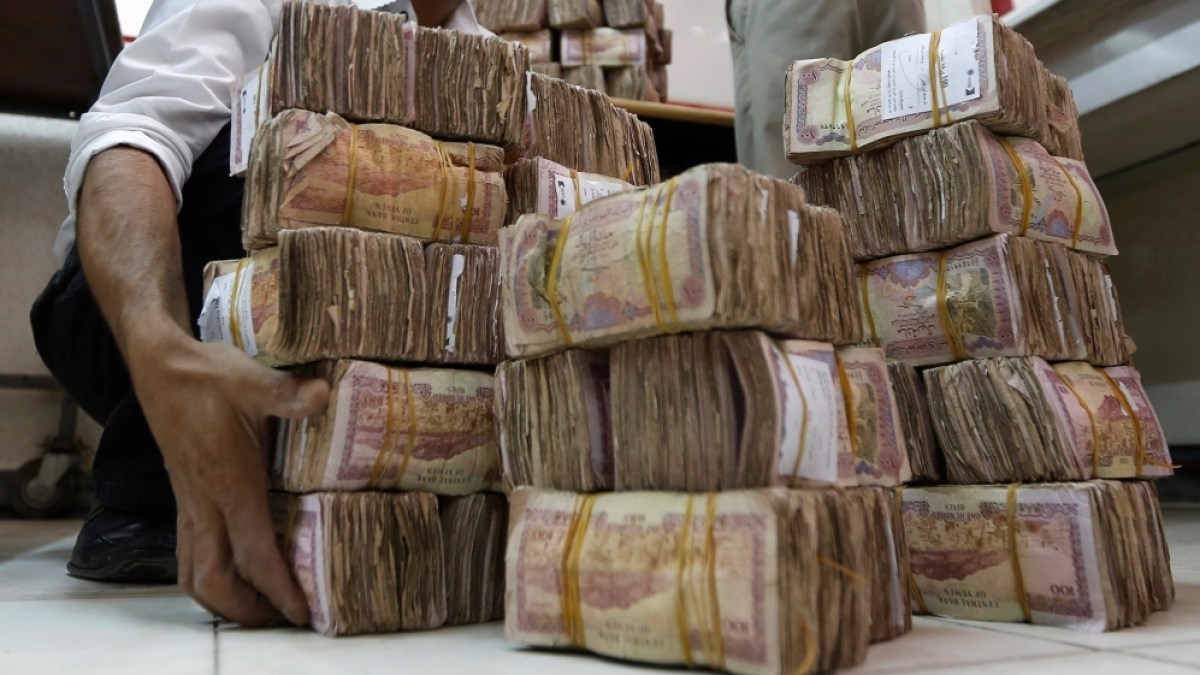
Government employees have also complained that the cash-strapped Yemeni government is paying salaries in low-denomination banknotes – mainly 100 riyals – forcing them to carry their wages in bags.

Munif Ali, a government employee in Lahj, took to Facebook to express his frustration, posting a video of himself sitting beside large, tightly packed bundles of 100- and 200-riyal notes that he said he received from the central bank. Munif, like many Yemenis on social media, said traders are refusing to accept large quantities of low-value notes. “Merchants are refusing to recognise this,” Munif said, referring to the stacks of 100- and 200-riyal notes in front of him. “Legal action should be taken against them.”

People who have kept their savings in Saudi riyals, the de facto currency in parts of Yemen, as well as Yemeni expatriates who send remittances in hard currency to their families, and soldiers paid in Saudi riyals, are among those most affected by the cash shortage.

To cope with cash shortages and the refusal of exchange firms to convert hard currency, Yemenis have adopted a range of workarounds. Some rely on trusted shopkeepers who allow delayed payments, while others exchange foreign currency at local groceries or supermarkets, often at lower, unfavourable rates. Banks and exchange firms have also introduced online money transfers, which have helped ease the crisis for some.

In rural areas, where internet access is limited and exchange shops are scarce, the problem is even more acute.

Saleh Omer, a resident of the Dawan district in Hadramout, told Al Jazeera that he received a remittance of 1,300 Saudi riyals sent from Saudi Arabia. But the exchange firm that handed him the money refused to convert it into Yemeni riyals, citing a lack of cash, and advised him to try nearby shops.

With the official exchange rate at about 410 riyals to the Saudi riyal, a shopkeeper agreed – after repeated appeals – to exchange only 500 riyals, and at a lower rate of 400. “I nearly begged the shopkeeper to exchange 500 riyals,” Saleh said. To convert the remaining 800 riyals, he added, he would have to return another day and go from one shop to another. “We are suffering greatly just to convert Saudi riyals into Yemeni riyals.”

Well-connected individuals are often better positioned than others to navigate the cash shortage, with some relying on personal contacts at banks and exchange firms to access cash. Khaled Omer, who runs a travel agency in Mukalla, said most of his business transactions are conducted in Saudi riyals or US dollars. But when he needs Yemeni riyals to pay employees or cover utilities, he turns to a trusted contact at a local exchange firm. “We work with a money exchange trader when we need riyals to pay salaries or meet basic expenses,” Khaled told Al Jazeera. “Exchange companies say they are facing a liquidity crunch.”

On social media, Yemenis say some patients have been denied medication as health facilities refuse to accept payment in Saudi riyals, while exchange firms decline to convert the currency into Yemeni riyals.

In Taiz, Hesham al-Samaan said a local hospital refused to accept Saudi riyals from a relative of a patient, forcing him to roam the city in search of someone to exchange the money to pay for treatment. “Is there any justice for the people, oh government? Will anyone hold accountable those who refuse to exchange currency and exploit people’s needs?” al-Samaan wrote in a Facebook post that drew dozens of comments from others reporting similar experiences, including being denied medical services because they did not have local currency.

For traders who import goods from Saudi Arabia, the cash crisis has become something of a blessing in disguise, as Saudi riyals are increasingly available at discounted rates. A clothing trader in Mukalla told Al Jazeera that he accepts payments in both Yemeni riyals and Saudi riyals, partly to attract customers and partly to secure the foreign currency he needs for his business. “As a businessman who sells goods in Yemeni riyals, I benefit from the cash shortage,” he said on condition of anonymity. “Exchange companies that need local currency I hold sell me Saudi riyals at lower rates.”