yahoo Press
Artemis II reentry: Will San Diego hear a sonic boom?
Images
1 / 9
2 / 9

3 / 9

4 / 9
5 / 9
6 / 9

7 / 9

8 / 9

9 / 9
SAN DIEGO (FOX 5/KUSI) — NASA’s Artemis II mission is expected to come to a close on Friday evening with the Orion spacecraft slated to splash down off San Diego’s coast.

Some are wondering: will a sonic boom be heard across the region when the spacecraft reenters the Earth’s atmosphere and barrels toward the West Coast?

The short answer: it’s possible — but far from guaranteed.

During reentry, the Orion spacecraft will propel back to its home planet at speeds approaching 25,000 miles per hour, according to NASA. That high-speed return, generating extreme heat and pressure, is what creates the potential for a sonic boom.

For those unfamiliar, a sonic boom is a loud, explosive sound caused when an object — such as an aircraft or other type of aerospace vehicle — travels faster than the speed of sound.

“Air reacts like a fluid to supersonic objects. As objects travel through the air, the air molecules are pushed aside with great force, and this forms a shock wave much like a boat creates a bow wave,” NASA explained. “The bigger and heavier the aircraft, the more air it displaces.”

Where to watch Artemis II crew’s return to Earth with kids in San Diego

As the Orion spacecraft tears through the atmosphere at hypersonic speeds, it will compress air in front of it, creating those shock waves. However, altitude determines the distance shock waves travel before reaching the ground — scientists say this has the most significant effect on the intensity of a sonic boom.

So, will San Diegans hear it? Well, it depends on several factors.

The first thing to consider is Orion’s flightpath and reentry location. Sonic booms are heard along what NASA described as a narrow “boom carpet” beneath the spacecraft’s trajectory. If Orion’s path lines up offshore, which it’s expected to do, the sound may stay over the ocean.

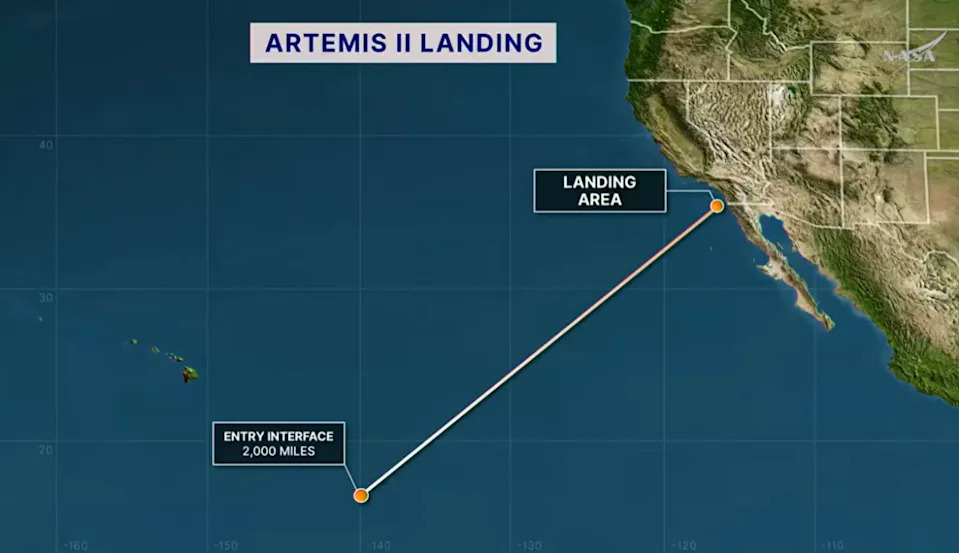
“During re-entry, the service module will separate about 20 minutes before Orion reaches the upper atmosphere southeast of Hawaii,” NASA officials explained.

This means the projected entry interface — the point where a spacecraft enters a planet’s atmosphere — will be located approximately 2,000 miles from the Pacific Ocean landing area, which is about 50 to 80 miles offshore from San Diego. This lessens the probability of hearing a sonic boom from land in Southern California.

Another factor to consider is altitude. Scientists say much of the loudest shockwaves form high in the atmosphere, which can reduce what’s heard on the ground.

Weather conditions are also a component, with NASA officials explaining, “The direction of travel and strength of shock waves are influenced by wind, speed and direction, and by air temperature and pressure.”

Put simply, temperature, wind and cloud layers can bend or weaken sound waves before they reach land.

Recent weather models show an 80% chance of favorable weather conditions for the tail end of the Artemis II mission, though NASA pointed to cloud coverage and potential for high winds on the ground as primary weather concerns, winds that could impact sonic boom levels.

The crew aboard the Orion spacecraft is expected to splash down near San Diego at 5:07 p.m. PST on Friday, April 10. Navy sailors on the USS John P. Murtha will be responsible for recovering both the Orion capsule and its crew in the open ocean.

On Thursday afternoon, officials with the U.S. Geological Survey (USGS) said a sonic boom could potentially be felt and heard throughout Southern California between 5 p.m. and 5:15 p.m. PST.

The USGS encourages anyone who thinks they might have heard or felt a sonic boom to fill out its “Did You Feel It” survey. This crowd sourcing tool typically collects eyewitness reports from people who feel earthquakes. It uses online responses to map shaking intensity, damage extent and human experience. In this special case, the USGS will map out sonic boom accounts.

While some coastal communities could hear a brief boom as NASA’s Artemis II mission to the moon reaches its end Friday, many residents across San Diego County may not hear anything at all. It will depend on precise timing, trajectory and atmospheric conditions.

Still, the event marks a rare moment: a spacecraft carrying astronauts returning from deep space, potentially announcing its arrival with a thunder-like crack over the Pacific Ocean.

Even if a sonic boom is not heard, the Artemis II return will remain a milestone in space exploration — and it’s all happening just off the coast of San Diego.

Copyright 2026 Nexstar Media, Inc. All rights reserved. This material may not be published, broadcast, rewritten, or redistributed.

For the latest news, weather, sports, and streaming video, head to FOX 5 San Diego & KUSI News.