yahoo Press
VIGI Lags the Broad Market but Delivers Quality International Dividend Growth
Images

1 / 5

2 / 5

3 / 5

4 / 5
5 / 5
Vanguard International Dividend Appreciation ETF (VIGI) holds 400 international companies with 7+ consecutive years of dividend growth while excluding top-yielding names to avoid payout cuts, delivering a 0.07% expense ratio and 102% returns over the past decade. Vanguard Total International Stock ETF (VXUS) returned 126% over the same period and currently leads VIGI by 20 percentage points over five years due to VIGI’s quality screen excluding growth and cyclical names.

VIGI’s dividend-growth screen provides downside protection but systematically underperforms broad international indices during risk-on periods when growth stocks and cyclicals lead, while currency exposure and highly variable quarterly distributions limit its utility as a standalone income strategy.

A recent study identified one single habit that doubled Americans’ retirement savings and moved retirement from dream, to reality. Read more here.

Most international ETFs hand you every stock in the world outside the U.S., including the dividend cutters, the yield traps, and the companies that have never grown a payout in their lives. Vanguard International Dividend Appreciation ETF (NYSEARCA:VIGI) takes a different approach: it only owns companies that have raised their dividend for at least seven consecutive years, then screens out the highest-yielding names to avoid those most likely to cut.

That dual filter is the whole thesis. Growth consistency signals financial discipline. Excluding the top-yielding quartile removes companies whose elevated payouts may reflect distress rather than strength. The result is roughly 400 international companies that have demonstrated growing cash flows across multiple economic cycles.

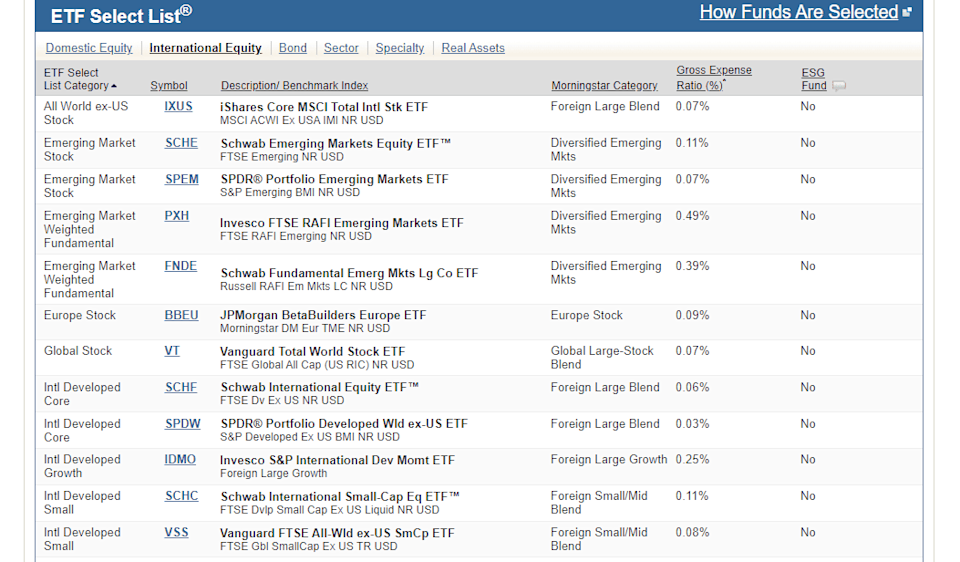
A table displays an ETF Select List focusing on international equity options with various fund details.

Read: Data Shows One Habit Doubles American’s Savings And Boosts Retirement

Most Americans drastically underestimate how much they need to retire and overestimate how prepared they are. But data shows that people with one habit have more than double the savings of those who don’t.

VIGI tracks the S&P Global Ex-U.S. Dividend Growers Index, a rules-based benchmark screening for dividend growth consistency rather than current yield. The fund launched in February 2016 and has grown to $9.6 billion in assets, reflecting sustained demand for quality-tilted international exposure.

The portfolio skews heavily toward developed markets. Top holdings include Swiss pharmaceutical giants Novartis at 5.19% and Roche at 4.81%, alongside Royal Bank of Canada at 4.49% and Mitsubishi UFJ Financial Group at 4.29%. Japan, Canada, Switzerland, and Western Europe dominate the geographic mix, with meaningful exposure to India through Reliance Industries. The top 10 holdings represent roughly 35% of the fund, keeping the strategy diversified but not diffuse.

The cost structure is hard to fault. At 0.07% annually, VIGI is among the cheapest international equity funds available. Portfolio turnover runs at just 14% per year, consistent with disciplined index tracking.

Income is modest by design. The current yield sits near 2%, and quarterly distributions vary meaningfully. The most recent payment was $0.565 per share, following a range across 2025 from $0.3627 to $0.5418. This is a total-return vehicle with a dividend-growth quality screen, not an income replacement strategy.

VIGI has delivered positive long-term returns. Over the past decade, the fund gained roughly 102% on a price-return basis. The Vanguard Total International Stock ETF (NYSEARCA:VXUS) returned nearly 126% over the same period.

The gap widens at shorter intervals. Over five years, VIGI gained about 20% while VXUS returned roughly 39%. Over the trailing one-year period, VIGI gained 4% against VXUS's nearly 22%. Year-to-date in 2026, VIGI is down about 6%, while VXUS is down less than 1%.


The consistent lag reflects the quality screen working as designed in an environment that rewarded growth stocks and cyclical exposure. The filter that protects on the downside also costs on the upside.

Capped upside relative to broad international: The dividend-growth screen systematically excludes parts of the international market. When cyclicals, emerging-market growth names, or high-yielding value stocks lead, VIGI will underperform a broad benchmark like VXUS. This is structural, not a temporary lag.

Currency risk without full insulation: VIGI holds positions across the Japanese yen, Swiss franc, Canadian dollar, euro, British pound, and Indian rupee. The fund uses currency forwards for management, but this does not eliminate the exposure. A strengthening U.S. dollar will compress returns regardless of how the underlying companies perform.

Income variability despite the dividend-growth mandate: The screening criterion is dividend growth at the company level, but VIGI's own distributions fluctuate based on timing and magnitude of international payouts. The December 2024 distribution was $0.2619, while the June 2025 payment was $0.5418. Investors building income plans around VIGI's quarterly check will find the variability difficult to budget around.

VIGI is structured as a quality-tilted complement within international allocations. Investors who pair it with broader international exposure get quality screening alongside wider market capture. Those who expect it to keep pace with the broader market during risk-on environments will find the quality filter works against them in those periods.

Most Americans drastically underestimate how much they need to retire and overestimate how prepared they are. But data shows that people with one habit have more than double the savings of those who don’t.

And no, it’s got nothing to do with increasing your income, savings, clipping coupons, or even cutting back on your lifestyle. It’s much more straightforward (and powerful) than any of that. Frankly, it’s shocking more people don’t adopt the habit given how easy it is.