yahoo Press
China’s auto market achieved steady growth in 2025
Images
1 / 5
2 / 5

3 / 5

4 / 5
5 / 5
2025 was a challenging year for global politics and the world economy. On one hand, regional conflicts erupted in multiple regions, posing challenges to global energy supplies and maritime supply chains. On the other hand, protectionism gained momentum, with tariff barriers proliferating worldwide, further straining the global economy. Although the "reciprocal tariffs" introduced by the US in April 2025 targeting global trading partners were ultimately struck down by the Supreme Court in early 2026 after multiple rounds of adjustments, they had already inflicted damage on the world economy. Moreover, the final decision of these reciprocal tariffs remains unresolved, continuing to cast uncertainty over the global economic outlook.

Additionally, countries including Russia, the EU, Canada, and Mexico raised tariffs on Chinese-made Electric Vehicles (EVs) in late 2024 and throughout 2025. Nonetheless, despite such complex and turbulent changes, China's automotive market still delivered a satisfactory performance in 2025, with production and sales volumes hitting record highs once again, securing China's position as the world's largest auto market for the 17th consecutive year.

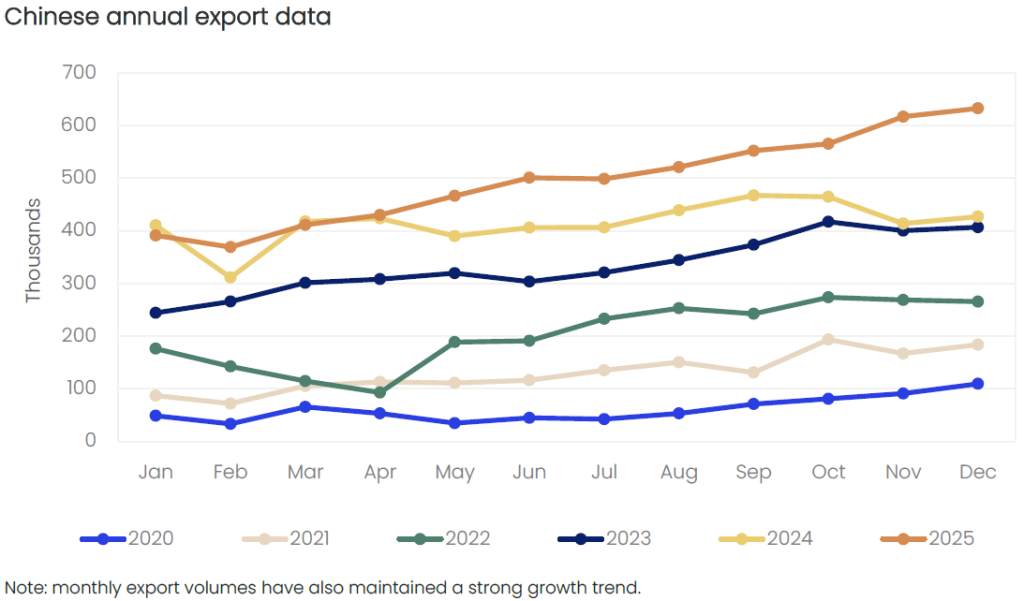
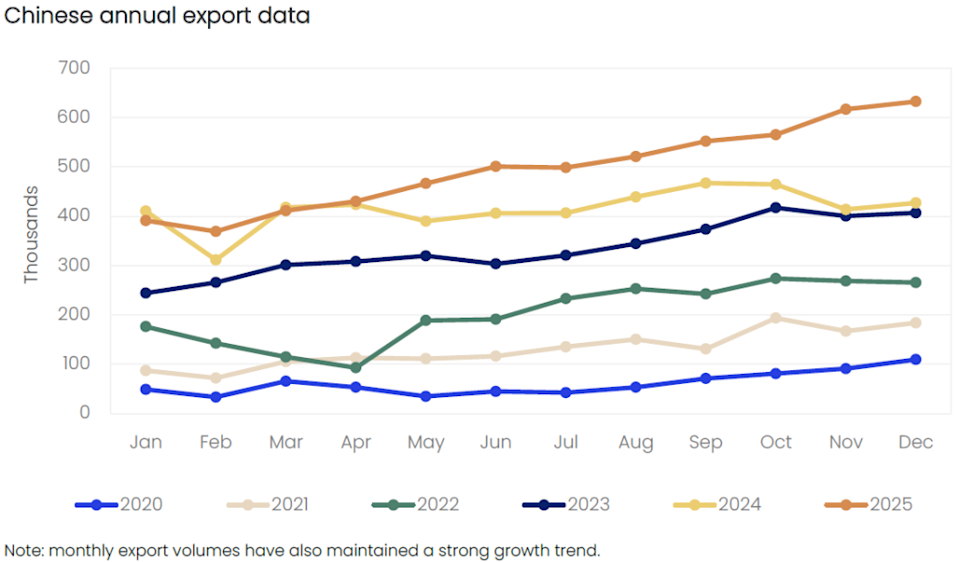
Annual domestic Light Vehicle (LV) sales exceeded 26.9 million units, up by 5.6% year-on-year (YoY), with Passenger Vehicle (PV) sales surpassing 24.3 million units (+5.6% YoY) and Light Commercial Vehicle (LCV) sales exceeding 2.6 million units (+6.1% YoY). On the export side, even in the face of tariff barriers, China’s LV shipments still exceeded 6.6 million units and achieved a YoY growth rate of 21%. Among them, PVs accounted for 6.0 million units with a 21.9% YoY increase, while LCVs totaled 660k units, marking a 15.5% YoY expansion.

Although the Chinese market achieved steady growth in 2025, the landscape has undergone tremendous changes, and the government is continuously refining relevant regulations and policy guidance to keep pace with the market's rapid development. Looking at full-year 2025, China’s automotive industry delivered solid progress in scale, structural optimization, technological innovation, and market standardization, signaling a shift into a new phase of high-quality development.

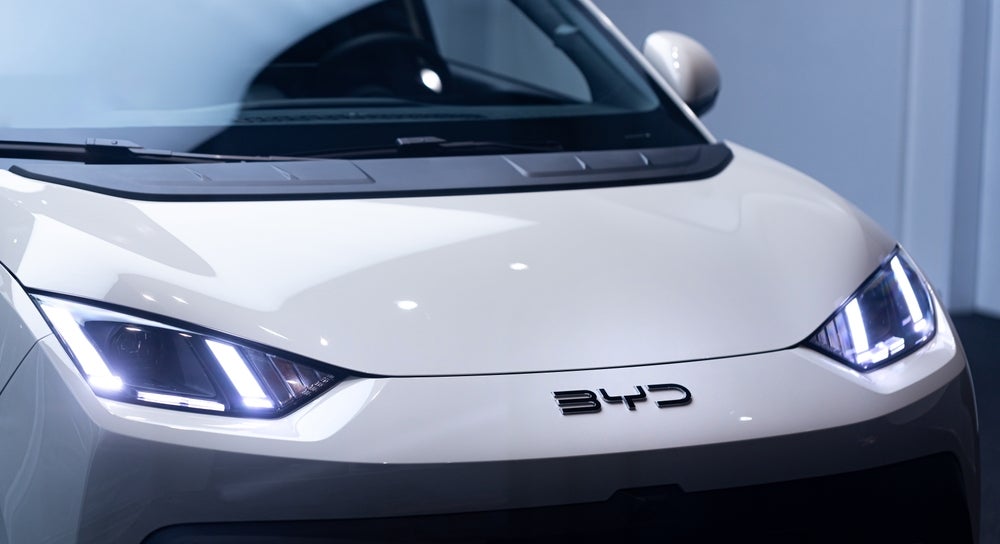
New Energy Vehicle (NEV) sales topped 13 million units, with a rise of 20% YoY, and became the main growth force. Many international brands are facing a continued downward trend, while domestic brands largely maintained robust growth throughout the year. However, government intervention on the price war—which started in Q3 2023—caused BYD Group to unexpectedly fall short of expectations. The automaker had delivered an impressive performance in 2024, but saw its volumes fall by 7.8% YoY in 2025, to 3.5 million units.

In addition, to address “involution-style” competition, regulators introduced a series of measures during the year, including steps to curb disorderly price wars, encourage automakers to honor payment-term commitments, run targeted campaigns to address online disorder, and the issuance of guidelines on price-compliance practices—all aimed at maintaining healthy competitive conditions. At the same time, the safety and regulatory framework continued to improve. The Ministry of Industry and Information Technology made the “no fire, no explosion” requirement for power batteries mandatory, standardized concealed door handles, and brought pure electric PVs under export licensing management. Oversight of used-car exports was also strengthened to support the industry’s sustainable development. With increasingly clear policy guidance and stricter regulations, it is believed that China's automotive industry will achieve more sustainable and healthier long-term development.

As the base of China's automotive market grows increasingly large, it is gradually entering an era of micro-growth. Moreover, the price war has been effectively contained by policy measures. With Tesla's Full Self-Driving (FSD) technology expected to be rolled out in 2026, the underlying logic of competition in the country’s auto industry will shift from “price gaming" to "value competition." Although a complete end to the price war remains unrealistic in the short term, the market will most likely enter a phase of technological competition and accelerated technological development in 2026. Meanwhile, with the support of policy subsidies, China's automotive market is still expected to achieve steady growth throughout the year.

Recent news regarding LV exports will also likely provide a boost. In March, Canada relaxed restrictions on imports of China-produced EVs, with an initial quota of 49k units covering Battery Electric Vehicles (BEVs), Hybrid Electric Vehicles (HEVs), and Plug-in Hybrid Electric Vehicles (PHEVs). During the first phase which takes place from March 1 to August 31, 2026, up to 24.5k import permits for China-produced EVs will be issued on a "first-come, first-served" basis, with approved vehicles subject to a 6.1% most-favored-nation tariff rate. The second phase quota period runs from September 1, 2026, to February 28, 2027, covering up to 24.5k vehicles plus any unused quota from the first phase, with plans to expand the quota to 70k units by 2030. Volkswagen Group has also reached an agreement with the EU to avoid the additional tariffs imposed by the bloc, while Canada has opened up new solutions for multiple other automakers to replace high tariff barriers. The successful negotiations between Volkswagen Group and the EU signal that more automakers will engage in similar talks with the bloc.

It is therefore evident that in 2026, China-produced vehicles are poised for further growth, and 2026 will mark the inaugural year for Chinese automobiles to formally enter the global market.

Kevin Zeng, Analyst, Light Vehicle Forecasting, GlobalData

"China’s auto market achieved steady growth in 2025" was originally created and published by Just Auto, a GlobalData owned brand.


The information on this site has been included in good faith for general informational purposes only. It is not intended to amount to advice on which you should rely, and we give no representation, warranty or guarantee, whether express or implied as to its accuracy or completeness. You must obtain professional or specialist advice before taking, or refraining from, any action on the basis of the content on our site.