yahoo Press
Australia and EU seal trade deal, seek to cut reliance on China for critical minerals
Images
1 / 4
2 / 4

3 / 4

4 / 4
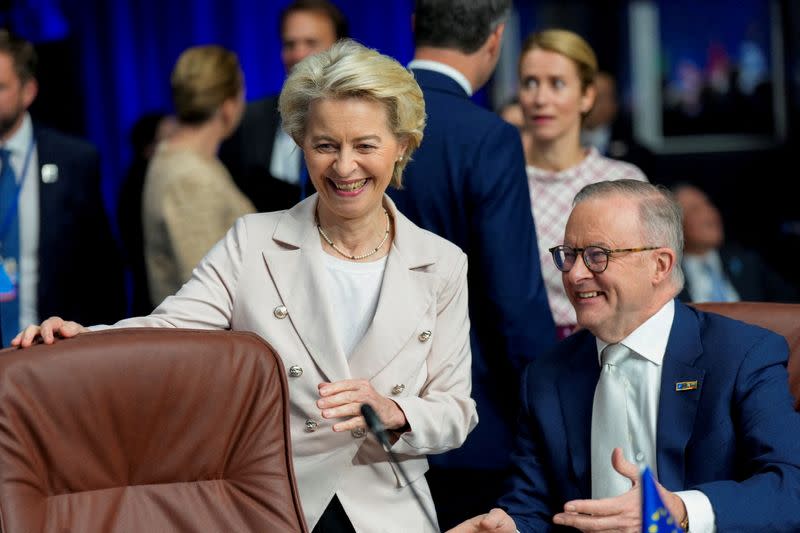
By Renju Jose SYDNEY, March 24 (Reuters) - Australia and the European Union signed a free trade agreement on Tuesday after eight years of negotiations, removing tariffs on almost all goods and potentially easing EU access to Australian critical minerals. However, some Australian agricultural exports, including beef and sheep meat, will face quotas. Australian farmers criticised the pact for offering what they called "subpar" access to the bloc, while French farmers argued the quotas were too generous. The deal follows intensified talks amid sharply higher U.S. tariffs under the Trump administration and growing Western concerns over China's dominant position in rare earths and other critical minerals. The two sides also signed an agreement to deepen security and defence cooperation. "The EU and Australia may be geographically far apart but we couldn't be closer in terms of how we see the world," European Commission President Ursula von der Leyen said in a statement. "With these dynamic new partnerships on security and defence, as well as trade, we are moving even closer together." The agreement will remove more than 99% of tariffs on EU goods exports to Australia, saving companies 1 billion euros ($1.2 billion) a year. EU exports to Australia are expected to grow by up to 33% over the next decade. Australian Prime Minister Anthony Albanese said the deal would be worth about A$10 billion ($7 billion) annually to the Australian economy. He said scrapping almost all import tariffs on Australian critical minerals entering the EU would help stabilise global supply chains. "For both Europe and Australia, getting China right is a strategic imperative, and this is why bringing to life our critical minerals partnership will be crucial to our success," von der Leyen told Australia's parliament. "We cannot be over-dependent on any supplier for such crucial ingredients, and that is precisely why we need each other." The agreement also underscores Europe's growing engagement in the Indo-Pacific, following trade accords concluded with Indonesia in September and India in January. EU industry groups including BusinessEurope, SpiritsEurope and the European Services Forum welcomed the deal. "Australia's resources potential is still far from being fully tapped by us," said Volker Treier, head of foreign trade at the German Chamber of Industry and Commerce. AUSTRALIA AGREES TO BEEF QUOTAS Australian tariffs will drop to zero from day one for European wine, sparkling wine, fruit, vegetables and chocolates, and over three years for cheeses. The EU will remove tariffs for many agricultural products but will maintain quotas for some key exports. For beef - a major sticking point that derailed talks in 2023 - the EU will open two tariff-rate quotas totalling 30,600 metric tons, with about 55% of that volume entering duty-free. French farmers, who have protested against increased beef imports expected under the EU-Mercosur deal, voiced concern. France's National Bovine Federation said von der Leyen was continuing to undermine the beef industry. Hamish McIntyre, president of the National Farmers Federation in Australia, said Australian farmers were "extremely disappointed that negotiations for a free trade deal with the European Union have concluded without commercially meaningful agricultural market access gains since Australia last walked away from negotiations." Under the deal, some EU geographical indication names such as Pecorino Romano or Ouzo will be fully protected after a short phasing-out period. Some producers of goods like feta, however, may continue using the name if the product's origin is clearly labelled. Australia also agreed to raise the luxury car tax threshold for EU-made electric vehicles to A$120,000 ($83,600), exempting about 75% of EVs from the bloc from the tax. EU firms exported 37 billion euros of goods to Australia in 2025 and 28 billion euros of services in 2023. The EU was Australia's third-largest two-way trading partner in 2024 and its sixth-largest export destination, while also being its second-largest source of foreign investment. ($1 = 0.8611 euros) ($1 = 1.4318 Australian dollars) (Reporting by Renju Jose in Sydney, Philip Blenkinsop in Brussels, Sybille de la Hamaide in Paris Maria Martinez in Berlin. Editing by Edwina Gibbs and Mark Potter)