yahoo Press
Your standard rifle can now be an anti-drone weapon. Seriously.
Images

1 / 17

2 / 17

3 / 17

4 / 17

5 / 17

6 / 17

7 / 17
8 / 17
9 / 17

10 / 17
11 / 17
12 / 17

13 / 17
14 / 17

15 / 17

16 / 17

17 / 17
For most of the last century, if something hostile was flying at your face, options boiled down to this: hope somebody around has a big gun. A Stinger team. A Patriot battery. An F-16 somewhere overhead doing F-16 things. The grunt on the ground pointed their tiny weapon up, got that potential threat in their sights, and proudly said out loud, “pew, pew.”Also Read: The grunt’s 250-year quest for a weapon that actually worksDrones have officially broken that arrangement. Cheap, fast, expendable unmanned aircraft flooding battlefields from Ukraine to the Middle East don’t care about your air defense umbrella. A $500 FPV (First-Person View) quadcopter rigged with a grenade doesn’t need to beat a Patriot missile. It just needs to find the one soldier who isn’t covered by one.But here’s the thing nobody’s really talking about yet, at least not enough: the counter-drone fight has gotten personal, as in, strapped-to-your-rifle, loaded-in-your-magazine personal.Anti-drone weaponry coming online right now are designed so that any soldier, with minimal training and zero extra nonsense, can look up… then shoot back.And some of them already are.

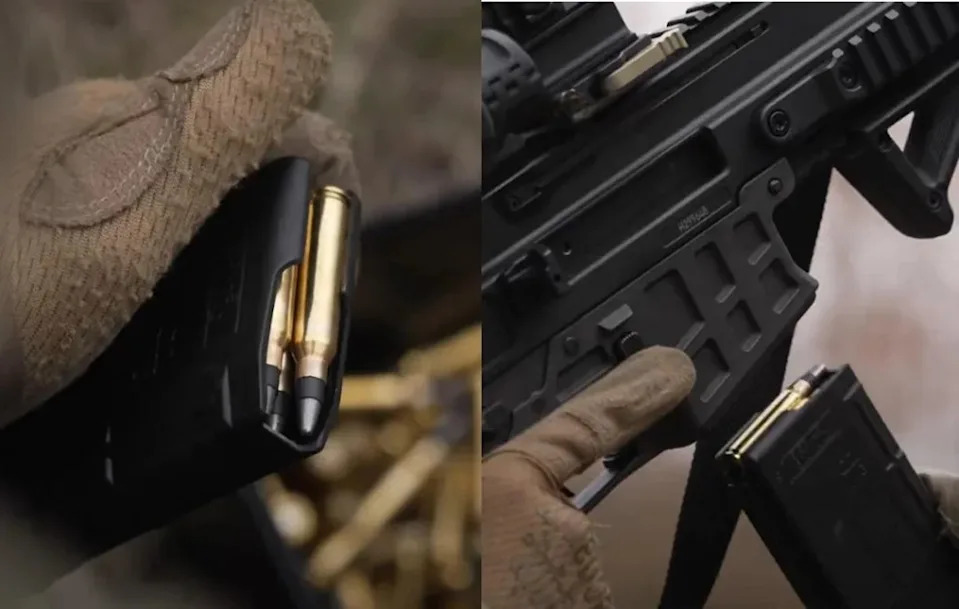
Ukraine, as it tends to do these days, got there first out of pure survival instinct and testicular fortitude.In mid-2025, Ukraine’s Brave1 defense innovation cluster rolled out a 5.56mm NATO round nicknamed “Horoshok”, Ukrainian for “little pea.” It looks like standard ammunition, fits in a standard magazine, and fires from any NATO 5.56 rifle a Ukrainian soldier already carries, including the M4 and CZ Bren.No new optics required. No extra battery needed. No added ounces to a kit that already weighs more than most people bench press.The difference is what happens after it leaves the barrel. The projectile fragments into roughly five smaller projectiles, creating a shotgun-style spread at rifle velocity, over 800 meters per second, nearly double what a smoothbore shotgun round delivers.One Ukrainian journalist and combatant wrote that he’d personally downed multiple FPV drones with Horoshok rounds after failing to hit maneuvering drones with conventional 5.56. That’s the kind of product review money can’t buy.

By December 2025, Ukraine’s Ministry of Defence announced plans to scale production to 400,000 rounds per month, with the stated goal of putting at least one anti-drone magazine in the hands of every frontline soldier.

That’s the beauty of it all. A soldier hears a drone, swaps a magazine, and engages. You could even designate soldiers as you would with  M240 teams. No new platform. No new training pipeline. No new thing to charge overnight, and pray still has juice in the morning. Just simple, old ammo.

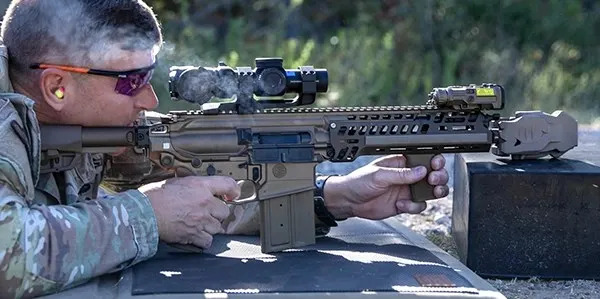
Ammunition is only half the battle. The other half is actually hitting a small, fast, Madden-esque target, juking you out of your boots, while your heart rate is higher than your credit score.Don’t worry about it; SMASH fire control system, built by Israeli company Smart Shooter, has your six.It mounts on the ubiquitous  Picatinny rail, weighs about a pound and a half, and runs for roughly 70 hours on a charge. Behind the casing is an AI-driven computer running target acquisition software. It’s officially the future, y’all.SMASH tracks drones like a hungry Hawk, then only allows the rifle to fire once a hit has been forecasted. The soldier pulls the trigger; the computer decides when the bullet leaves the weapon.In May 2024, the U.S. Army awarded Smart Shooter a $13 million contract to push the SMASH 2000L into frontline units under the Transformation In Contact program, which is the Army’s way of saying “skip the paperwork, get this in soldiers’ hands now.”The 82nd Airborne and 1st Cavalry Division have already received SMASH systems alongside other handheld counter-drone gear.

Giving individual soldiers better tools is one thing. Giving a squad an integrated defensive bubble is another.That’s exactly what Project Flytrap set out to build. A joint U.S.-UK counter-drone exercise running through Germany and Poland in the summer of 2025, Flytrap combined wearable RF (radio frequency) detectors, a system called “Wingman” that scans for drone signals in real time, with body-worn “Pitbull” jammers, the compact EchoShield radar capable of tracking nano-drones out to 30 kilometers, SMASH optics on rifles, and 12-gauge SkyNet shotgun shells that deploy a five-foot capture net to tangle a drone’s propellers.Layered all together, and you get something close to what every grunt actually needs: 360-degree awareness around a squad, with multiple ways to kill or disable whatever shows up. Detect it with Wingman. Jam it with Pitbull. If it keeps coming, shoot it with SMASH or snag it with a net round. Boom.

Here’s where things start sounding like science fiction. They’re not.Directed energy has moved out of the lab and onto the battlefield faster than most people realize. The driver is those sweet sweet benjamins. A Patriot interceptor costs somewhere around $4 million per shot. Israel’s Iron Beam laser system, which saw its first confirmed combat intercepts during operations in early 2026, costs roughly $2 per shot. That’s not a typo.The interesting part for the individual soldier is what’s happening at the small end of the power scale. The Nuburu Lyocon is a rifle-mounted laser dazzler that uses multiple light wavelengths, green, blue, and infrared, to blind a drone’s cameras and sensors. It doesn’t melt the airframe.Basically, imagine Terminators were deployed by an unpredictable man, then the scary robots were looking for your family, forcing you to toil away in the Tesla mines if captured; all you’d have to do is point your rifle at them and shoot your laser light into their stupid robot eyes.Did we mention it mounts on good ol’ Picatinny rails again? As of March 2026, prototype trials are underway. Also, anything that has robot legs is dumb.For anyone wondering whether a soldier could accidentally or recreationally blind a buddy with one of these things, the short answer is that modern laser dazzlers are specifically engineered not to cause permanent eye damage in humans.France has gone further with the CILAS HELMA-LP, a laser rifle, based on the AR-15 platform, paired with a backpack power unit that weighs about 33 pounds (15 kilograms) in total. French special operations units have experimented with it.Effective against static or slow-moving targets out to around 500 meters, though holding the beam on a fast-maneuvering drone long enough to lock on remains a very real issue. Think of it more as a problem made for a sniper than a rifleman.

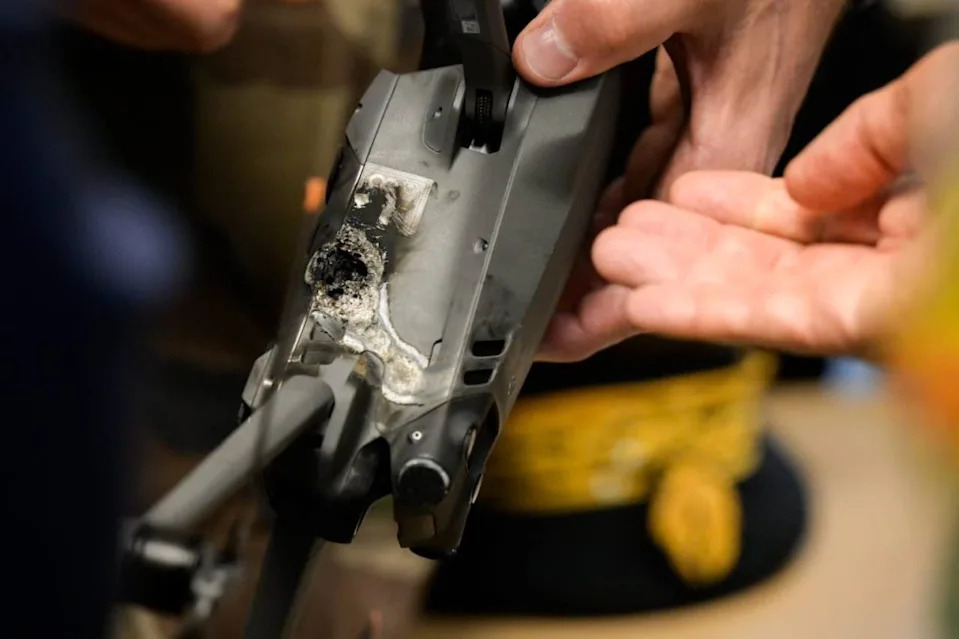
Of course, this is where Ukraine comes through again. Recently, they introduced us to Sunray, a portable laser system compact enough to fit in the trunk of a sedan or on the bed of a pickup truck. During field tests, it tracked and burned through a small drone’s airframe within seconds, causing the drone to fail in midair.Observers described the engagement as “invisible lightning”, no sound, no muzzle flash, no visible beam.Brave1 also backed the SlimBeam, a 1.5-kilowatt laser turret weighing 50 kilograms that can hard-kill a drone at 800 meters or blind its optics at two kilometers. A two-person team can deploy it. Thirty minutes of battery-powered operation, potentially being utilized on the frontlines today.

All this is enough to make one wonder what someone who has actually humped a ruck up a mountain would say about the new equipment.“I love the idea, but unless it weighs as much as a flashlight and takes AA batteries, I don’t know how much more crap you can pile on the individual fighters,” exclaimed GWOT veteran Spc. Stewart Deroo, 10th Mountain Division.Stately, and he’s not wrong. Every new capability strapped onto a soldier is another pound on a frame already carrying 80 to 120 of them. The best technology in the world is worthless if the person carrying it is too smoked to employ it.That’s exactly why the most promising systems in this space are the ones that add almost nothing. Horoshok rounds weigh what ammunition already weighs. The SMASH optic replaces an existing sight and runs for days on a single charge.The Pitbull jammer weighs under three pounds and clips to a plate carrier. The engineers, whether they’re in Kyiv or Tel Aviv or Picatinny Arsenal, seem to have gotten the message: if it doesn’t fit in a kit that’s already too heavy, it doesn’t fit.Ready or not, the era of drone warfare has been here for a few years now. It is not going away. However, the idea that there’s nothing between you and a $500 quadcopter with a grenade? That part’s already outdated.Until the next drop, stand easy.

• The M72 LAW: the tube that toughened the infantry• The Mk-19 grenade launcher and how it helped shape the War on Terror• Why traditional jungle warfare training needs an upgrade for 2026

Weapons

By Adam Gramegna

Weapons

By Miguel Ortiz

Firearms

By Miguel Ortiz

Vietnam War

By Blake Stilwell

Weapons

By Blake Stilwell