yahoo Press
President Petro is Killing Colombia’s Oil Industry
Images
1 / 6
2 / 6

3 / 6

4 / 6
5 / 6

6 / 6
Colombia’s economically vital oil industry is caught in a death spiral. Production recently collapsed to multi-year lows as foreign energy investment dries up. Once South America’s third-largest oil producer, Colombia slipped to fifth place after being overtaken by Argentina and Guyana. The reforms implemented by Colombia’s first leftist President, Gustavo Petro, including tax hikes, a ban on hydraulic fracturing, and the cessation of issuing exploration contracts, are deterring foreign investors. This is sharply impacting the economy and government finances at a crucial time, with a fiscal crisis looming.

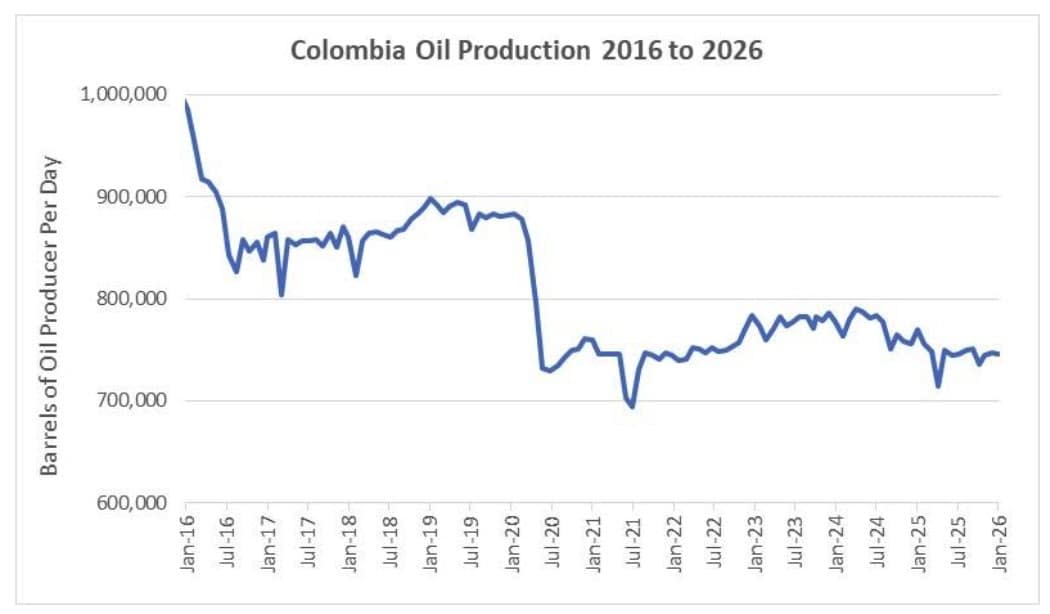
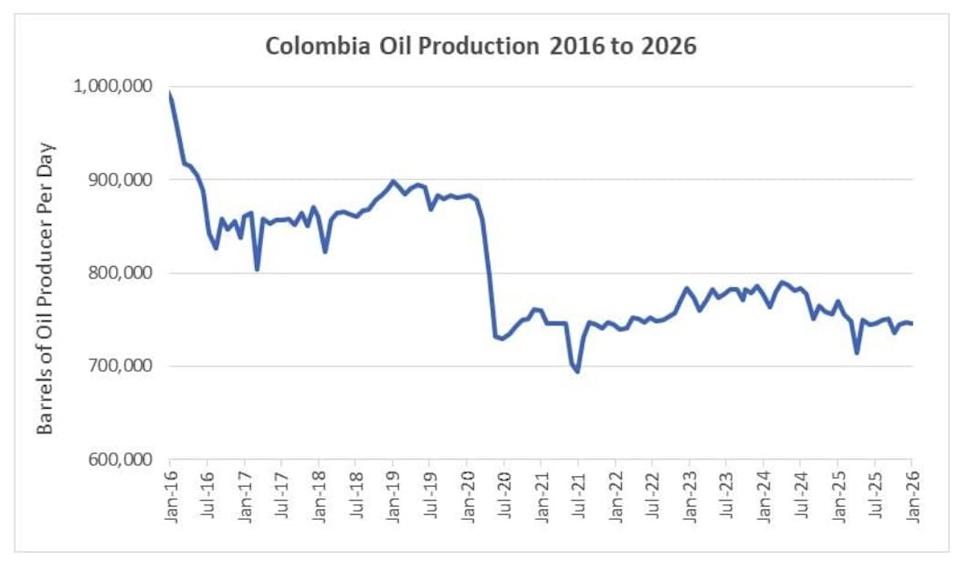
Upon taking office in August 2022, Petro instituted a series of regulatory amendments aimed at increasing tax revenue and weaning Colombia off its dependence on fossil fuels. Among these measures were tax hikes for extractive industries, the implementation of a scaled levy on oil sales, which starts when the Brent price hits $67.30 per barrel, and ending oil exploration. Those reforms, along with rising rural violence, because of soaring cocaine production, are deterring foreign energy investment. Since Petro took office, Colombia’s oil production has plunged to multi-year lows not seen since the 2020 COVID pandemic.

In January 2026, data from Colombia's hydrocarbons regulator, the National Hydrocarbons Agency (ANH), show that the country lifted an average of 746,444 barrels per day. While this was flat month over month, it was 3% lower compared to the same period a year earlier. This also represents a sharp decline from a decade earlier, when Colombia pumped 985,671 barrels per day in January 2016.

Source: Colombia National Hydrocarbons Agency (ANH).

Natural gas production is also in freefall. Colombia only pumped 683 million cubic feet of natural gas per day for January 2026.

Source: Colombia National Hydrocarbons Agency (ANH).

Not only is this 1.4% lower month over month it represents a stunning 16.7% decline compared to the same period a year earlier. That number is significantly lower than the 1.05 billion cubic feet lifted a decade earlier during January 2016. This marked drop in commercial natural gas output is particularly telling because something like 70% of the fossil fuel produced in Colombia is a byproduct of lifting petroleum.

Related: This Ohio Factory is Trump’s Secret Weapon in the Rare Earth War

The primary reason for such a sharp decline in hydrocarbon output is a lack of new discoveries, along with rapidly rising decline rates for Colombia’s mature oil and gas fields. There has not been a world-class oil discovery in the Andean country since the 1990s. According to data from the industry regulator, the ANH, there was only one oil discovery in Colombia since 2010 that has exceeded 200 million barrels. Over that period, most discoveries contained less than 50 million barrels, with only four exceeding 100 million barrels.

As a result of Petro’s reforms, several foreign oil companies significantly dialed down spending in Colombia, with some shuttering operations or even exiting the country altogether. This is because the president’s regulatory reforms, including multiple tax hikes, are creating considerable uncertainty for drillers, with the profitability of oil operations in Colombia under threat. Increasingly, strained government finances point to additional tax increases for extractive industries, further undermining the profitability of the oil patch.

The situation is so severe Petro suspended Colombia’s fiscal rule, a 2011 measure introduced to promote sustainable government spending. Attempts to bolster fiscal revenue failed, resulting in the 2025 deficit ballooning to 7.5% of GDP, the second-worst in Colombia’s modern history. Economists expect the deficit to continue rising, with it estimated to reach a record 8.1% of GDP in 2026. Falling fiscal income, coupled with increased spending, primarily on security in the wake of rising rural violence and cocaine trafficking, is responsible for the deficit blowing out.

Petro, who is constitutionally barred from running for re-election, is engaging in what analysts describe as reckless spending. He is doing this to boost the electoral fortunes of his chosen successor, Ivan Cepdeda, in the 2026 presidential vote. This includes reinstating a costly fuel subsidy, which Petro gradually phased out from late 2022, with domestic gasoline prices reaching parity with international prices by early 2024. This burdensome expense left the government with a projected debt of $8.8 billion with local oil companies, placing considerable pressure on Bogota’s finances.

The growing pressure on Colombia’s oil industry is creating a vicious cycle where weaker production causes fiscal income to fall further because of significantly lower oil rents. This becomes evidence with the oil industry’s contribution to the broader economy and government revenue declining since Petro took office. By the fourth quarter of 2025, data from Colombia’s statistical agency DANE showed the energy patch was responsible for just over 2% of GDP compared to nearly 4% a decade earlier. Fiscal income earned by oil fell from 11% in 2019 to 7% for 2025, placing additional financial pressure on a cash-strapped Bogota.

Related: The Invisible Metals Powering a Trillion-Dollar Economy

As a result, it is unlikely that higher oil prices will deliver any tangible benefit for Colombia’s economy. Even the sharp uptick in prices sparked by U.S. and Israeli strikes on Iran, which sees the international Brent benchmark trading at $101 per barrel, will fail to deliver any meaningful benefit. Whereas a decade ago, such a rally would have injected considerable additional income into Colombia’s economy and government coffers. There is the very real risk that higher oil prices will see foreign energy companies redirect investment to more profitable and business friendly South America countries.

This is what is occurring with Guyana, which is experiencing a massive oil boom that saw it emerge as one of the world's wealthiest countries on GDP per capita. Exxon exited Colombia because of higher taxes and Petro’s licensing reforms, including a ban on hydraulic fracturing. Instead, the energy supermajor chose to focus on offshore Guyana, notably the Stabroek Block, where it is the operator and controls 40%, with 35% held by Chrevon and the remaining 25% by CNOOC. Exxon has secured extremely favorable terms for that acreage, making it highly profitable to operate.

Those developments underscore the growing unpopularity of investing in Colombia’s oil industry because of Petro’s reforms and the considerable uncertainty they have created. This will continue weighing on Colombia’s hydrocarbon output and government revenue earned from the sector. It also increases the risk of a natural gas shortage, which will weigh on the economy and even challenge the stability of Colombia’s electricity grid. If those events transpire, it will add further fuel to an emerging fiscal crisis unless spending is reined in and additional sources of revenue are tapped.

By Matthew Smith for Oilprice.com

More Top Reads From Oilprice.com

Zombie Tankers Appear in Hormuz as War Fuels Traffic Chaos

High Oil Prices Could Force Fed To Raise Rates

LNG Exports Plunge to 6-Month Low as War Throttles Supply

Oilprice Intelligence brings you the signals before they become front-page news. This is the same expert analysis read by veteran traders and political advisors. Get it free, twice a week, and you'll always know why the market is moving before everyone else.

You get the geopolitical intelligence, the hidden inventory data, and the market whispers that move billions - and we'll send you $389 in premium energy intelligence, on us, just for subscribing. Join 400,000+ readers today. Get access immediately by clicking here.