yahoo Press
Microchip Technology vs. TE Connectivity: Two Mature Chip Plays, One Better Buy
Images
1 / 4
2 / 4

3 / 4

4 / 4
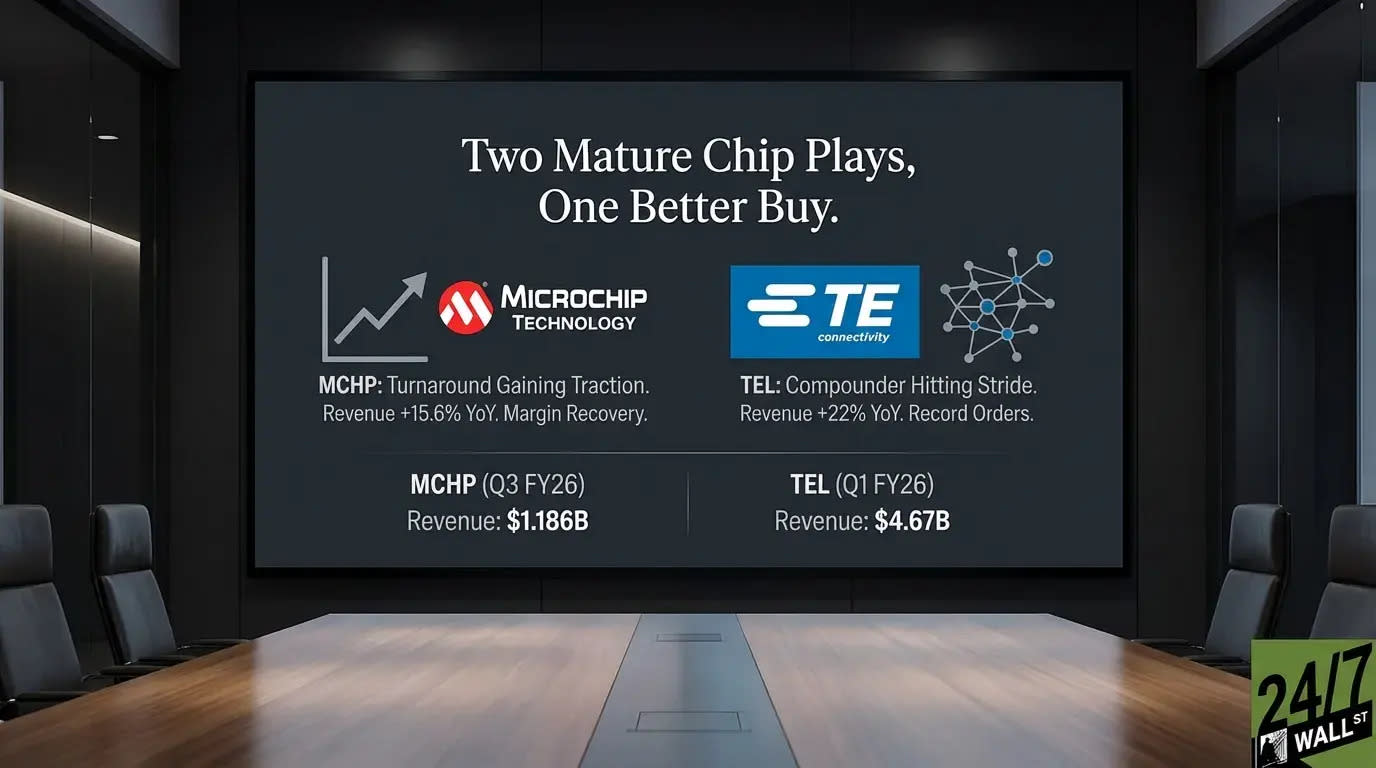
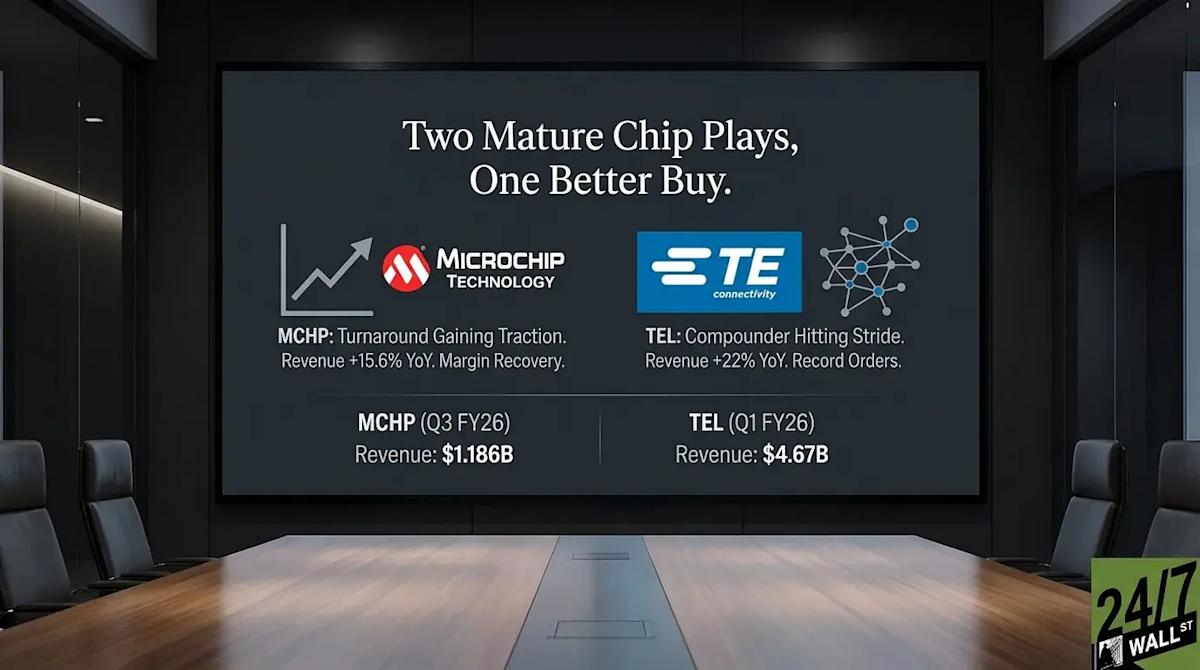
Microchip Technology (MCHP) posted Q3 revenue of $1.186B, up 15.6% year over year, with non-GAAP gross margins expanding to 60.5% from 52% a year ago as its nine-point turnaround plan gains traction. TE Connectivity (TEL) delivered Q1 FY2026 revenue of $4.67B, up 22% year over year, with record orders of $5.1B and 38% growth in its Industrial Solutions segment driven by AI data center connectivity and grid hardening.

Microchip is executing a margin recovery as inventory normalizes and factory utilization improves, while TE is in growth mode, capturing AI infrastructure spending today with AI data center revenue having tripled from $300M in FY2024 to over $900M in FY2025.

The analyst who called NVIDIA in 2010 just named his top 10 AI stocks. Get them here FREE.

Microchip Technology (NASDAQ:MCHP) just posted a third consecutive quarter of sequential revenue recovery, while TE Connectivity (NYSE:TEL) delivered record orders and double-digit growth across both segments. Two mature industrial-facing names, two very different stories.

Microchip's recovery is accelerating. Revenue came in at $1.186 billion, up 4% sequentially and 15.6% year over year. Non-GAAP gross margins expanded to 60.5%, up from 52% just a year ago. CEO Steve Sanghi has been methodical: close underperforming fabs, normalize inventory, rebuild customer relationships. The nine-point recovery plan is producing visible results.

TE Connectivity is operating in a different gear. Q1 FY2026 revenue hit $4.67 billion, up 22% year over year, with record orders of $5.1 billion, up 28%. The Industrial Solutions segment grew 38% year over year, fueled by AI data center connectivity and grid hardening. CEO Terrence Curtin put it directly: "Our teams delivered strongly against our strategy, resulting in first quarter earnings growth over 30% and sales growth of more than 20%, both of which were above our guidance."

READ: The analyst who called NVIDIA in 2010 just named his top 10 AI stocks

Metric

MCHP (Q3 FY26)

TEL (Q1 FY26)

Revenue

$1.186B

$4.67B

YoY Revenue Growth

+15.6%

+22%

Adj. Operating Margin

28.5%

22.2%

Free Cash Flow

$318.9M

$608M

Forward P/E

24x

18x

Microchip sells microcontrollers and analog chips into roughly 120,000 customers across industrial, automotive, and aerospace markets. Its moat is breadth and deep customer integration. The risk: inventory normalization still has room to run, and macro softness could slow the recovery.

TE makes the connectors, cables, and sensors that move power and data through machines, vehicles, and data centers. Its AI data center revenue tripled from $300 million in FY2024 to over $900 million in FY2025. Hyperscaler capex is expected to grow roughly 20% in FY2026, and TE has design wins in place to capture that spend.

For Microchip, the question is whether gross margins can keep climbing toward 65% long-term target as factory utilization improves. Guidance for the March quarter calls for net sales of $1.260 billion at the midpoint, representing nearly 30% year-over-year growth. Tariffs and macro softness remain key variables.

For TE, the watch item is whether the Transportation segment stabilizes in Western markets while the AI-driven Industrial segment holds momentum. Analyst consensus sits at target price of $275 against a current price of $199.41, suggesting meaningful upside if execution holds.

Microchip is a legitimate turnaround, and Sanghi has earned credibility executing his plan. MCHP at a forward P/E of roughly 24x with a 2.9% dividend yield. The stock is down about 23% over the past month, representing a significant pullback from recent highs.

But TE is already in growth mode, not recovery mode. It is capturing AI infrastructure spend today, growing content per vehicle independent of EV adoption rates, and generating over $600 million in quarterly free cash flow. At a forward P/E closer to 18x, the valuation reflects a business with more near-term earnings visibility. Analysts tracking AI infrastructure exposure may find TE's near-term earnings visibility worth examining alongside Microchip's ongoing margin recovery story.

Wall Street is pouring billions into AI, but most investors are buying the wrong stocks. The analyst who first identified NVIDIA as a buy back in 2010 — before its 28,000% run — has just pinpointed 10 new AI companies he believes could deliver outsized returns from here. One dominates a $100 billion equipment market. Another is solving the single biggest bottleneck holding back AI data centers. A third is a pure-play on an optical networking market set to quadruple. Most investors haven't heard of half these names. Get the free list of all 10 stocks here.