yahoo Press
Galaxy season: Spring brings deep space wonder to the northern hemisphere night sky
Images

1 / 18
2 / 18

3 / 18

4 / 18

5 / 18

6 / 18
7 / 18
8 / 18
9 / 18
10 / 18
11 / 18
12 / 18
13 / 18

14 / 18
15 / 18
16 / 18
17 / 18

18 / 18
When you buy through links on our articles, Future and its syndication partners may earn a commission.

Spring is almost here, which means it's galaxy season for amateur astronomers! Grab your telescope and join us as we highlight some of the most beautiful galactic targets visible in the spring night sky over the coming months.

Our view of the night sky is constantly changing as Earth makes its yearly journey around the sun. In spring, the northern hemisphere points away from the dusty plane of the Milky Way, revealing constellations teeming with majestic galaxies.

"Constellations like Leo and Virgo are where our nearest galaxy clusters lie and in springtime, these constellations are best visible at midnight, the darkest point of the day," Finn Burridge, Science Communicator at Royal Observatory Greenwich told Space.com in an email.

"Galaxies are hard to spot," Burridge continued. "They are very faint and distant and need perfectly dark conditions to see them best, so avoid a full or large Moon. You'll also need a telescope or large binoculars to spot them. However, they are incredibly rewarding to see and image."

Many of the galaxies visible in spring lie in the direction of the Virgo Cluster and Coma Cluster, enormous collections of galaxies that together host thousands of members that rival our own Milky Way in scale and grandeur.

The vast majority of these galaxies are too dim to spot with the naked eye, though a telescope with an aperture of at least 6 inches can reveal some of their ancient light, especially when viewed from a dark-sky location. Be sure to check out our picks of the best astronomy smartphone apps to help you find your way around the night sky.

Many modern-day amateur telescopes come equipped with GoTo mounts, which automatically aim the optics at thousands of observable targets that are easily selected from pre-programmed astronomy catalogues. We've also finder charts for each target(s) along with tips on how to find them in the night sky.

Each target is also accompanied by a beautiful image captured by talented astrophotographers who spent hours collecting and processing their ancient light to reveal spectacular detail in their sweeping spiral arms and active nuclei. What you will see through the eyepiece of your telescope will be radically different, but still undeniably incredible.

Galaxies are, by their very nature, challenging targets to observe. Their light has traveled for far longer than there have been humans on Earth and as a result they are very faint. Oftentimes, they are best viewed using the averted-eye method, wherein you place the galaxy on the periphery of your vision, where rod cells, which excel in low-light conditions, are gathered. Sadly, these cells are unable to detect color, so galaxies often appear as a nebulous halo of light surrounding a bright central core, occasionally featuring hints of dark, dusty lanes.

Co-ordinates:

Right ascension: 11h 18m 56s

Declination: +13° 05' 32”

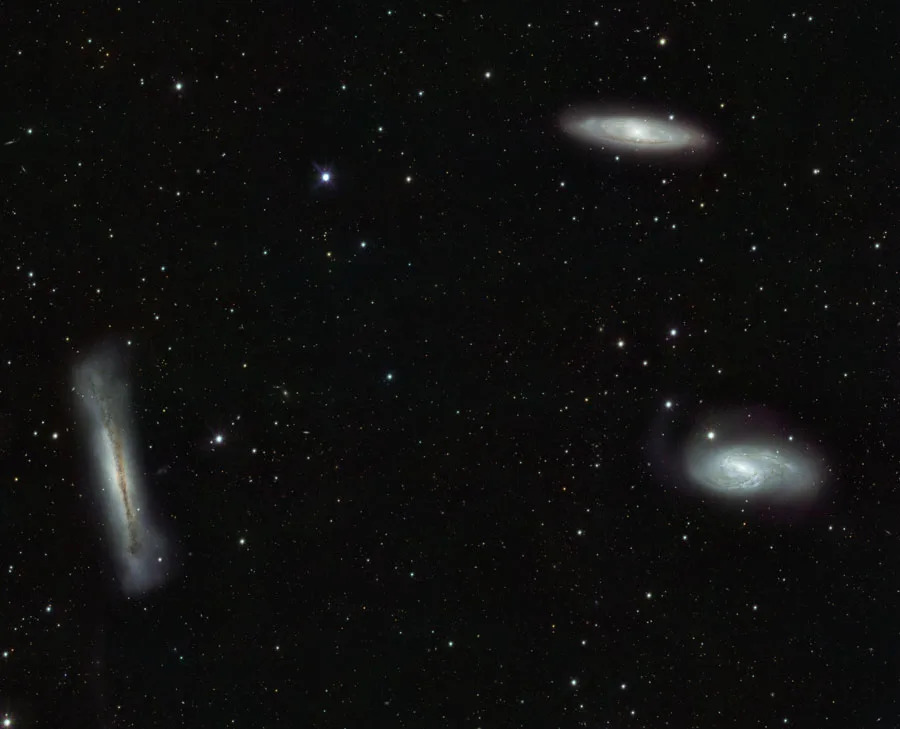
"One of my personal favourites to view in spring is called the Leo Triplet, shared Burridge. "Three galaxies, currently interacting with each other, appear very close together just under the constellation of Leo and they look quite nice through a telescope, and even nicer to image."

The Leo Triplet is made up of the spiral galaxies Messier 65 (M65), M66 and NGC 3628, all of which sit within 1 degree of each other in the night sky — roughly the width of your outstretched little finger — close enough to fit in the field of view of a backyard telescope.

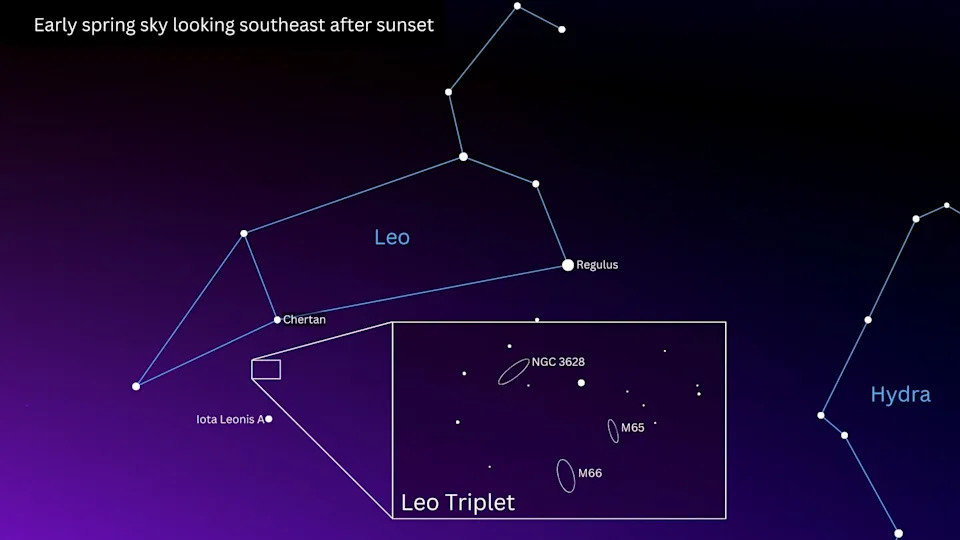
To find the Leo Triplet, first locate the constellation Leo, the lion, which shines in the southeastern sky in the hours after sunset in early spring. Next, isolate the stars Chertan and Iota Leonis A, which together make up one of the hind legs of the celestial lion. The Leo Triplet can be found in the patch of sky directly between these two stars.

M66's bright core should prove relatively easy to spot through a 6-inch telescope under moderately dark skies, as will the dimmer nucleus of M65. The more extreme edge-on profile of NGC 3628 — often referred to as the "Hamburger Galaxy" thanks to its distinctive dust lane — will pose the greatest challenge, requiring larger apertures and the darkest skies to truly appreciate.

Co-ordinates:

Right ascension: 9h 55m 33s

Declination: +68° 56' 24”

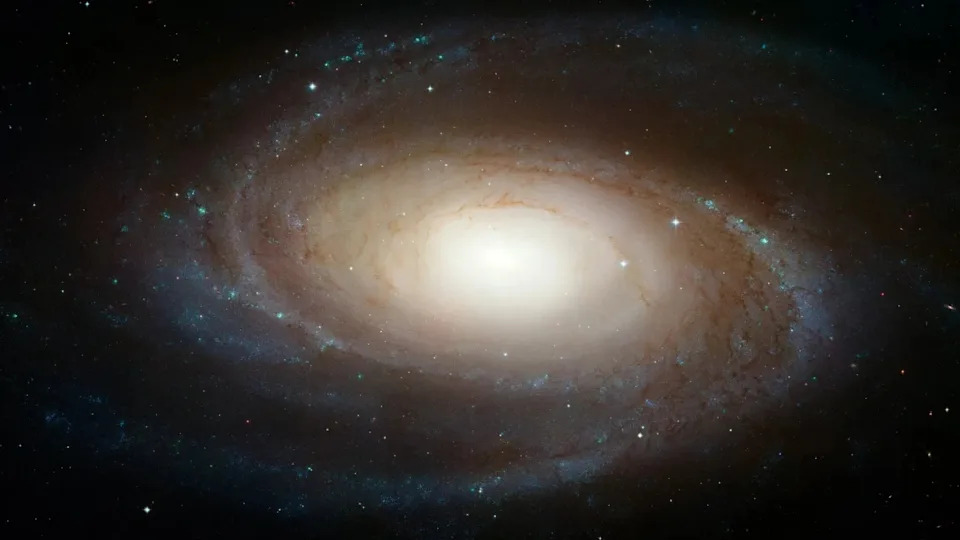
Our next target is Bode's Galaxy — a vast spiral monster that glows in the constellation Ursa Major (the Great Bear), some 11.6 million light-years from Earth. The galaxy shines with an apparent magnitude of 6.9, making it one of the brightest galaxies in the northern hemisphere sky.

Astronomers use magnitude to measure the brightness of objects in the night sky. The lower the number, the brighter the object! Under very dark skies, the human eye can detect objects with a magnitude as low as +6.5, while binoculars and telescopes can be used to see much fainter objects such as galaxies and nebulas.

Bode's majestic spiral is accompanied by the smaller "Cigar Galaxy" Messier 82, which gained its nickname thanks to its distinctive elongated shape. It is currently undergoing an outburst of star formation thanks to the gravitational influence of its galactic neighbor.

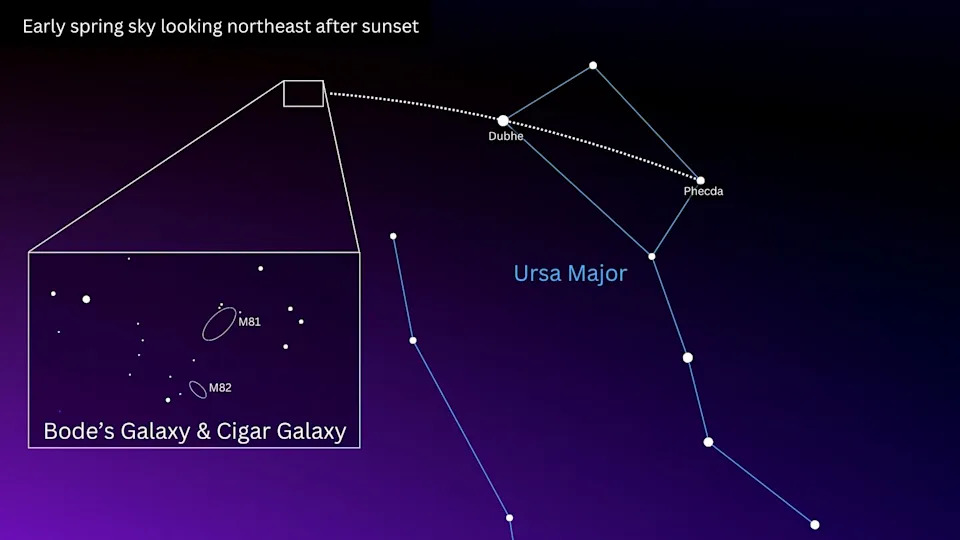
To find Bode's Galaxy, you first need to locate the famous Big Dipper asterism in Ursa Major, glowing in the northeastern sky in the hours following sunset in spring. Next, locate the bright stars Phecda, forming part of the base of the "bowl" of the dipper, and Dubhe, which forms its pouring tip. Draw an imaginary line between the two and follow it out into space for roughly the same distance again.

Sweep your telescope over that region to find Bode's Galaxy, which will appear as a hazy oval of light with a brighter central core, with the Cigar Galaxy less than 1 degree away.

Read our starhopping guide to locating Bode's Galaxy for more.

Co-ordinates:

Right ascension: 12h 41m 20s

Declination: -11° 45' 59”

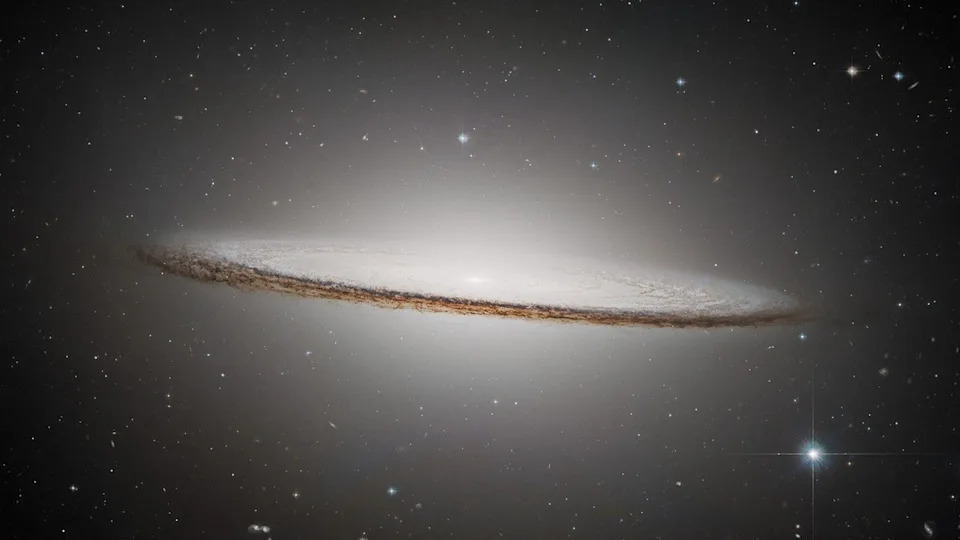
Next up, we have M104, also known as the Sombrero Galaxy — a breathtaking cosmic structure that currently rests almost edge-on to the Milky Way, some 28 million light-years from Earth, looking remarkably akin to the broad-rimmed hat for which it is named!

The Sombrero Galaxy was imaged to magnificent effect by the Hubble Space Telescope — most recently to mark its 35th anniversary in space — which revealed its sweeping disk-like structure and pronounced dusty lanes shining beneath its glowing galactic core.

That bright galactic core can also be seen with the help of a 6-inch telescope shining between the constellation Virgo and the smaller constellation Corvus. If you have access to a telescope with an aperture of 8-inches or more, along with a pristinely clear night, you may also be able to detect the subtle suggestion of the dense dust lane running through the edge-on galaxy, which appears as a small oval patch of light in the eyepiece.

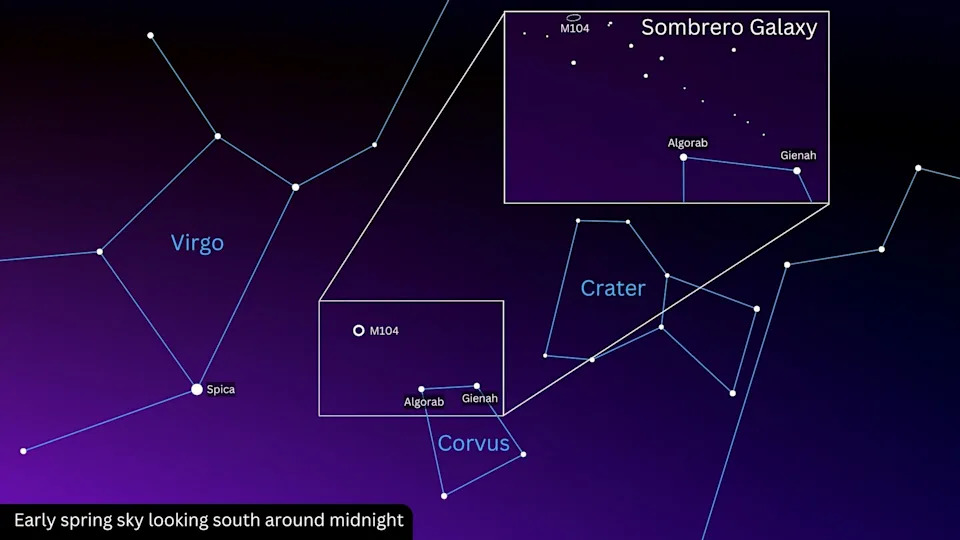
To find it, first locate Spica, the brightest star in Virgo, which can be found ascending in the southeastern sky in the hours surrounding midnight in early Spring. Then, look for the four brightest stars of the constellation Corvus, which form a diamond pattern to the right of Virgo. The upper two stars are Gienah (right) and Algorab (left).

Grab your telescope and look out for a line of faint stars extending diagonally from Gienag above Algorab, which will lead you directly to the patch of sky containing M104! Check out our starhopping guide to finding the Sombrero Galaxy for a more detailed guide!

Co-ordinates:

Right ascension: 13h 29m 53s

Declination: +47° 11' 42”

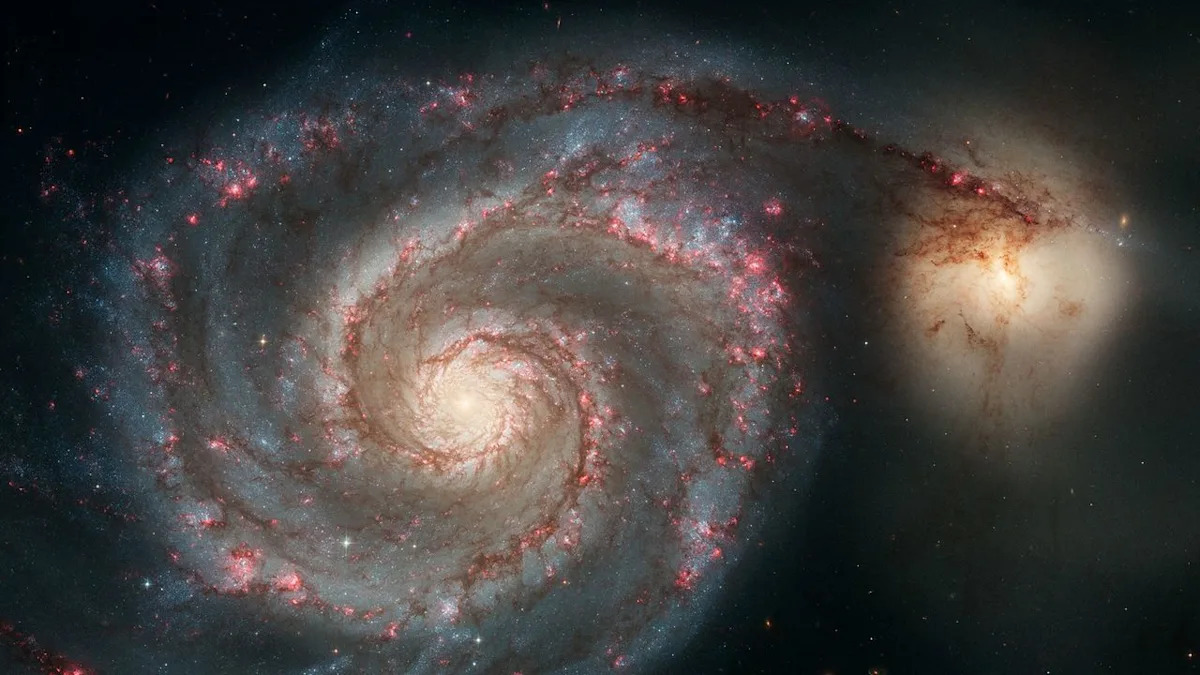
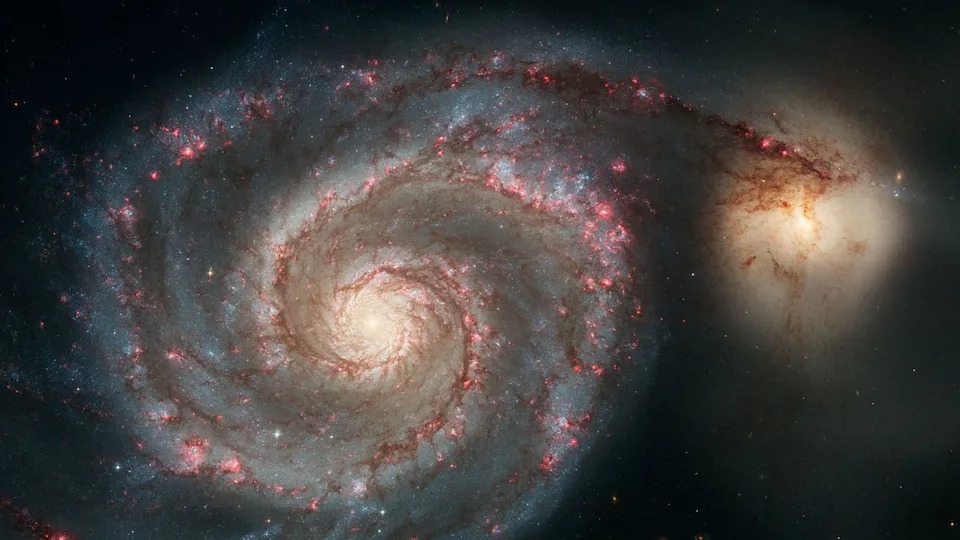
Our next target is the Whirlpool Galaxy (M51a), which shines face-on to Earth in the constellation Canes Venatici, some 31 million light-years from Earth. The sweeping structure of its "grand-design" spiral arms has led to it being known as the Whirlpool Galaxy, which blazes with the light of countless energetic stars.

Its rampant star formation was triggered in part by the gravitational influence exerted by the nearby galaxy NGC 5195, the glowing core of which can be seen shining at one end of the Whirlpool Galaxy's great spiral structure.

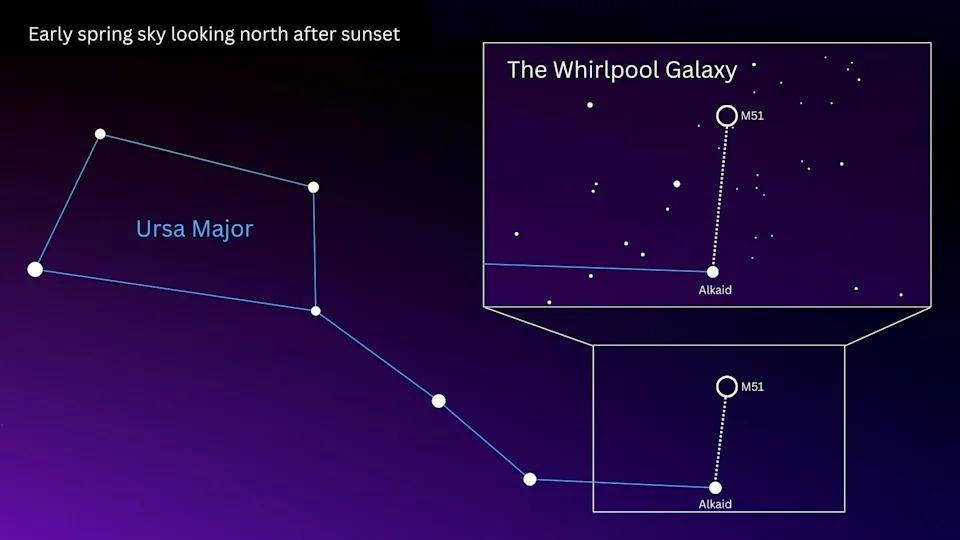
To find m51, you'll first need to locate the Big Dipper asterism in Ursa Major. Next, locate the bright blue-white star Alkaid — the outermost of the three stars that form the end of the "handle" in the stellar formation.

Imagine that the Dipper is a saucepan lying flat on a table, and sweep your telescope "downward" from Alkaid approximately 4 degrees — slightly less than the width of your three middle fingers held at arm's length — and you will find two milky patches of light representing the Whirlpool and its companion NGC 5195.

Co-ordinates:

Right ascension: 12h 26m 53s

Declination: +13° 09'

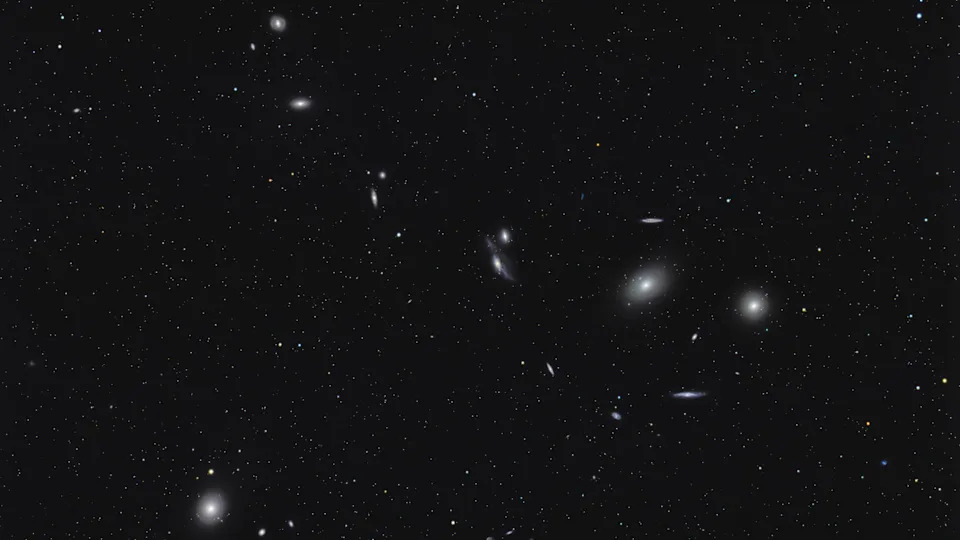
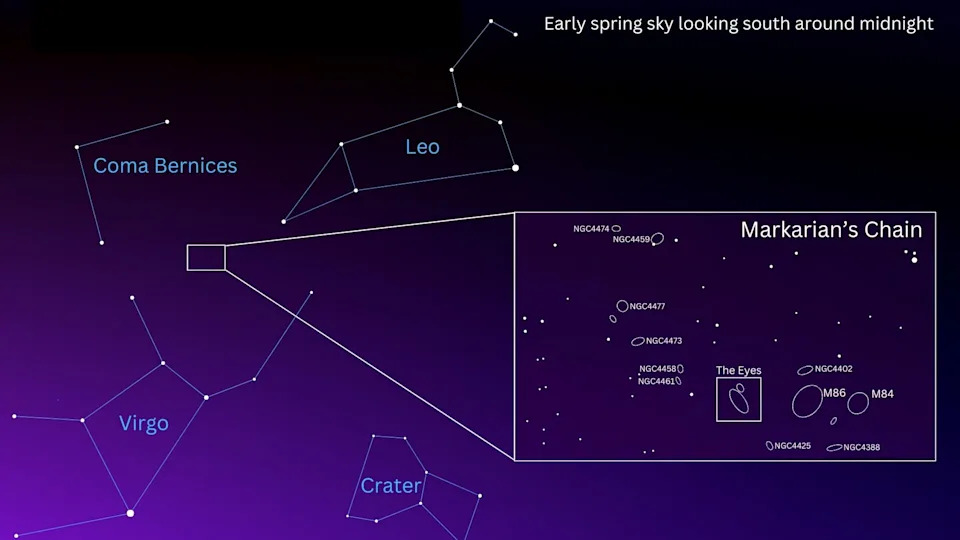
Finally, we come to Markarian's Chain, a gorgeous string of galaxies whose ancient light shines out between the constellations of Leo, Virgo and Coma Berenices. The chain is named after Armenian astrophysicist Benjamin Egishevich Markarian, who found that several of these galaxies share similar motions and distances, indicating they belong to the same cluster

Among the brightest galaxies in this region are M84 and M86, each a galactic heavyweight in their own right that plays host to billions of stars. Look toward the middle of the chain to find a pair of unusual galaxies often known simply as "The Eyes", which shine some 50 million light-years from Earth in the constellation Virgo and have become misshapen due to interactions with their galactic neighbors.

Finding Markarian's Chain is pretty easy. All you have to do is find the magnitude 2 star Denebola, which marks the tail of the lion in Leo. Next search out the magnitude 3 star Vindemiatrix in the constellation Virgo. The chain is located in the patch of sky directly between these two stellar bodies.

Want to upgrade your skywatching gear? Then be sure to check out our picks of the best telescopes available in 2026. If you're into astrophotography you may also want to read our roundup of the best smart telescopes from a range of brands that excel at deep space astrophotography.

Editor's Note: If you would like to share your galactic astrophotography with Space.com's readers, then please send your photo(s), comments, name and location to spacephotos@space.com.