Press
A rope was the miners’ lifeline to the surface. Then it stopped moving
Images
1 / 20

2 / 20

3 / 20

4 / 20

5 / 20

6 / 20

7 / 20

8 / 20

9 / 20

10 / 20

11 / 20

12 / 20

13 / 20

14 / 20

15 / 20

16 / 20

17 / 20

18 / 20

19 / 20

20 / 20
How men were left to starve in a South African gold mine.

Share

Save

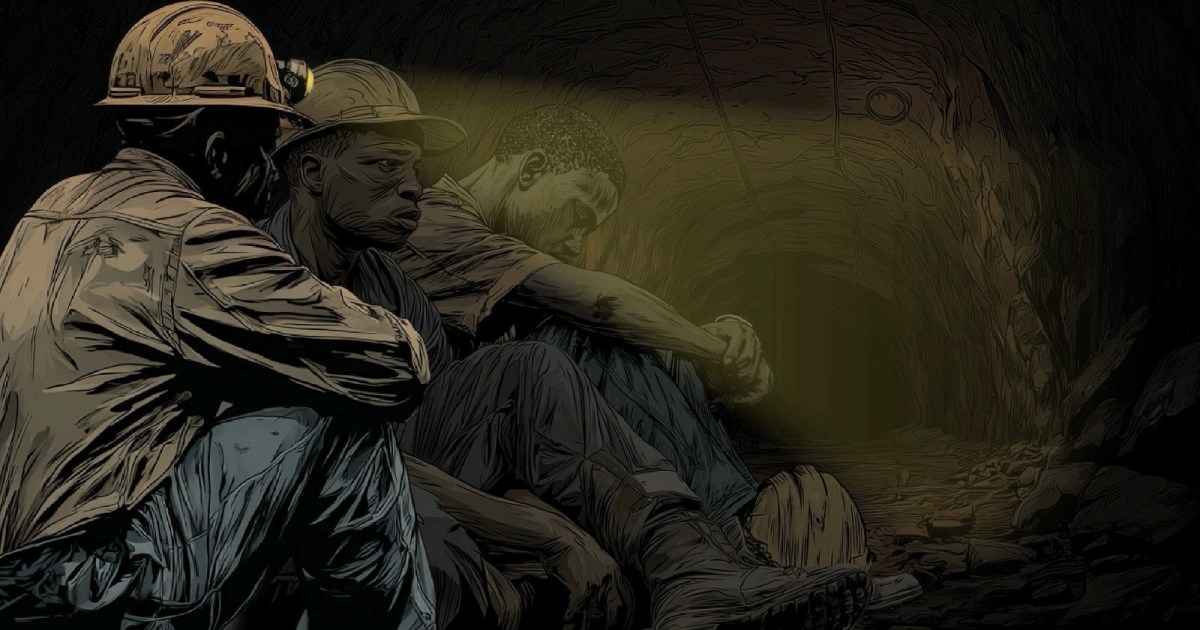
Ayanda Ndabeni watched the faint glow from his headlamp fight the vast darkness 1,500 metres (4,920 feet) below ground.

His miner's lamp had lasted for more than a week after he was lowered down into the shaft of the gold mine. But now the batteries were dying.

He gently flipped the plastic switch of his lamp, turning it off, and the trapped men around him became shadows.

In the stifling heat and humidity, their anxiety pressed in from all sides. Around them, the dark rock gleamed with contaminated water.

Ayanda had descended into Shaft 10 of the Buffelsfontein mine in late September 2024, lowered by a team of nearly 20 men operating ropes and a pulley above ground. That day, he’d spotted police vehicles near the mine’s entrance. The 36-year-old assumed it was just routine patrols around the mine system, which is 2km (1.2 miles) deep.

But then the rope pulley, via which food, water, batteries and other items arrived, stopped moving. The shouting that usually indicated the rope operators were sending down a man or supplies also fell silent.

When huge rocks came crashing down the shaft, they knew it was a warning. The men whispered of their growing fears that something was very wrong on the surface.

Patrick Ntsokolo was also in Shaft 10.

He was a few hundred metres higher up than Ayanda and had arrived in late July.

Patrick was new to the mines. Tasked by the leaders of the artisanal miners with collecting the food, water and alcohol lowered down by the rope pulley, he hauled supplies along the slippery tunnels to small shops. Those first weeks were relaxed, fun even. There was fried chicken to eat, washed down with beer cooled in fridges run on diesel generators.

But in mid-August, things started to change. Deliveries, including medicines like antiretroviral (ARV) pills for those living with HIV, had become sporadic, and supplies began to dry up.

Then, in late August, he remembers that huge rocks first came hurtling down the shaft as though pushed by an excavator.

It felt as though the shaft entrance was being blocked. Patrick was terrified. Deep underground, he started to panic.

“My God, where am I?” he asked himself. “Am I gonna die here?’"

From the late 19th century until recently, more gold was mined in South Africa than in any other country. The first gold was discovered in 1886 in what is now downtown Johannesburg. There was so much rich gold ore that very quickly, diggings sprang up everywhere around the site, and the city grew around the shafts that were being dug deep into the earth.

Gold became a cornerstone of the country’s economy and was the massive engine of South Africa’s growth for much of the late 19th and 20th centuries.

By 1970, when gold mining peaked in South Africa, the country was producing 70 percent of the world’s gold from some of the deepest mines on the planet.

The Buffelsfontein gold mine is part of a mining complex that covers a vast area around the once thriving town of Stilfontein, about 150km (93 miles) southwest of Johannesburg.

Stilfontein was founded in 1949. The racist laws of the time under apartheid (1948 to 1994) prohibited Black and white people from living in the same areas, so Stilfontein was established as a residential area for the white people overseeing the mines, and about 10km (6 miles) to the east, the township of Khuma was constructed for Black workers. As gold deposits were discovered, Stilfontein and its mines grew rapidly. Tonnes of gold were dug out over the following decades.

But by the 2000s, gold production had declined sharply across the country as mines were worked out and gold seams were becoming too deep to mine economically.

By 2013, most of Stilfontein’s mines had closed and were abandoned. Thousands of people had lost their jobs, leaving many families without any income.

The closures left behind a maze of kilometres of shafts, tunnels and diggings once interconnected, many now shut off from one another by rock falls and rising groundwater contaminated with toxic chemicals leached from the worked-out gold seams.

One of the major shafts, known as Margaret Shaft, has a functioning cage lift. It is still in operation today and is used to pump underground water to prevent flooding in neighbouring active mines.

In the late 1980s, more than half a million people worked in traditional gold mining in South Africa. Now, fewer than 100,000 do. But by some estimates, about half of the rich gold ore remains underground.

As the traditional mines shut down, the disused shafts became a focus for illegal mining by artisanal miners like Ayanda and Patrick.

The first informal miners started arriving in mining areas outside Johannesburg in the late 1990s, and soon thousands were working in mines that had shut down. They came from neighbouring countries - Mozambique, Zimbabwe, Lesotho and Malawi. While most are foreigners, a significant number are South Africans, many of whom were employed by mining companies or whose fathers were before being retrenched.

Today, an estimated 30,000 miners are working illegally across South Africa’s 6,000 abandoned gold mines. They are known as “zama zamas”, which means “try try” or “take a chance” in isiZulu.

The shafts where formal mining has ceased are often sealed with concrete and deserted. Zama zamas dynamite the concrete and descend into the shafts. Sometimes they enter the main underground workings through old ventilation shafts or working shafts like Margaret, or they dig their own tunnels into the ground to access the disused mines.

Those who are willing to risk their lives by climbing into the old mines and finding their way through the rusting steel infrastructure and collapsing tunnels still find gold - lots of it.

The zama zamas operate within an organised illicit industry. At the top of the criminal syndicates are the bosses, the “kingpins”, who seldom go underground but sell the mined gold illegally into the international gold market, ranging from the Middle East to the West and across Asia to countries like India and China.

Below them are the gold buyers and local leaders who run operations at specific mines and take a cut of each miner’s work - either in gold dust or in cash.

The leaders oversee teams of men who raise and lower people and goods on ropes to ensure food and drink supplies reach the workers at the lowest levels and mining operations run smoothly.

Underground, there are shops for the miners to buy food, mining tools and other supplies and taverns for them to relax and drink in.

Zama zamas stay underground for weeks or months at a time, trying to make a living for their families.

The criminal gangs who run operations are increasingly armed. In recent years, violence has broken out in areas where the artisanal miners are active, sometimes due to gangs fighting for control over mining territory or confrontations with security officers for mining companies as they try to mine illegally.

In December in the township of Bekkersdal near Johannesburg, zama zamas were associated with a mass shooting at a tavern where 12 men fired at random on patrons, killing at least 10 people. Police said the attackers were suspected of being illegal miners. Many South Africans consider zama zamas to be members of violent criminal gangs and have demanded action from the government, including for the military to be deployed.

The road to the township of Khuma turns off from a section of the highway where a large pile of mined-out rock and sand towers over grasslands. The mine dump is a remnant of decades of commercial underground mining.

A potholed tar road leads past corrugated iron shacks and simple red and yellow brick houses that dot the edge of town. The centre of the township consists mostly of rundown brick houses built in the 1940s and 50s along red dirt roads and surrounded by leafy trees.

For Khuma’s 46,000 Black residents, both South African and foreign, the dangerous, difficult work of informal mining was their lifeblood. For years, it was done largely openly without government interference.

So when Operation Vala Umgodi, or “close the hole” in isiZulu, arrived at Stilfontein in August 2024, everyone was affected - those on the surface and those below ground.

The government launched the operation in December 2023 to crack down on illegal mining, arguing it was robbing the country of $3bn every year. Previous attempts had been sporadic, but the new, coordinated effort involved not only the South African Police Service but also the military, the Department of Home Affairs and other security entities. Starting in the central Free State and Northern Cape provinces, police descended on illegal mining operations, demolishing structures, stopping food supplies from reaching miners, seizing mining equipment and vehicles, and arresting hundreds of people, mostly immigrants. People were charged with illegal mining, and many were deported.

By September 2024, authorities working across the country had arrested nearly 14,000 people and seized 312 firearms along with hundreds of vehicles and millions of rands of cash, gold and uncut diamonds.

The operations usually lasted a few days before the police moved on to the next mine. That was until they reached Stilfontein in North West province.

When the operation arrived at Stilfontein with its vast, labyrinthine tunnel system, many zama zamas expected to see some arrests of fellow miners and seizures of cash and mining equipment before the police left. So, they reasoned, if they kept their heads down and didn’t resurface, they would avoid arrest.

The initial patrols were haphazard, and miners entered or left between police shifts like Ayanda, who, about 7km (4 miles) southwest of Khuma, had descended by rope into the gaping dark hole of Shaft 10.

Mandla Charles also entered the mines after the operation arrived in Stilfontein.

In late September, the 39-year-old was deep underground, digging out the gold-bearing rock at the stope face of a tunnel in dust-filled air with a hammer and chisel.

Every few days, he would take the rock he had mined to the makeshift, underground processing plant where men operated pendukas, repurposed steel gas cylinders that are spun by hand to crush rock and extract gold.

Mandla had been a zama zama since he was 23, and he could tell which seams held gold and distinguish the shining gold-like crystals from the real thing.

His father had been a rock drill operator in the Hartebeesfontein mine in Stilfontein and handled heavy pneumatic drills to hammer into the gold-bearing reef. It was gruelling work. Operators worked in tight, low spaces, and the drill would shake their entire body while water to cool the machine flew out, covering them in a grey slush of water and rock dust.

Mandla remembers his father provided his family with a comfortable life in Khuma. But in the late 1990s, the Charles family’s fortunes changed. His father lost his job and fell critically ill with tuberculosis. The brutal work and the constant exposure to rock dust had worn him out. So Mandla joined the zama zamas to support his family.

After arriving that September, he slept at night on a mattress in a dry, comfortable nook in the rock face. He got on well with the other miners and cooked porridge and barbecued meat over open fires.

The zama zamas had a special code. “You don't steal underground. You don't beat someone underground,” Mandla explained. “There is [a] strict law there. If you are sick, we are taking you, all of us underground there, we take you outside.”

He was looking forward to returning home to his wife and four children in a few weeks with his earnings. Before returning to their house between two white eucalyptus trees on Khuma’s outskirts, he would have to pay the leaders for his food and other supplies, the penduka operators and the men who worked the crude rope pulley system - the miners’ lifeline to the surface.

By late September, residents in Khuma had begun to worry about the men underground.

Some women came to talk to Johannes Qankase, a community organiser and former African National Congress party councillor, outside his brick house on the red-dust road. Whenever there was a problem, people in the township would consult the 40-year-old.

The authorities guarding the mine shafts weren’t allowing them to send supplies down to their husbands, sons and partners below ground, the women reported.

“We can’t be against law enforcement,” Johannes told them. The police would soon leave the area anyway, he thought, and the deliveries would resume.

Elsewhere in the township, 32-year-old Zinzi Tom was inside the one-room, tin-walled house she shared with six others: her mother; her 12-year-old son, Liza; her younger sister; their brother Ayanda, 28; and his two children.

Ayanda Tom had been underground since July, digging for gold to support them all. Zinzi was used to her brother going down for a few months at a time. Usually, he’d send infrequent letters up the ropes, or she would get an update about him from another miner who had surfaced. News from him was always sporadic, but the gap between his last update was longer than usual, and she found it strange. He would need to contact them soon to give them money. The cash to pay for the children’s school transport had nearly run out, and money for food was running low. She had other worries too. Her mother was often breathless and moved slowly these days. No one knew what was wrong with her.

Ayanda said he would return in September or October at the latest. But it was late September, and there had been no word from him.

Zinzi had grown up in Khuma, the fourth of six children. Her father had worked in Buffelsfontein until he lost his job just before the mine closed in 2013. She remembers how, around this time, zamas zamas from other countries had moved in alongside the South African families. Some were prejudiced against the newcomers, but Zinzi liked living in such a mixed community. “Regardless of what nationality you are, you see the same sun,” she said.

A few years ago, she and her mother had sat down with Ayanda when he announced he was going to become a zama zama. "Are you sure?" they'd asked him.

Their situation was too difficult, he’d replied. “Let me go and hustle. I’m going to risk my life.”

In early October, the grass around Buffelsfontein was growing long, green and sweet as the spring sun warmed the air. In the distance, cattle grazed, and white clouds scudded across the clear blue sky.

Shortly after the women came to speak to Johannes, he and other community members realised the authorities were determined to stay until the miners surfaced. They were now constantly guarding the shafts and preventing community members from setting up teams to operate the rope pulley to send supplies down - and pull men up.

Miners had been exiting from Margaret Shaft via the lift, and many were arrested, but Ayanda Ndabeni, Patrick, Mandla and hundreds more men around them were trapped in Shafts 10 and 11 with no way to get to Margaret.

Underground, the routes through the collapsed tunnels and pools of water to Margaret and its elevator were kilometres long, and many were impassable. Some miners wandered for days trying to find a way out.

Community leaders and members tried to reason with the police guarding the entrances and grew frustrated by the refusal to let them supply the men underground.

“It’s been a long time that you are just standing here in these holes,” Johannes remembered telling the police. “And those people are fiancées, girlfriends, wives of those men underground. They are very worried because those men are not getting food any more, they are not getting water any more.

“They will end up dying underground.”

Down a rutted road in Khuma, 21-year-old Nthatisi Mahase was anxious about her boyfriend, Bahlekase Teketsi. The couple had come to the township from Lesotho in search of work and a better life after Nthatisi fell pregnant. “Bahlekase was not working in Lesotho, so we came to South Africa to try to make ends meet,” she explained.

Bahlekase, 29, was earning money mining underground while Nthatisi, then four months pregnant, stayed in Khuma in the single-room corrugated iron shack they shared with three women.

Bahlekase had told her the work could be dangerous. At times, the rope used to lower a man was so worn that it snapped, and the miner would fall to his death. He’d heard stories of men being kidnapped and forced to work as slaves, so he felt fortunate to be paid by his bosses. Bahlekase had told her he was going to work in Rustenburg, a platinum mining town about a two-hour drive north of Khuma.

Nthatisi had been trying to call him, but all she got was his voicemail.

“Usually, he'd send me money, but this time, he was not sending me money. So I wondered, ‘What is the situation? What's happening?’” she recounted.

The thought wouldn’t leave her that he was among the men now at risk of starvation.

Ayanda Ndabeni watched a group of men in Shaft 10 squatting around a fire, roasting large, winged cockroaches in a metal bowl.

Occasionally, deliveries from the surface - instant porridge and mageu, a nutritious maize drink - had made it down, but they weren’t nearly enough.

The men had shared as best they could, six to a packet of porridge.

It was now mid-October. The food stores had long been finished, and the miners hadn’t eaten for days.

“There's nothing else we can eat here,” one of the men by the fire said.

“These police guys, once the cockroaches are finished, they will make us to eat each other,” another joked.

Everyone laughed.

People had started drinking the contaminated underground water. Ayanda and the others tried to convince one another to stay strong even though there was no food, drinking water or medication. But men were starting to get sick. Some were starting to starve.

At night, Ayanda slept fitfully. His stomach burned from the mine water. His head ached from hunger, and he felt dizzy. His thoughts spun as he tried to keep the fear of dying at bay.

One night, as the men around him snored and moved restlessly, he noticed that one man was not breathing at all. He had died.

Ayanda reacted swiftly. Feeling sick with the enormity of what was beginning to happen underground, he made his way to Shaft 11, where the rare delivery had come down and where the ropes might return.

He stooped and crawled through the 3km-long (2-mile) passage between the shafts across the wet floor under low-hanging rock. It took him about an hour to reach the other side, where he reported the death to zama zama leaders. Some men went to collect the body, and when they returned, they wrapped it tightly in plastic to wait for a rope to send the man up for a proper burial.

Mandla made his way through the tunnels, crawling and climbing along rope in parts, to the 1,700-metre-deep (5,580-foot) Tony Shaft.

With no food left to eat, he had decided to risk climbing the shaft to the surface rather than starve to death. He carried what he figured was about 150g of gold, roughly worth 150,000 rand ($9,354).

Over three days, Mandla climbed hundreds of metres up the steel girders that run the length of the shaft. The “gaters”, as zama zamas call them, are a relic of the commercial mining days when an elevator operated.

About 20 miners decided to try to climb out of Tony Shaft.

Not everyone survived. Some fell to their deaths while climbing, and the sounds of their bodies striking steel and rock as they hurtled to the bottom still haunt Mandla. He estimated that maybe half of them made it.

Mandla inched up 150 metres (492ft) from one rusted platform to the next, resting there for some hours. For energy, he ate the toothpaste he had bought in the underground shop for brushing his teeth and drank water he collected in a plastic bottle from the rock. The hunger and humidity sapped his strength, but he continued to climb.

It was night-time on October 19 when he gathered his strength for one last push to climb out of Tony Shaft. Before he did, he hid his gold.

He worked his way up through the last rusty tangles of the old elevator scaffolding and clambered out. The almost-full moon glowed in the night sky, and in its pale light, he saw a white Nyala, an armoured police vehicle, near the entrance. His heart leapt in his chest, and he quickly raised his hands before the police could shoot.

Nothing moved. The Nyala stood silently in the moonlight. The officers were fast asleep. Mandla looked around him, dropped his hands and ran as quickly as he could into the long grass - and towards his home between the white eucalyptus trees.

For most of October, the standoff between police and the community continued. More miners resurfaced from Margaret Shaft. Many remained trapped.

In early November, notices printed in English, isiXhosa, Sesotho and Tsonga were dropped into the shafts, telling the trapped miners that Margaret was "the safest existing exit".

Around the same time, the NGO Mining Affected Communities United in Action (MACUA), which was now supporting the community, issued its first public warning about the miners’ situation.

The police said they had “restricted” supplies and urged miners to resurface to get aid.

On the night of November 13, light from the television screens in Khuma flickered through the windows of its houses with the evening news. Residents watched as Minister in the Presidency of South Africa Khumbudzo Ntshavheni said at a news conference: “We are not sending help to criminals. We are going to smoke them out.”

Zinzi felt rage boiling up inside her at this pronouncement. The stress of not knowing what was happening underground had put her family constantly on edge. There was no more money, and they were waking up the children before dawn to get them ready for the long walk through muddy streets to school.

But in mid-November, the police did allow the community to rescue some miners and send down supplies.

Community members assembled at Shaft 11 to man the ropes and sent down porridge, bundles of mageu, bottled water and medicines brought by a group of women and older men. A web of ropes was strung across the opening, holding a pulley suspended directly over the centre of the shaft through which a threaded, laden rope was fed down.

Mandla joined them. Johannes welcomed his help - he had influence both in the community and underground with the other zama zamas. He allowed himself to feel a little hopeful.

Johannes had first gone with a delegation from the community to Stilfontein police station on October 21. They’d had five or six meetings since, telling the authorities they weren’t against the operation but “were against the issue of people dying”.

He told them the stranded miners couldn’t get to Margaret. “There is no way a person can resurface without getting any assistance from those who are above ground,” he explained. Finally, the police agreed to allow the community to start their own rescue operations.

In mid-November, Ayanda Ndabeni sat in the darkness of Shaft 11. More men had died. He sat as far away as he could from the bodies, which had started to smell.

He knew he was going to be rescued that day. Two days earlier, Ayanda heard a noise from above and looked up to see a tiny light coming down the shaft. As it grew closer, he saw that there was a person being lowered down.

The other miners had started shouting excitedly, “Hey, come, come,” until the man reached them nearly 1,300 metres (4,365ft) below ground. A Mozambican miner named Sipho had volunteered to go down. He saw the starving men and bodies and urged the miners to stay strong - they would soon be rescued.

Sipho had brought a note too: “Ayanda Ndabeni, we need you out.” Skilled at operating the ropes, Ayanda was needed above ground.

The miners wanted to tie Ayanda to the rope, but he refused, telling them, “Take the sick guys first.”

The day Ayanda left the mine, four ill, emaciated miners were pulled up before it was his turn. It took about 45 minutes for the rope to go down and another 45 for it to come back up.

The last load that day was a body wrapped in plastic. As it surfaced, the men swung the body towards the side of the shaft where they could grab it. The smell overpowered Johannes, and he gagged. Out of the corner of his eye, he noticed that the police, too, were recoiling from the smell. Only the mortuary van workers would approach the body.

The rescued men brought news from underground.

Zinzi finally received word of Ayanda Tom. “He’s in Shaft 10,” a rescued miner told her.

“I can’t stand around and wait to die. I’m going to climb the gaters,” her brother had told him.

She could already hardly sleep from all the anxiety. The “not knowing” was anguish. “We had been praying. We were struggling.”

That month, her mother turned grey and collapsed in the chair she was sitting on. Doctors in the hospital said it was a heart attack.

Nhathisi, meanwhile, already had her suspicions but was still shocked when her friends confirmed Bahlekase was also in Shaft 10.

By the end of November, at least 1,300 miners had surfaced and been arrested, including about 100 children and people coerced by armed men to work in the mines.

The authorities maintained that gang members armed with assault rifles were not allowing the miners to surface unless they handed over the gold they had mined. Some miners “may be heavily armed”, President Cyril Ramaphosa said in a statement.

Gwede Mantashe, Minister of Mineral and Petroleum Resources, said the men trapped in Stilfontein were criminal “foot soldiers”.

“Illegal mining is as bad as cash heists,” he said. "It is an attack on the economy of the country. It’s people who come in numbers to steal gold.”

On December 2, Mandla, Johannes, Zinzi and other community members gathered around Shaft 11 as Ayanda worked with men to send down the rope with food and water. The ropes were worn, and the men shuffled slowly on foot through the dust as they hauled the lines.

The previous day, a judge at the High Court in Pretoria issued an interim order after rights lawyers supporting MACUA urged the court to stop the state from using starvation as a tool for combating criminality and allow aid to be sent down.

The community of Khuma was now free to act.

Then, on December 20 in the same court, Judge Mamyeni Mazibuko looked out over a crowd of lawyers and journalists.

She ruled that she found no “evidence or facts that were brought before me that there is a duty or responsibility by the police … to supply food under the circumstances … to the trapped miners”.

At the entrance to Shaft 11, everybody involved in the rescue operations realised that they were on their own. The police were not going to help them.

The people of Khuma had rescued 29 miners, and 11 bodies had been brought up. Hundreds were believed to still be trapped underground.

But funds were running too low to replace the worn ropes. Mandla visited shopkeepers in Khuma. Some donated money and food to send underground, but he knew the ropes would soon have to stop. The community’s efforts were breaking down. They needed the government to step in. It was the only solution.

Below ground, men were gathering at the hollowed-out area at a depth of about 1,300 metres in Shaft 11.

Patrick had made his way there in November, having heard there might be food, as the men around him in Shaft 10 tried to survive on salt and toothpaste mixed with water collected at the bottom of the rock face. On his way to the passage, he had seen a body hanging from the shadowed mass of steel girders above him. The man had fallen from the upper levels while trying to escape.

As he half-crawled, half-staggered along the passage, he felt he heard his children telling him: “You’re not going to die here. This is not going to be your grave.”

But now in Shaft 11, panic was growing. The rescues were too slow. Not enough food or water was coming down. Patrick was finding it hard to cling to hope. The miners were growing weaker and had only the stagnant water oozing out of the rock to sustain themselves. Over two days, seven people had died.

Below the men, the shaft stretched even deeper into blackness filled with water to an unknown depth.

One day, a miner looked at Patrick with frightened eyes: “You know what?” he gasped. “I’m going to throw myself down this shaft.”

Patrick pleaded with him.

“No, man, you can’t do that,” Patrick told him. “It’s not our time to die here. We must believe in God. Our graves are not going to be this deep. We will go out. We’ve got families outside.”

The man didn’t jump, but his despair affected Patrick deeply. He still believed in his own survival, but the atmosphere among the men starving and dying in Shaft 11 was too much to bear.

On December 22, he decided to return to Shaft 10 and climb the girders. It was dangerous, but he had to do something to survive.

He had barely entered the passageway that led back to Shaft 10 when, somewhere in the darkness, he heard a voice.

“Do you want to buy some meat? Some pork?” the voice asked. “There are people selling it if you want some.”

He then saw men cooking over a fire.

Patrick returned to Shaft 11, reporting to the leaders that people were eating some kind of meat. They found the man who had approached Patrick, and he showed them the meat. It was human flesh. Then they found the man who had sold it to him. He admitted he’d taken it from the bodies of people who had fallen and died while trying to climb out.

The leaders were horrified. “You are not supposed to eat human flesh,” they said.

“We are hungry. What can we do? We are not killing these people. These people, they are falling, and we find them hanging,” the men told them.

Patrick was surprised that the men were not punished, but neither could he condemn them. It was the only way they had found to survive. But the horror of it spurred him on. He returned to Shaft 10 and began to climb.

On December 25, Christmas Day, he was almost blinded by the sunlight as he climbed out of the shaft. He’d climbed for more than 1km (0.6 miles) over three days, cutting his arms on sharp protruding steel, and come across nine bodies hanging from the girders.

He saw a flash of blue out of the corner of his eye and a glint of steel. A policeman grabbed him, forced his hands behind his back and handcuffed him. He was dimly aware of a small crowd watching and the hubbub of their angry voices as the police shoved him into a white van.

Mandla and Johannes watched as their friend Patrick was handcuffed and led away. Four miners had come up early that morning. After giving her mother her medication, Zinzi went to Shaft 10 to see if there was any news about her brother. There was nothing to celebrate this Christmas, she thought.

But there were still sounds coming from inside the shaft, and men were climbing up. Four more miners surfaced over the course of the morning. There was no sign of Zinzi’s brother, Ayanda.

In late December, police removed the anchoring rocks for the rope pulley at Shaft 11.

Against a backdrop of court actions as rights groups pushed for the government to rescue the miners, Johannes, Mandla and others pleaded with the police at the shaft entrance.

“Let us not bury them alive,” Johannes urged. “Let us help them to resurface. Then the law must take its course. Arrest them, do whatever you want to do, but save those lives.”

With no supplies going down since Christmas, on January 9, the community rebuilt the pulley system, and two handwritten notes were brought up.

“Mothers and fathers, we come in peace. People around us are dying by the hour, and currently, 109 people have died,” read the first.

The second began: “Greetings parents please be aware there are a lot of decompose bodies here also know even today there will be bodies to be retrieved, know the food you have sent can’t feed all the people who are here.”

The next day, Judge Ronel Tolmay of the High Court in Pretoria ordered the government to rescue the men.

But on January 13, Mine Rescue Services refused to descend, believing the men underground could be heavily armed or a kingpin and his cohorts were holding miners against their will.

Mandla and another community leader volunteered to go down in the red rescue cage to confirm there were no weapons, that it was safe for the rescue to proceed and to organise the men underground.

It took 25 minutes to descend through the darkness to the trapped miners. Mandla could smell the corpses before he reached the starving and sick men and dozens of wrapped bodies. He felt sorrow as he told the survivors, “I did try to fight with our government and told them that they are killing you, but they didn't listen to us.”

“But we’re here to save your bones at least. We have to get you to your families.”

Only six men could properly fit in the cage, but Mandla helped more get in, as many as 12.

Over the next three days, Zinzi watched the cage come up and go down. Each time the cage surfaced, she felt hope surge through her, thinking that she would find her brother in it alive.

On January 16, 2025, when the last cage surfaced, Zinzi, who had stayed strong for her family, collapsed mentally.

Eighty-six bodies were retrieved from the mine while 246 miners were brought up alive. Zinzi’s brother, Ayanda, was not among them, nor was Nthatisi's boyfriend, Bahlekase.

After the rescue, seven more people died in the hospital, bringing the death toll to 93.

MACUA, which represents the Stilfontein community’s interests, blamed the government and police for the deaths. They have requested that parliament instigate an inquiry, which has been referred to the Portfolio Committee on Mineral and Petroleum Resources. No investigation has begun. MACUA questions why there has not been an Independent Police Investigative Directorate (IPID) inquiry and notes the silence from most government bodies.

“The operation, which was approved at cabinet level, must ultimately be held to account and pay reparations,” Christopher Rutledge, executive director at MACUA, told Al Jazeera.

The South African Human Rights Commission investigated the events at Stilfontein in September 2025. They concluded that depriving the miners of essential supplies violated their human rights. They held another inquiry in February this year and are expected to present their findings in May.

The police have not released the names of the deceased, although 38 people were identified. At least 30 individuals among the unclaimed bodies were given funerals.

About 1,800 miners surfaced and were arrested at Stilfontein, about 1,500 of whom were deported, while 27 foreign children were handed over to the Department of Social Development. The youngest was 14 years old.

Al Jazeera reached out to the South African Police Service, the president’s office, and the Department of Mineral Resources and Energy with questions, but did not receive a response.

The township of Khuma, meanwhile, is largely quiet, the dusty streets almost deserted.

The nearby shafts have been sealed, and the police presence has returned to routine local patrols.

In February, protests erupted briefly. Roads were barricaded with logs, stones and burning tyres while the residents manning them demanded jobs and better service delivery.

The economy of the township has collapsed with no money in circulation. Many people stay at home, waiting, uncertain about what is next for them. Some gather to talk about their situation at the local taverns. There is little else to do.

Ayanda Ndabeni has been working on a vegetable farm near the town of Ventersdorp in North West province. He says he will never do zama zama work again.

“Our government is killing us … calling us criminals, [saying] we deserve to die, because when you say, ‘Smoke them out,’ it means … kill the people,” he said. “But the real criminals today are the ones that are ruling us.”

Since coming up from underground, “I don’t have anything”, Ayanda said, adding that there are no jobs in Stilfontein. “It’s an abandoned place now.”

Patrick Ntsokolo is in Khuma looking for a job and surviving on government financial assistance of 350 rand ($20) a month.

Nthatisi Mahase gave birth to her daughter Oratiloe, meaning “you are loved” in Sesotho, on March 7, 2025.

She will likely never know what happened to Bahlekase and remains devastated.

“There is no longer hope. I’m full of regrets because he's no longer with me,” she said.

Johannes Qankase cannot find employment in Khuma but remains active in community affairs. “They succeeded. They smoked them out,” Johannes reflected bitterly.

Zinzi Tom remains in Khuma. She suffers from an anxiety disorder linked to stress and grief about her brother Ayanda’s unknown fate.

“We could have saved many people,” Zinzi explained. “But they said they were criminals. They would smoke them out. It was very sad and painful to hear that. They never cared.”

Mandla Charles is doing zama zama work farther east in Mpumalanga province. He is underground most of the time, but said he will return to Stilfontein one day.

“It’s in my blood. I am a zama zama. Even if the operation is over, we will go back there. They will find us down there again. Zama zama will never end,” he said. “I will go down because I left my gold there.”

This story was reported over the course of a year, from February 2025 to February 2026. All ages given are as of February 2025.

All videos were created by Mohamed Hussein using Midjourney.