Press
How Iran war ship attacks choked off Strait of Hormuz
Images
1 / 11

2 / 11
3 / 11
4 / 11
5 / 11

6 / 11
7 / 11
8 / 11
9 / 11

10 / 11
11 / 11
Six ships have been attacked in the Gulf in less than 48 hours, bringing the total of vessels attacked since the start of the war to 18, according to reports by UK Maritime Trade Operations (UKMTO) and the maritime intelligence company Vanguard.

It comes as Iran's new supreme leader Mojtaba Khamenei vowed to keep blocking the Strait of Hormuz in his first public statement on Thursday.

Verified footage showed two tankers on fire in Iraqi waters at the north of the Gulf late on Wednesday and UKMTO reported the ships had been "struck by an unknown projectile".

Safesea Vishnu, a US-owned vessel heading to India, was hit by an "unmanned speed boat carrying explosives" which "rammed into it, resulting in a major fire onboard", Indian authorities said.

Video filmed from a small boat - and authenticated by BBC Verify - shows a large explosion on the Safesea Vishnu before the boat speeds away and those on board can be heard celebrating.

The head of the General Company for Iraqi ports said it rescued 38 crew members from the attacked ship and that one person has died, according to the Iraqi News Agency.

There were no reported injuries on the second vessel, the Maltese-flagged Zefyros.

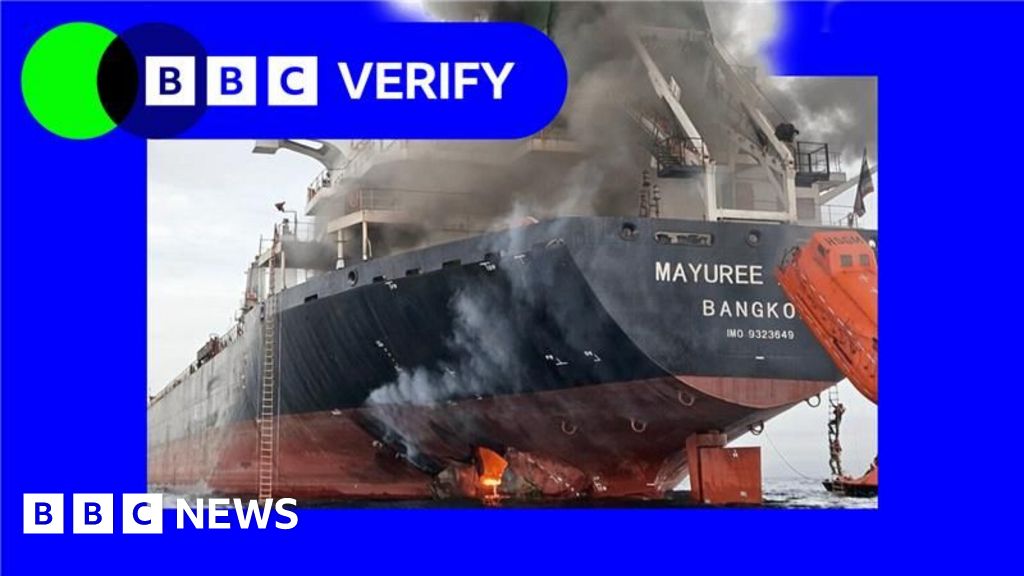
Three crew members are still missing and believed to be trapped in the engine room of another vessel, the Thai-flagged Mayuree Naree, that was hit while transiting through the Strait of Hormuz on Wednesday morning, the ship's owner told BBC Verify.

"In theory, Iran can keep threatening shipping indefinitely," said Nick Brown from the defence intelligence company Janes.

"Iranian forces are well practised in decoy, camouflage and subterfuge tactics, and many of their smaller weapons can be disguised in commercial vehicles, hidden in buildings and out of sight along Iran's long coastline," he added.

"Small craft, robot craft, small submarines, shore based missiles, even mobile artillery - all of which Iran has - could attack ships as they sail past," said Professor Michael Clarke from King's College London.

The latest data from the ship tracking firm MarineTraffic shows that just six vessels have passed through the strait since Monday.

Tracking these ships has been difficult as some may have been turning off their onboard trackers, as Iran continues to target vessels. Signal jamming is also causing many ships to transmit misleading location data.

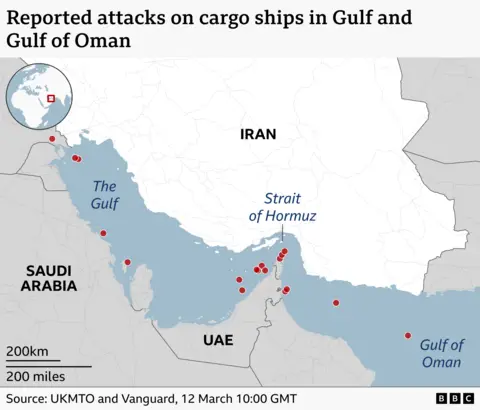
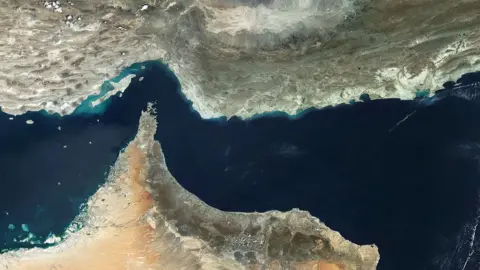
The locations of the strikes on vessels reported by UKMTO and Vanguard show the attacks have spanned the length of the Gulf and the Gulf of Oman, but most have been concentrated near the Strait of Hormuz.

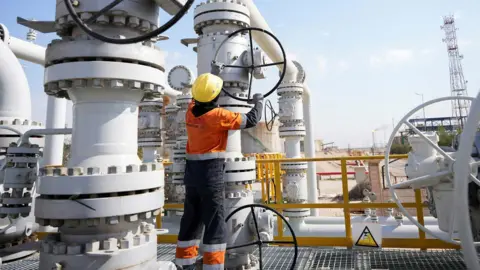
About 20% of the world's oil - around 20 million barrels per day - usually transits through this narrow corridor between Iran in the north and Oman and the United Arab Emirates in the south.

It is also a key trading route for other commodities such as helium, the chemical sulphate, and urea, which is used to produce fertiliser.

"No ship wants to pass through there and no insurer wants to insure those ships that are passing through there. This is the scenario that we've all been predicting for a long time - the closing of the strait - which is a nightmare," said Neil Quilliam from the Chatham House think-tank.

Ten of the ships reported by UKMTO and Vanguard as having been attacked since 28 February are tankers, according to MarineTraffic data.

Iran has said it would "not allow even a single litre of oil" heading for the US, Israel and their partners to pass through the strait.

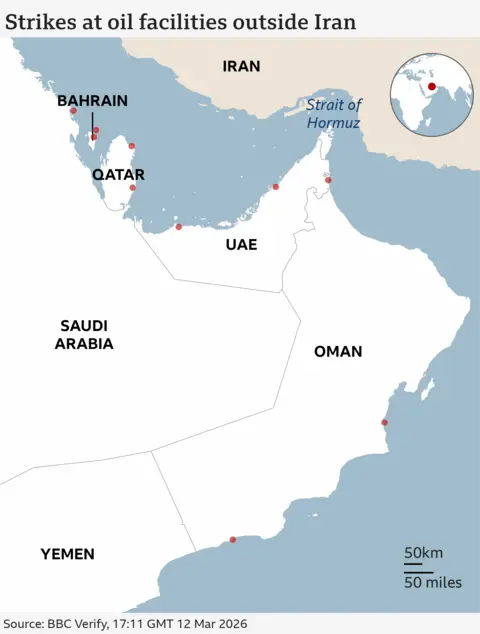
In addition to strikes on oil tankers, we have also verified 10 strikes on oil facilities and depots since the conflict began on 28 February, spanning Bahrain, Oman, Saudi Arabia, the UAE and Qatar.

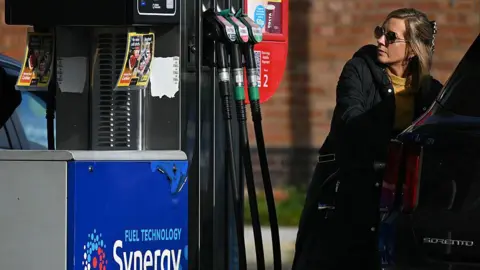
Energy prices have soared since the start of the war, approaching $120 a barrel on Monday.

A spokesperson for Iran's military command, Ebrahim Zolfaqari, this week warned: "Get ready for the oil barrel to be at $200 because the oil price depends on the regional stability which you have destabilised."

Thirty two countries unanimously voted to release 400 million barrels of oil to offset the "effective closure" of the shipping channel, the International Energy Agency (IEA) announced on Wednesday.

US President Donald Trump told his supporters in Kentucky on Wednesday the decision would "substantially reduce oil prices" and earlier described the fluctuations in price of oil as a "matter of war".

Trump last week pledged a military escort for oil tankers moving through the Strait of Hormuz "if necessary", but experts have told BBC Verify it is unlikely this could guarantee the safety of every ship.

"If the US intention is to escort all commercial vessels, this would require diverting many assets away from other tasks," said Professor Basil Germond, a visiting fellow at the Royal Navy Strategic Studies Centre.

"Even if a convoy is 90% effective, which ship owners and crew unions are prepared to play Russian roulette in one of them?" said Clarke.

US Central Command released footage on Wednesday of what it described as strikes on 16 mine-laying ships in the Iranian navy.

The Iranian military inventory includes the Sadaf-02 sea mine, designed to sit just below the waterline and detonate after contact with a passing ship, plus the more-advanced Maham-2, which sits deeper and detonates when it detects a moving ship above through magnetic or sound sensors.  There have so far been no reports of ships hitting mines.

"The regime in Tehran has this asymmetric power. It costs them nothing compared to the cost of defending commercial shipping," said Germond.

"Will this proposed escort convince shipping companies that the strait is safe enough? It is a question of who is more credible: the US Navy or the Iranians," he said.

"And the proof will only be in the pudding."

Additional reporting by Paul Brown, Becky Dale and Shruti Menon.

It comes as Iranian attacks on ships intensify in the crucial Strait of Hormuz waterway.

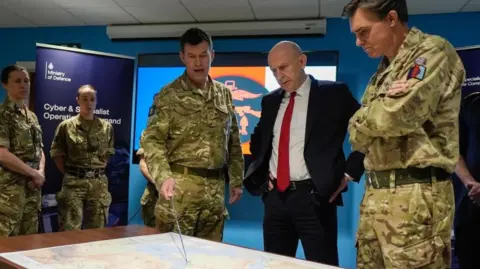
British forces based in Iraq shot down two drones overnight, Defence Secretary John Healey has confirmed.

Iran says it will "set fire" to ships trying to sail through the world's most vital oil transit point.

US president Donald Trump says Iran are "welcome" at the 2026 World Cup but it is not "appropriate" for them to be there.

Oil price moves have made headlines since the Iran conflict started - but why have there been such sharp swings?