Press
How Iran war laid bare the world's reliance on Gulf oil and gas
Images
1 / 10

2 / 10
3 / 10
4 / 10
5 / 10
6 / 10

7 / 10
8 / 10
9 / 10

10 / 10
The US-Israel war with Iran has made startlingly clear how much the world relies on energy from the Gulf region.

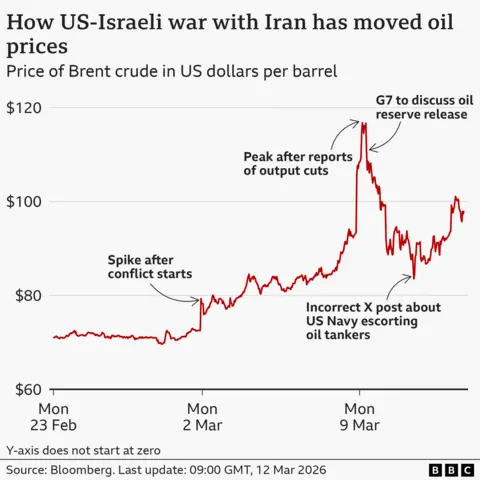
Since the conflict began, the price of oil has soared and is currently trading at over a third higher at $100 a barrel, pushed up by air strikes on shipping and energy infrastructure, and the effective closure of the Strait of Hormuz, a vital waterway for energy shipments, which carries a fifth of global oil supplies.

Nowhere is feeling the effects of the current energy crisis quite like Asia. Last year, nearly 90% of all the oil and gas that passed through the Strait of Hormuz was bound for the region.

Ordinary people rely on it to heat their homes, fuel their vehicles and generate electricity. Businesses need it to power the region's vast manufacturing base.

South East Asia, in particular, is highly exposed to the blockage in the Persian Gulf. Even countries that produce oil themselves, such as Malaysia and Indonesia, have gradually started producing less and importing more over the past decade.

The vulnerability is also partly to do with the type of oil produced in the Middle East and how countries in the region refine it.

"Middle Eastern crude is generally 'heavy sour' or 'medium sour'," says Jane Nakano, a senior fellow in the Energy Security and Climate Change Program at the Center for Strategic and International Studies.

Refineries in South East Asia, Nakano explains, have been set up to process this type of crude oil and simply switching to another provider, such as the US, is not straightforward.

"It would take significant investment to alter refinery specifications," she says.

It puts many countries in a bind. The Philippines, for example, gets around 95% of its crude oil from the Middle East. The country's president has already told public workers to switch to a four-day working week to save fuel.

Working from home is being heavily encouraged by various governments in the region. Other fuel-saving measures, such as setting air conditioner temperatures in public offices at a higher than usual 26°C, were announced by Thailand's energy minister on Tuesday.

South East Asia is also heavily reliant on food imports. The island city-state of Singapore imports 90% of its food, while all of Indonesia's wheat, for example, comes from outside the country.

This makes food prices particularly sensitive to rising transportation costs. Last week, the price of jet fuel had soared by nearly 60%.

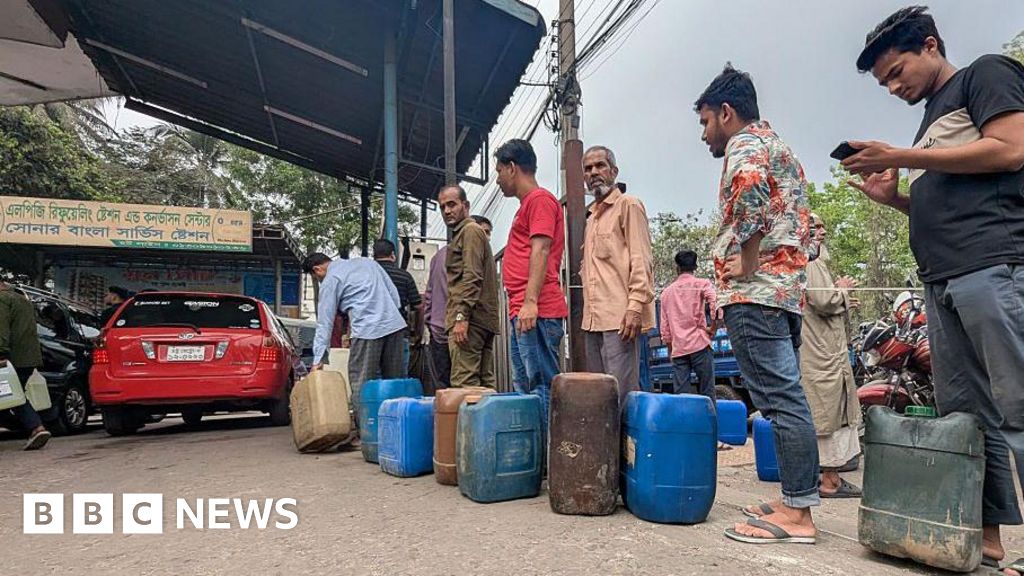
Vietnam is also feeling the strain. The price of diesel has gone up there by nearly 60% since last month. In some cities this week there were long queues of moped riders at petrol stations panic-buying fuel. There have been similar scenes in Bangladesh.

Prices at the pumps have been going up around the world, although to a lesser extent than seen in Asia.

In the US average petrol prices are up 23% on a month ago, while diesel prices are up by a third. In the UK diesel is up 9%.

It is something that governments are keeping an eye on.

South Korea has ordered a temporary cap on the price of fuel to ease anxiety over the rising price of oil.

Japan has said it will provide subsidies to oil wholesalers, in order to contain retail petrol prices.

In France, TotalEnergies has said it will cap the price of petrol and diesel at its service stations from Friday until the end of the month, according to Reuters.

In the UK, a planned rise in fuel duty scheduled for September, is being kept under review.

Asia's biggest economy, China, is certainly the best placed to weather the storm. Over the years, it has built up one of the world's largest oil reserves, which would last it a few months.

Unofficially, China also buys millions of barrels of Iranian oil, which is under US sanctions. Vessel-tracking data suggests that some of this is still arriving.

This is in addition to more than 46 million barrels of Iranian crude oil, which is currently in floating storage in the South China Sea, according to data from the trade analytics group Kpler.

Rises in petrol prices will be felt less keenly in China, given that one third of all new cars sold there are electric.

Compared to other Asian countries, China is also far less reliant on oil when it comes to generating electricity - most of that is powered by coal.

The continent's other major economies, Japan and South Korea, have agreed to release millions of barrels from national stockpiles, in line with an International Energy Agency (IEA) agreement announced on Wednesday.

Even so, both countries' dependence on Middle Eastern energy has increased since they decided to buy less Russian oil and gas in the wake of the invasion of Ukraine in 2022.

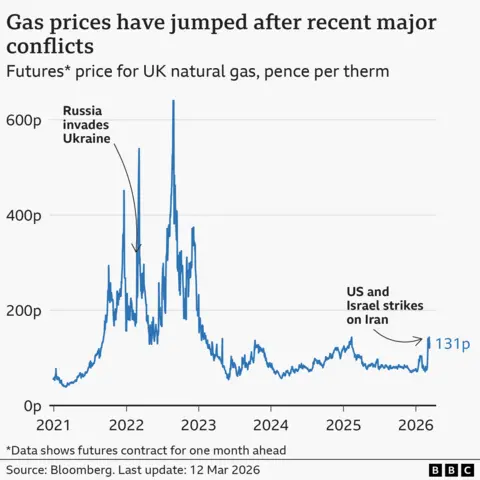
When it comes to gas, the Ukraine war also had a major impact on where Europe gets its supplies from as it sought to turn away from its reliance on Russia. The UK and the EU now get most of their liquefied natural gas (LNG) from Norway and the US.

The EU gets only around 10% of its gas direct from Qatar, while the UK gets about 2%, according to Capital Economics.

But while countries in Europe may be less exposed to the reduction in gas supply from the Gulf - QatarEnergy, one of the world's biggest exporters, halted production last week following "military attacks" on its facilities - that doesn't mean they are immune to it, says David Oxley, Capital's chief climate and commodities economist.

"Asian customers who are no longer getting that gas are going elsewhere and pushing up global gas prices," he says.

The US, however, is proving to be the exception.

It has ramped up its fracking in recent years, increasing its own gas production, leaving it "the most insulated from this shock," says Oxley.

But there are constraints on its ability to export gas - it is a costly and time-consuming process to build up its infrastructure.

So while there is more coming online all the time - which is an important factor in why the rise in gas prices has not been as big as that seen in 2002 - in the near term it is not enough to make up for the loss of Gulf supplies, Oxley says.

Additional reporting by Osmond Chia in Singapore

Three American military refuelling aircraft that previously stopped at the airport are believed to be supporting US-Israeli airstrikes.

John Reid Trucking Limited, in Brigg, typically buys more than 20,000 litres of fuel a week.

Teachers, engineers and shopkeepers tell the BBC they fear Iran falling into chaos.

Conflict has spread across the Middle East since the US and Israel launched wide-ranging strikes on Iran on 28 February.

The conflict in the Middle East could raise the cost of petrol, household energy bills and even food.