Press
France's ghost car scandal that allowed one million illegal vehicles onto the roads
Images

1 / 10

2 / 10

3 / 10

4 / 10
5 / 10
6 / 10

7 / 10

8 / 10
9 / 10
10 / 10
A million illegally-registered cars are being driven in France in a fraud scandal that has cost hundreds of millions of euros in lost taxes and fines, according to the state auditor.

The fraud – in which fake dealerships manipulate the records of the state vehicle licensing agency (SIV) – is also endangering lives by allowing unsafe cars and lorries onto the road.

And it has proved a boon for crime.

Vulnerabilities "have allowed the whole gamut of criminality – from petty delinquency to organised crime – to penetrate the registration system in order to pursue their fraudulent ends", according to the Cour des Comptes in a report released Thursday.

The fraud goes back to 2017, when the French government decided to part-privatise the system, in a bid to speed up the notoriously slow process of delivering registration papers to car-buyers.

Some 2,000 civil servants were assigned to new tasks, and instead car-dealers were given the right to access the register themselves in order to issue documents for their clients.

But according to the Cour des Comptes, the new system relied excessively – and mistakenly – on good faith.

In fact, it was quickly abused by hundreds of unscrupulous operators who found they could set up ghost dealerships and then, for a fee, fiddle with the registry.

The report said that there were around one million cars on the road which had been registered by nearly 300 "fictitious companies operating totally free of state control".

Papers shown by drivers of these vehicles would appear normal to a police officer, but afterwards the car and its owner would be untraceable.

"For solely the years 2022-2024 the financial prejudice was €550m (£475m), in non-collection of registration fees, and speeding and parking fines," it said.

In all, the auditor listed 30 different types of fraud linked to the scam, from avoiding environmental taxes on heavily-polluting cars, to altering results of road-worthiness tests, and suppressing the identity of a car's previous owner.

In a special report on the phenomenon, Le Monde newspaper told of a SIV-eur (as the fraudsters are known to police) who helped a luxury car importer escape tens of thousands of euros in import and environmental taxes.

He did this by registering the Rolls-Royces and Mercedes as vehicles specially adapted for disabled people, meaning they were exempt from duty.

Stolen vehicles can be re-registered by SIV-eurs to avoid detection, and drug gangs use SIV-ed cars for special jobs, like so-called "go-fast" deliveries down motorways.

According to Le Figaro newspaper, police were alerted by a big increase in "very fast" speeding offences – up 160% between 2016 and 2022. When they looked into registrations, they found that many had been faked.

The Cour des Comptes said the state had been lax in not checking the credentials of the 30,000 dealers to whom it allows access to the SIV.

All would-be entrants had to do was set up a shell company and then apply for access to the registry, which was normally given.

"This is what happens when you try to reduce the size of the state. Before, people had to queue for two hours for their papers. Everyone complained, but at least everything was properly checked," an insider told Le Monde newspaper.

France's interior ministry said it acknowledged the problem, and was taking steps to remedy it. An action plan announced last year has led to an increase in fraud detections, while the number of authorisations to access the SIV has been sharply reduced.

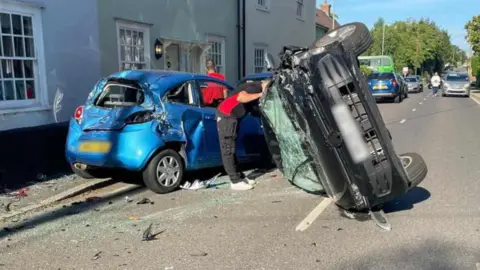
Footage captures the moment a car crashes and flips over in Coggeshall, narrowly missing a jogger.

Christopher Lavis suffered a fractured cheek bone, a fractured eye socket and a broken nose when Christopher Shaw punched him for sticking to the speed limit.

Road safety commissioner Mat MacDonald reveals data showing that pedestrian deaths have increased.

A stretch of about two miles of the A267 has been closed since roadworks began.

The 20‑minute session could ease parking problems on the busy street nearby, councillors say.