yahoo Press
Astronomers witness colossal supernova explosion create one of the most magnetic stars in the universe for the first time
Images
1 / 10
2 / 10

3 / 10

4 / 10
5 / 10
6 / 10
7 / 10

8 / 10

9 / 10

10 / 10
When you buy through links on our articles, Future and its syndication partners may earn a commission.

Astronomers have witnessed the birth of a rapidly spinning, highly magnetized neutron star or "magnetar" for the first time. The observation of this event, triggered by the death of a massive star, confirms the link between the creation of magnetars and super-bright supernova explosions. These superluminous supernovas can be as much as ten times brighter and last much longer than the typical supernova explosions that occur when massive stars run out of nuclear fuel and undergo gravitational collapse, or "core collapse," to birth neutron stars or black holes.

Almost since they were first discovered in the early 2000s, scientists have theorized that the birth of magnetars, which have the most powerful magnetic fields in the known universe, are connected to superluminous supernovas, but the smoking gun confirmation of this connection was missing.

"What's really exciting is that this is definitive evidence for a magnetar forming as the result of a superluminous supernova core collapse," team member Alex Filippenko of the University of California, Berkeley, said in a statement.

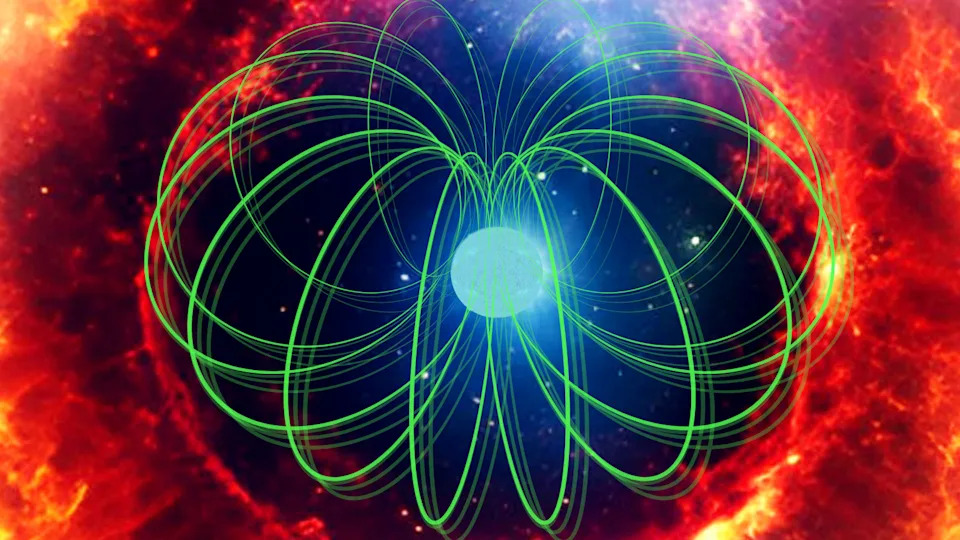
The theory connecting magnetars and superluminous supernovas was first suggested by Dan Kasen and Lars Bildsten of UC Berkeley and independently by Stanford Woosley of UC Santa Cruz. It suggests that when a star that possesses a powerful magnetic field and that is around 25 times the mass of the sun collapses, its magnetic field intensifies. The result is a magnetar with a magnetic field 100 to 1,000 times as strong as the magnetic field of a "standard" neutron star.The collapse of the core of a massive star to a width of around 12 miles (20 kilometers) has another consequence. Just as an ice skater at the Winter Olympics draws in their arms to increase their spin speed, the rapid decrease in diameter of a neutron star speeds up its rotation. As a result, some newborn neutron stars can spin at a rate of 700 times a second or more. These objects can blast beams of radiation from their poles that sweep across the universe like light from a cosmic lighthouse. In these cases, neutron stars and magnetars are referred to as pulsars.

As magnetars spin rapidly, their rotating magnetic fields accelerate particles and then fire them out into material shed by the progenitor star during their supernova death. That causes this debris to increase in brightness.

The team behind this research confirmed this connection when they analysed data from a supernova spotted in 2024 and designated SN 2024afav. This investigation revealed strange "chirps" in the light curve from this supernova, which are indicative of general relativistic effects caused by a magnetar.

"The basis of Dan Kasen and Stan Woosley's model is that all you need is the energy of the magnetar deep within, and a good fraction of it will get absorbed, and that'll explain why the thing is superluminous," Filippenko said. "What had not been demonstrated was that a magnetar did in fact form in the middle of the supernova."The researcher added that this is what this research, published on Wednesday (March 11) in the journal Nature, finally demonstrates.

"For years, the magnetar idea has felt almost like a theorist's magic trick — hiding a powerful engine behind layers of supernova debris. It was a natural explanation for the extraordinary brightness of these explosions, but we couldn't see it directly," Kasen said. "The chirp in this supernova signal is like that engine pulling back the curtain and revealing that it's really there."

First spotted by the 27-telescope network of the Las Cumbres Observatory in Dec. 2024, the brightness of SN 2024afav was tracked by astronomers for 200 days. What the team noticed was that this supernova, which occurred around 1 billion light-years from Earth, didn't gradually fade after like a typical supernova.

After peaking at the 50-day mark, the brightness of SN 2024afav gradually oscillated downward, with a series of four noticeable "bumps" in brightness that resemble a sound increasing in frequency. Hence, these features were labelled chirps.

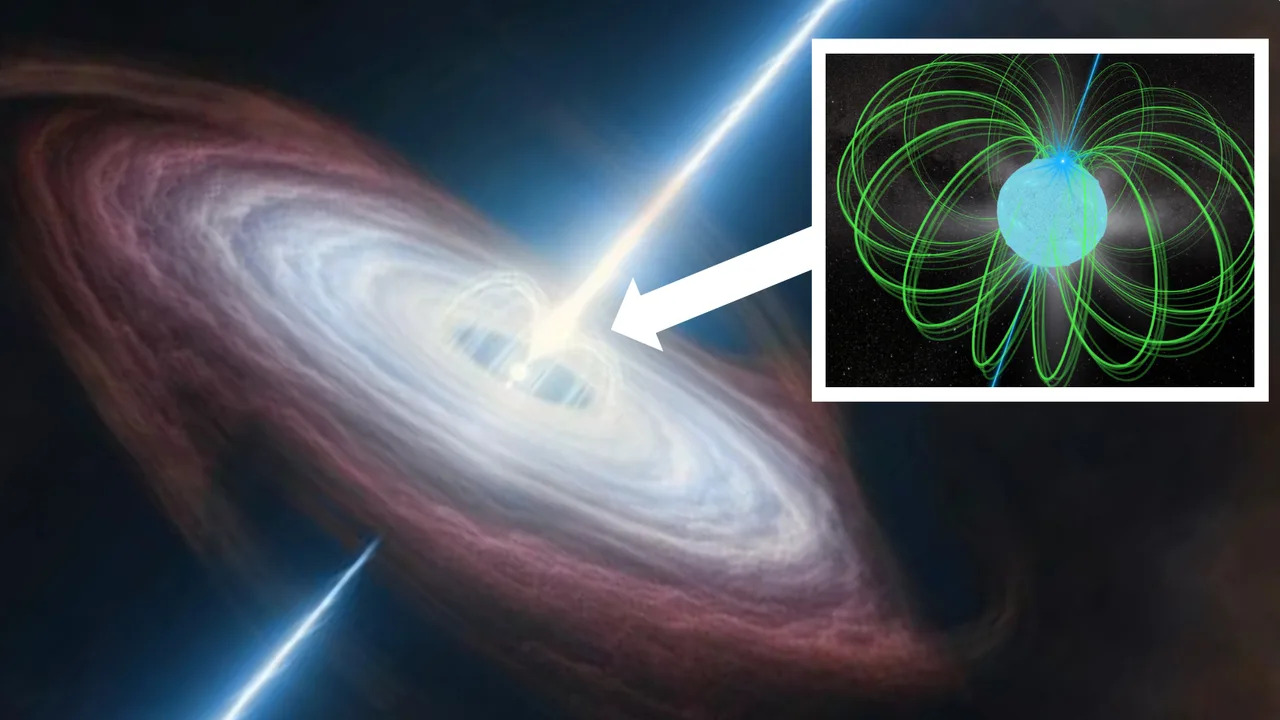
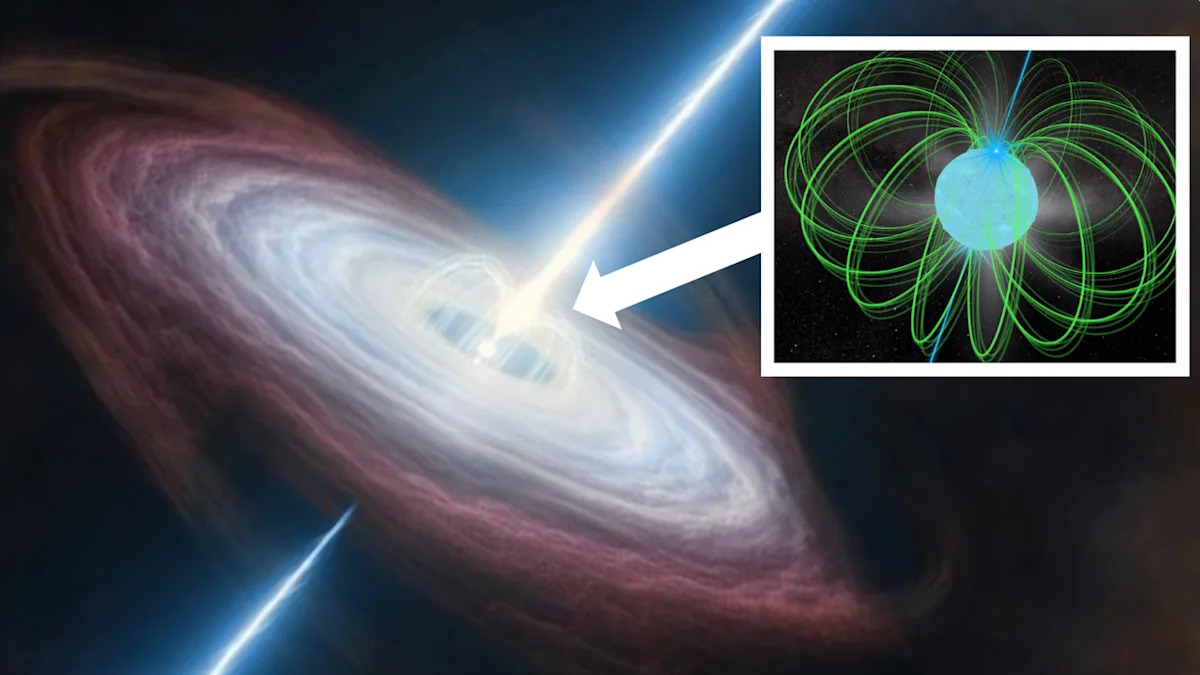
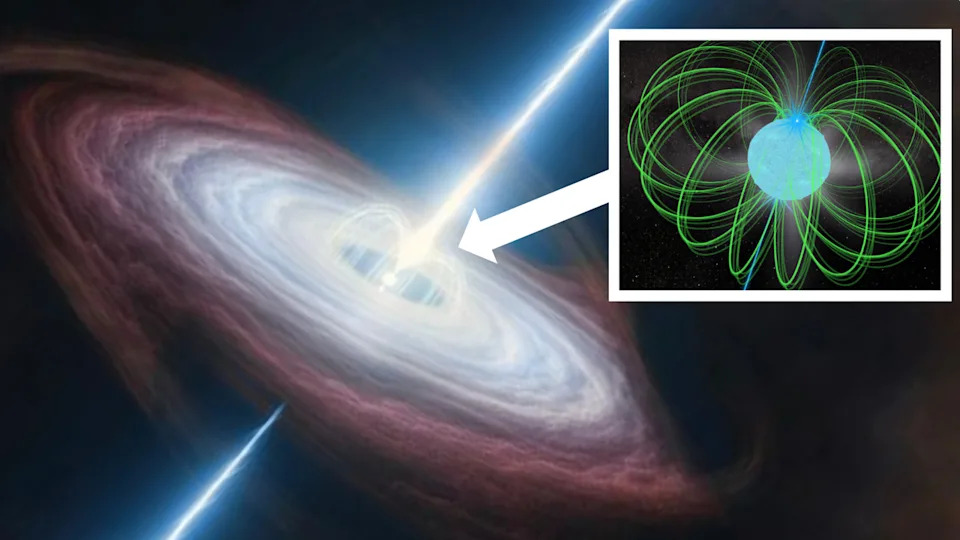
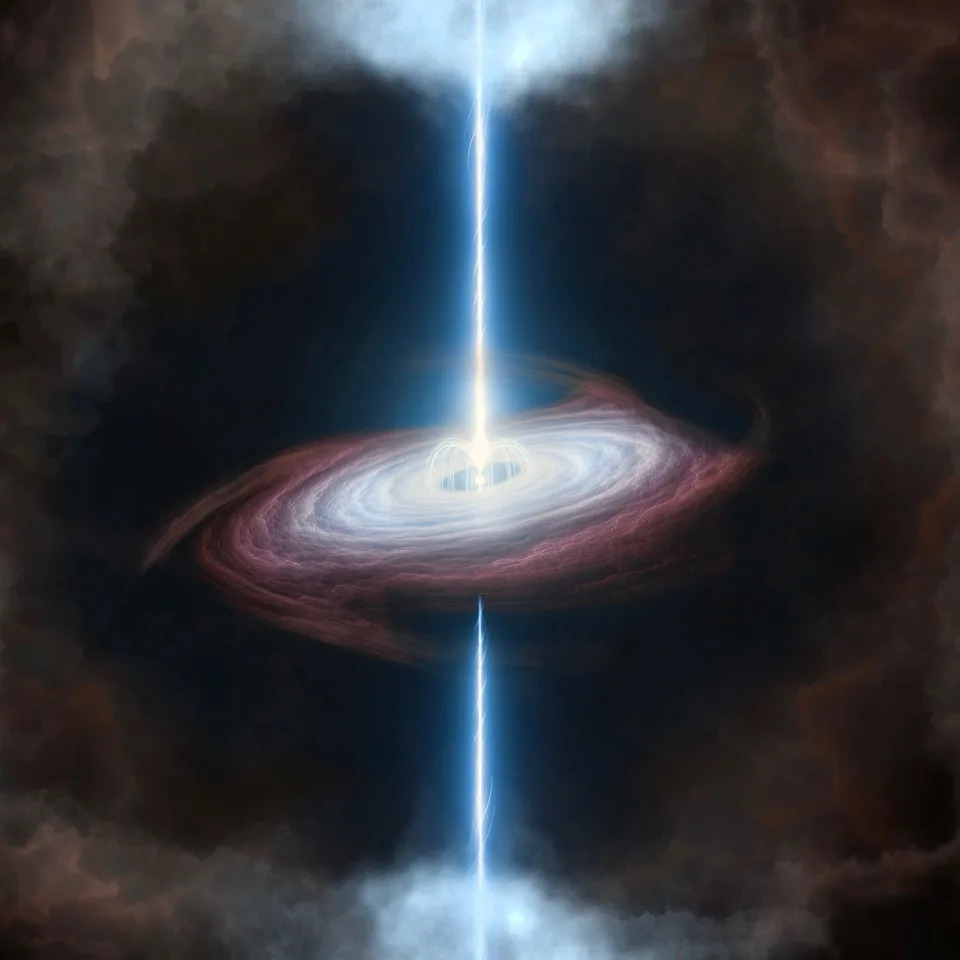
Similar bumps have been seen in the light curves of other supernovas, with scientists linking them to shocks rippling out from the central stellar body and striking previously ejected material. However, no previous supernova had demonstrated as many as four of these chirps.This team theorizes that material from the explosion seen as SN 2024afav actually fell back to the central magnetar after it was ejected, forming a swirling flattened cloud called an accretion disk around this powerful stellar remnant.

Because material ejected in the supernova is unlikely to be symmetric, the accretion disk is also unlikely to be symmetric. That leads to the axis of spin of the magnetar and that of the accretion disk being misaligned.

Einstein's theory of gravity, known as general relativity, suggests that as objects of great mass spin, they drag the very fabric of space along with them, a process called "frame-dragging" or the Lense-Thirring effect. This effect would cause the accretion disk to wobble, and a wobbling accretion disk would occasionally block light from the magnetar and occasionally reflect it. This creates a strobing effect that turns the entire system into a cosmic "lighthouse."

As the disk contracts and falls to the magnetar, the rate of this wobbling increases, and that generates the chirps seen in the light curve of SN 2024afav."We tested several ideas, including purely Newtonian effects and precession driven by the magnetar's magnetic fields, but only Lense-Thirring precession matched the timing perfectly," lead author of the paper, Joseph Farah of UC Berkeley, said. "It is the first time general relativity has been needed to describe the mechanics of a supernova."

The team was also able to determine that this central object is spinning around 238 times every second and has a magnetic field around 300 trillion times more powerful than Earth's magnetosphere, confirming this as a magnetar. That's the smoking gun astronomers have been looking for to connect magnetars and superluminous supernovas."He [lead author Joseph Farah] has tied the bumps into the magnetar model and explained everything with the best-tested theory in astrophysics — general relativity. It is incredibly elegant." Filippenko added. "To see a clear effect of Einstein's general theory of relativity is always exciting, but seeing it for the first time in a supernova is especially rewarding."