Press
Winter Paralympics 2026: Germans protest against Russia during medal ceremony
Images

1 / 20
2 / 20
3 / 20
4 / 20
5 / 20
6 / 20

7 / 20
8 / 20
9 / 20
10 / 20
11 / 20

12 / 20
13 / 20
14 / 20
15 / 20
16 / 20
17 / 20
18 / 20
19 / 20
20 / 20
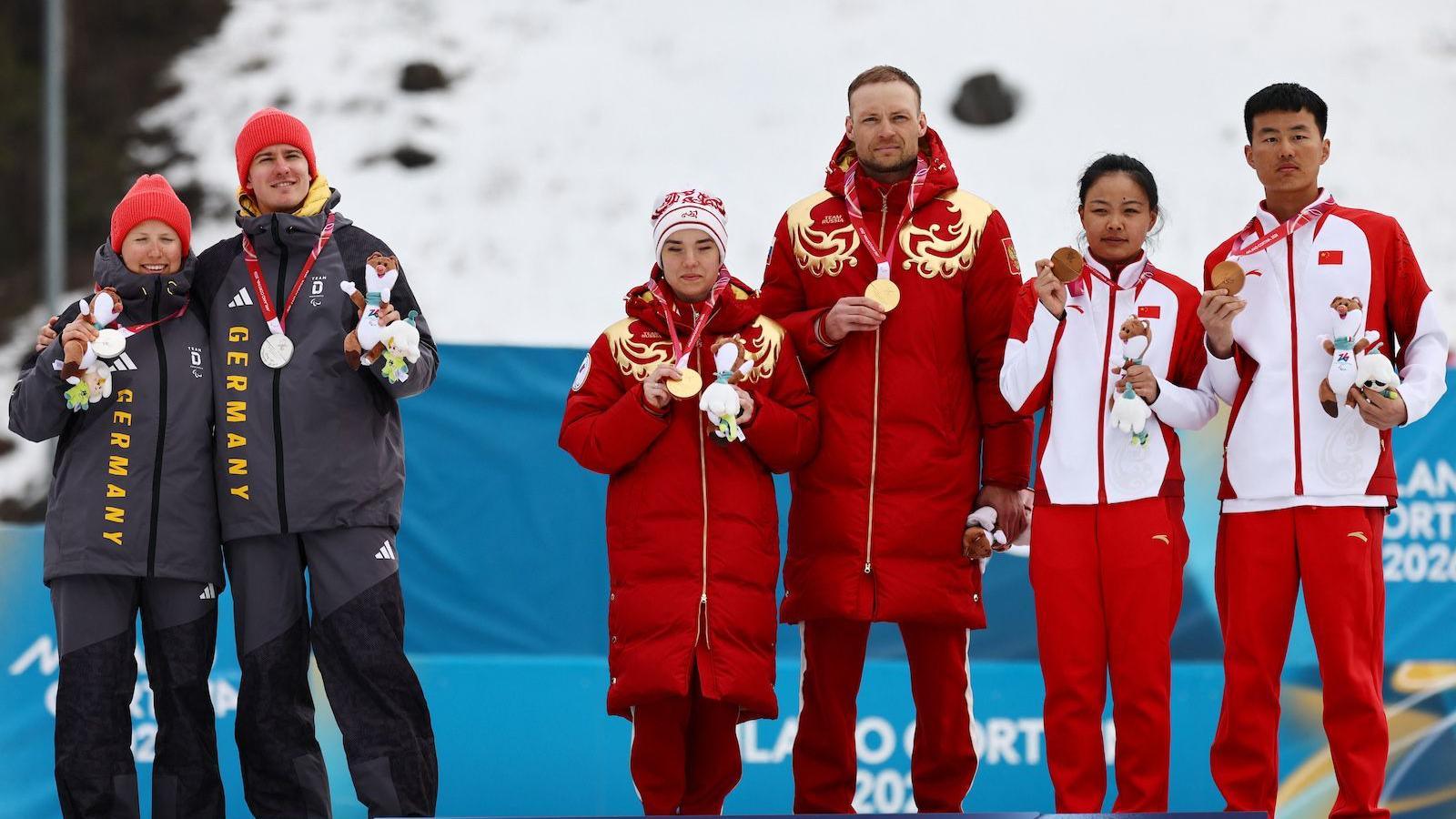
The German medallists (left) kept their distance from the Russians during post-ceremony photographs

German cross-country skiers turned their backs on the Russian gold medallists on the Winter Paralympics podium in protest against the nation's inclusion at the Games.

For the first time since 2014, Russian athletes are competing under their nation's flag at a Paralympics after the International Paralympic Committee lifted its suspension of the country in September.

Russia and its athletes had been banned following the state-sponsored doping scandal before further sanctions followed after its 2022 invasion of Ukraine.

On Tuesday, Anastasiia Bagiian and her guide Sergei Siniakin won gold in the women's sprint classic vision impaired event, Russia's second of three golds at the Games so far.

As the national anthem played, Germany's Linn Kazmaier and her guide Florian Baumann, the silver medallists, turned their backs to the Russians.

Speaking to German outlet Bild,, external Kazmaier said: "The medal ceremony felt completely strange. I don't know the [Russians], I don't know if perhaps they also support the system in Russia as little as we do.

"Perhaps they are really nice people, who we could be friends with. That it is so totally overshadowed by politics is simply a complete shame.

"That's why we decided to leave our hats on and not turn towards the flag, because we do not support it."

Russia win their first gold medal of Paralympics

Injured Russian soldiers can compete at Paralympics

In total, six Russian athletes and four from Belarus - an ally of Russia - are competing at the Milan-Cortina Winter Paralympics after the lifting of the IPC's ban.

As a result, teams from seven countries - including Ukraine - boycotted Friday's opening ceremony in Verona.

Para-alpine skier Varvara Voronchikhina won Russia's first gold on Monday - her medal ceremony proceeded with no protest.

Bild also reported that Kazmaier and Baumann refused to be involved in the medallists' selfie that takes place after every medal ceremony.

"Four years ago in Beijing we had a great exchange with the Ukrainians. We wanted to show solidarity to them," said Baumann.

"It's not about the Russian athletes, themselves. It's also difficult for many of them, but the IPC's decision to have Russia here under their flag, with their anthem and their full contingent in attendance, while the Ukrainians are also here, I find simply not correct."

The IPC told BBC Sport it was aware of the protest and is gathering and analysing evidence on the matter.

The German Paralympic Committee said: "This was an expression of solidarity with their friends, the Ukrainian athletes."

On Wednesday, Ukraine's Paralympic committee accused the IPC and the Games organising committee of subjecting its athletes and coaches to "systematic pressure" during the Games.

In a lengthy statement, it said its team had faced "openly negative manifestations and even obstacles", including the removal of a Ukraine flag from the team's headquarters in Italy and the placing of it in a "less visible" location.

It added that the family of Para-biathlon Paralympic champion Taras Rad had Ukraine flags and scarves removed from them in the stands, while an IPC representative allegedly tried to force fellow gold medallist Oleksandra Kononova to remove earrings featuring the flag of Ukraine and the words "stop war".

Kononova said she received a warning from the IPC as athletes competing at the Paralympics are prohibited from displaying political messaging.

In the statement, Ukraine said: "There appears the impression of an incomprehensible and very special partnership of the IPC with the NPCs of Russia and Belarus."

In a statement, the Milan-Cortina 2026 organising committee told BBC Sport: "We are aware of the statement issued by the National Paralympic Committee of Ukraine and, with the IPC, are reviewing the matters referenced, several of which we are hearing about for the first time.

"Milano Cortina 2026 works closely with the IPC and national delegations to ensure a respectful and welcoming environment for all athletes. The rules and procedures in place during the Games are designed to support that environment and apply equally to all teams, without preference to any delegation."

On the case of the earrings, the IPC's chief brand and communications officer Craig Spence said: "While we are empathetic to the situation faced by Ukrainian people, that empathy does not stretch to allowing NPC Ukraine to break the rules that govern these Games.

"Earlier this week, a Ukrainian medallist was wearing earrings with the message 'Stop War' prior to heading to the podium. This messaging was spotted by a member of staff who politely asked for them to be removed as they could be in breach of the IPC's rules. The athlete agreed and removed them."

What happens when at the Winter Paralympics?

Winter Paralympics medal table

What do I need to know about the 2026 Winter Paralympics?