yahoo Press
Stock market today: Dow, S&P 500, Nasdaq slip amid fresh inflation data, continued Iran fallout
Images
1 / 7

2 / 7

3 / 7

4 / 7

5 / 7

6 / 7

7 / 7
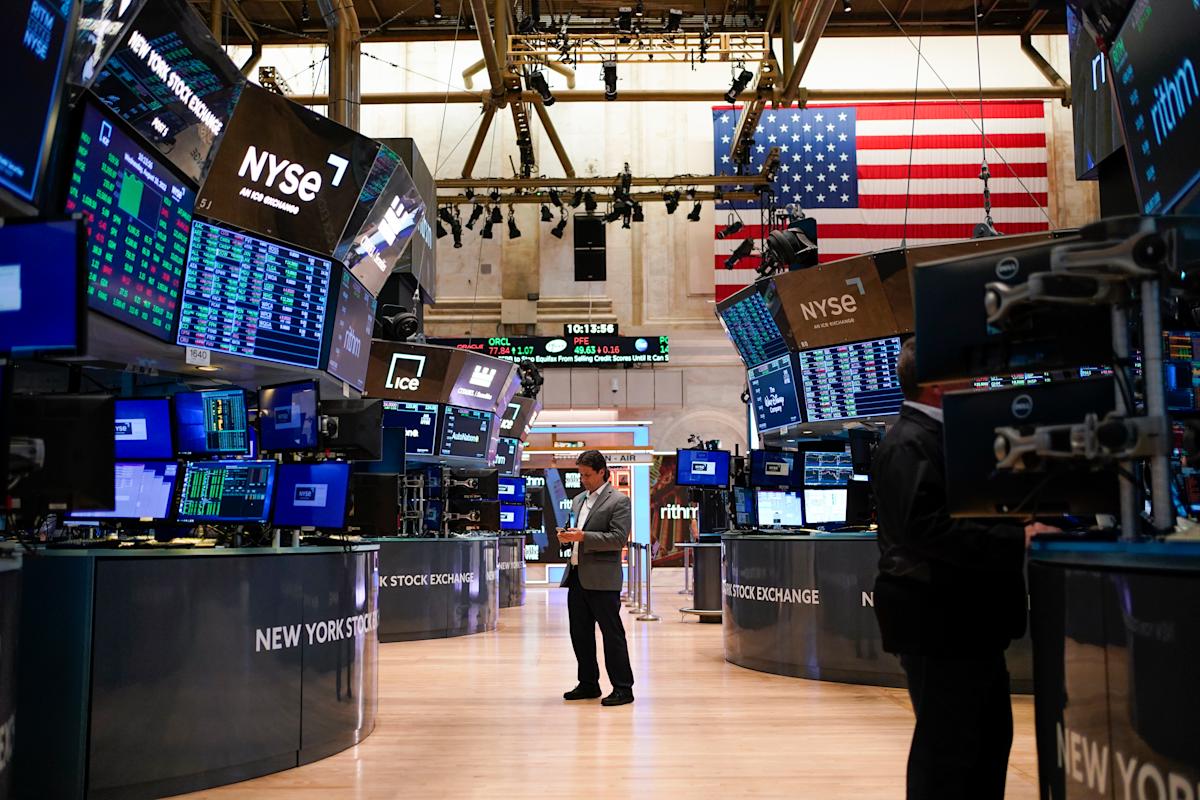
US stocks split at the opening bell on Wednesday as investors eyed attacks on shipping in the Iran war and assessed the latest inflation report, which came in line with expectations.

The tech-heavy Nasdaq Composite (^IXIC) moved 0.2% lower while the S&P 500 (^GSPC) lost 0.4%. The Dow Jones Industrial Average (^DJI) dropped 0.9%, or more than 400 points, after stocks closed Tuesday's volatile session little changed.

Worries about the knock-on effects from the Iran war have dominated markets this week, spurring oil market volatility that has reverberated through stocks. Crude prices rose on reports that three vessels came under fire in the Strait of Hormuz on Wednesday morning, as the Iran war continues to menace shipping. Futures for West Texas Intermediate (CL=F) and Brent (BZ=F) crude gained, trading above $85 and $90 a barrel, respectively.

Meanwhile, the International Energy Agency said it would release 400 million barrels of oil from reserves to ease the supply crunch and put the brakes on a roaring oil rally that briefly lifted prices toward $120 per barrel on Monday. The action is the agency's largest-ever emergency oil release in history.

Beyond geopolitics, Wall Street received the first of two highly anticipated inflation readings due this week. February's Consumer Price Index showed consumer prices rose 0.3% over the previous month and 2.4% year over year, matching expectations.

The CPI reading will be followed by January’s Personal Consumption Expenditures index on Friday.

The data provides insight into inflation trends and the broader health of the US economy, particularly as recent indicators suggest the labor market may be losing some momentum. It didn't, however, capture the effects of the oil price surge this month.

In earnings, Oracle shares surged over 10% after the tech giant posted an upbeat earnings report and outlook.

Shares in med-tech giant Stryker Corporation (SYK) sank by as much as 5% Wednesday morning after the company experienced widespread outages following a cyberattack.

In a message to employees, Stryker leadership said the company "is currently experiencing a severe, global disruption across the Windows environment impacting both client devices and servers,” according to the Wall Street Journal. The notice said the company hasn’t identified the root cause and is actively engaged with Microsoft.

The attack, which prompted a global outage across Stryker's systems, is potentially linked to an Iran-backed hacking group, the Journal reported, noting that staff and contractors had seen the logo of the pro-Palestinian group Handala on their computers.

Handala has claimed responsibility for a string of cyberattacks throughout Israel and the wider Gulf region.

“Our teams are actively working to restore systems and operations as quickly as possible. Stryker has business continuity measures in place, and we’re committed to continuing to serve our customers,” a Stryker spokesperson said in a statement to the Journal.

In large-cap stock sectors, energy (XLE) and tech (XLK) are leading today — and they're also leading in March month-to-date (but not in that order).

In general, March is shaping up to be a reversal month. Materials (XLB) and consumer staples (XLP) are the biggest losers after ranking among the leaders in January and February, with healthcare (XLV) also rolling over.

The big surprise might be tech in the No. 2 slot so far this month — especially as it's not because of semis. Notably, the iShares Semiconductor ETF (SOXX) is still in the red in March.

The rebound is coming more from software — see the iShares software ETF (IGV) — a notable shift after that group spent nearly six months under pressure. That leaves room for some skepticism, as this could still be a short covering rather than fresh conviction.

The one constant is energy. XLE was a leader in January and February and is still near the top in March.

Yahoo Finance's Daniel Howley reports:

Read more here.

The International Energy Agency (IEA) said its members would release 400 million barrels of oil from strategic petroleum reserves, the agency's largest-ever release, in an attempt to keep a lid on surging oil prices as the war in the Middle East disrupts energy markets.

Futures for West Texas Intermediate (CL=F) and Brent (BZ=F) briefly dipped before regaining ground and trading at $85 and $87 per barrel, respectively. Earlier in the week, oil prices shot up to around $120 per barrel amid a supply crunch in the Strait of Hormuz, a critical waterway for oil transport.

The emergency release is the IEA's sixth in history and more than doubles the amount of oil released following Russia's invasion of Ukraine in 2022. The 32 IEA members hold over 1.2 billion barrels in reserves, plus a further 600 million barrels of industry stocks held under government obligation.

“The oil market challenges we are facing are unprecedented in scale, therefore I am very glad that IEA Member countries have responded with an emergency collective action of unprecedented size,” IEA Executive Director Fatih Birol said.

Read more here.

The US stock market opened Wednesday's trading session on mixed footing as investors eyed attacks on shipping in the Iran war and assessed the latest inflation report, which came in line with expectations.

The Nasdaq Composite (^IXIC) led gains, rising 0.3%, while the S&P 500 (^GSPC) gained roughly 0.2%. Meanwhile, the Dow Jones Industrial Average (^DJI) slipped by roughly 0.2%.

Crude prices rose on news that three vessels came under fire in the Strait of Hormuz on Wednesday morning. Futures for West Texas Intermediate (CL=F) and Brent (BZ=F) crude gained, trading above $85 and $90 a barrel, respectively. In an attempt to put a lid on energy pricing, the IEA has proposed a record release of reserves to ease the supply crunch and put the brakes on a roaring oil rally.

On the economic calendar, February's Consumer Price Index showed consumer prices rose 0.3% over the previous month and 2.4% year over year, matching expectations. The CPI reading will be followed by January’s Personal Consumption Expenditures index on Friday.

In earnings, Oracle (ORCL) shares jumped on a strong earnings report and outlook.

After a very brief spike upwards, which was quickly reversed, the futures of the major indexes (YM=F, NQ=F, ES=F) plus the Russell 2000 (RTY=F) are all drifting lower, with all but Nasdaq futures hitting fresh session lows. Nevertheless, the declines are modest.

The reaction in bonds is more material.

Long-term yields (^TNX, ^TYX) were already higher coming into the report and have added to gains. The 10-year and 30-year yields are both up five basis points to one-month highs. Both tenors are seeing their biggest monthly jumps since last May, as higher uncertainty and higher oil prices feed into the bond math.

When the market opens shortly, focus will be on the 6,800 level in the S&P 500 (^GSPC), which has been the battleground since the Iran conflict began. The last two days, the benchmark index has closed within a few points of that level.

Consumer prices rose 0.3% in February over the previous month, according to data released by the Bureau of Labor Statistics on Friday morning, matching expectations and rising slightly higher than the previous month's 0.2% increase. The inflation measure rose 2.4% year over year, also matching expectations and January's year-on-year reading.

The "core" Consumer Price Index, which excludes the volatile food and energy categories, rose by 0.2% from the previous month and 2.5% over the previous year. Both readings were in line with economists' expectations.

The month-over month reading for core inflation cooled slightly from January's 0.3% increase, while the year-on-year reading remained unchanged from the previous month.

Fuel oil and utility gas prices rose 11.1% and 3.1%, respectively, from the previous month, driven in part by a cold-weather snap that blanketed the US with freezing temperatures, prompting Americans to crank up their heat.

As Yahoo Finance's Emma Ockerman noted, the report covers the period before the war with Iran broke out, which has raised gas prices and fueled concerns of higher utility bills.

"Perhaps more important than the [February] data is the evolving risk space for inflation," Bank of America's Stephen Juneau said in a research report last week, noting that a longer conflict "would put upward pressure on headline, core inflation and inflation expectations in the months ahead."

Gasoline prices rose 0.8% month over month in February, but that figure could jump in future reports. Gas pump prices averaged $3.578 per gallon nationally, up from $2.937 one month ago.

Shell (SHEL) is among a group of companies that have declared force majeure on LNG deliveries to Asia after the shutdown of the Las Raffan LNG complex in Qatar, Bloomberg reported. Force majeure is a legal measure that frees suppliers from liability in extraordinary circumstances.

Shares in the British energy major picked up a bit more than 1% in premarket trading on Wednesday morning after an initial drop on the news.

Shell has an equity partnership with QatarEnergy, the state-run Qatari energy giant that operates Las Raffan, the world's largest single LNG plant. Las Raffan has now been shut for several days after drone strikes amid the Iran war, putting intense pressure on the global LNG market.

QatarEnergy declared force majeure on its energy deliveries, and it's unclear when the plant will be brought back online.

CarMax (KMX) stock rose 8% in premarket trading on news that activist investor Starboard Value has built a $350 million stake in the company.

According to Bloomberg, Starboard nominated its CEO, Jeff Smith, and Frontdoor's CEO, Bill Cobb, to the CarMax board. The activist supports CarMax's incoming CEO, Keith Barr, but is looking to accelerate the used-car dealer's turnaround plans.

Bloomberg reports:

Read more here.

Market watchers and consumers will soon get fresh data on how much inflation shifted in February, with the release of the CPI report at 8:30 a.m. ET.

Yahoo Finance's Emma Ockerman takes a look at what to watch in the data:

Read more here.

Growing concerns about credit quality also weighed on the market mood, after reports that JPMorgan (JPM) has marked down the value of private credit loan portfolios and tightened lending.

From Bloomberg:

Read more here.

Three commercial vessels came under fire in the Gulf early on Wednesday morning as Iran launched strikes against oil-exporting neighbors, in a continued threat to shipping in the crucial Strait of Hormuz waterway.

Bloomberg reports:

Read more here.

Oracle (ORCL) reported its third quarter earnings after the bell on Tuesday, beating expectations on the top and bottom lines, while raising its 2027 revenue guidance to $90 billion, sending the company's stock higher.

Shares jumped as much as 10% during premarket trading on Wednesday

The announcement comes amid reports that the company has axed plans to expand an AI data center with OpenAI (OPAI.PVT) and that it’s preparing to cut thousands of jobs.

In the first quarter, revenue is expected to be flat to up 2% year over year to a range of $117 million to $120 million, compared to $124 million expected.

Groupon's CEO Dusan Senkypl attributed some of the weakness to demand challenges in the online discount marketplace's non-paid channels.

"The pace of growth improvement in 2026 will be more moderate than the trajectory we were building toward," Senkypl said. "The headwinds I described in organic, owned, and enterprise channels are addressable, and we have clear action plans against each, but the fixes will take time to compound."

In the fourth quarter, earnings per share of $0.17 were in line with Wall Street estimates. Revenue of $132.7 million missed the Street's forecast of $136.5 million.

Groupon (GRPN) stock swung 10% lower in premarket trading on Wednesday following the company's weaker-than-expected financial guidance.

For 2026, Groupon forecast revenue of $513 million to $523 million, below analysts' expectations of $540 million, according to S&P Global Market Intelligence. Billings are expected to grow 3% to 5%.

In the first quarter, revenue is expected to be flat to up 2% year over year to a range of $117 million to $120 million, compared to $124 million expected.

Groupon's CEO Dusan Senkypl attributed some of the weakness to demand challenges in the online discount marketplace's non-paid channels.

"The pace of growth improvement in 2026 will be more moderate than the trajectory we were building toward," Senkypl said. "The headwinds I described in organic, owned, and enterprise channels are addressable, and we have clear action plans against each, but the fixes will take time to compound."

In the fourth quarter, earnings per share of $0.17 were in line with Wall Street estimates. Revenue of $132.7 million missed the Street's forecast of $136.5 million.

One of the pure stock stories in the past week of Operation Epic Fury volatility is memory-chip play Sandisk (SNDK).

The stock is up 10% in the past five days. That brings its one-year gain to an eye-watering 1,067%.

I think what Hewlett Packard Enterprise (HPE) CEO Antonio Neri told me this week on the outlook for memory chip prices explains the move in Sandisk:

Higher chip prices weighed on HPE's quarter, as you can watch in the below clip.

It was a well-received quarter from Oracle (ORCL) — the stock is up close to 10% in premarket.

I think this call-out from the RBC Capital Markets team sums up the general thinking on the Street for Oracle, post-earnings release on Tuesday:

Bloomberg reports:

Read more here.

Bloomberg report:

Read more here.