Press
Al Quds Day march to be banned after government approves Met request
Images

1 / 8

2 / 8
3 / 8

4 / 8

5 / 8

6 / 8

7 / 8

8 / 8
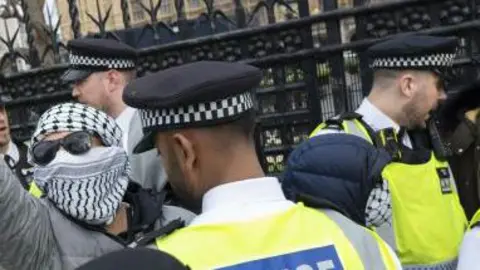
The government has approved a request from the Metropolitan Police to ban a  march due to take place in London on Sunday.

Home Secretary Shabana Mahmood said it was aimed at preventing "serious public disorder" at the annual Al Quds Day march, which has always been seen as pro-Iranian though organisers say it is more of a pro-Palestinian event.

The Met said the threshold to ban a protest was high and it had not taken its decision lightly. It is the first time a protest march has been banned since 2012.

Faisal Bodi, of the Islamic Human Rights Commission which organises the event, said a ban would mean a "sad day for freedom of expression".

Mahmood said a stationary demonstration could take place instead under strict conditions.

"I am satisfied doing so is necessary to prevent serious public disorder, due to the scale of the protest and multiple counter-protests, in the context of the ongoing conflict in the Middle East," Mahmood said in a statement.

"Should a stationary demonstration proceed, the police will be able to apply strict conditions. I expect to see the full force of the law applied to anyone spreading hatred and division instead of exercising their right to peaceful protest."

Assistant Commissioner Ade Adelekan, Public Order lead for the Met, said that the ban applied to the "Al Quds march and any associated counter-protest marches" and would be in place from 16:00 on Wednesday, to last one month.

"The Al Quds march is uniquely contentious having originated in Iran and in London is organised by the Islamic Human Rights Commission, an organisation supportive of the Iranian regime," he added.

Noting that the power to ban a march had not been used since 2012, he said the Met had "safely policed hundreds of protests from across the political spectrum including 32 major pro-Palestinian protests and many more both pro and anti the Iranian regime".

"But in our assessment this march raises unique risks and challenges," he continued.

"We must consider the likely high numbers of protestors and counter protestors coming together and the extreme tensions between different factions. We have taken into consideration the likely impact on protests of the volatile situation in the Middle East, with the Iranian regime attacking British allies and military bases overseas."

Previous Al Quds marches had "resulted in arrests for supporting terrorist organisations and antisemitic hate crimes", the assistant commissioner added.

"However, the decision to ban it this year is purely based on a risk assessment of this specific protest and counter-protests – we do not police taste or decency or prefer one political view over another, but we will do everything we can to reduce violence and disorder," he said.

Former Met chief superintendent Dal Babu, who sits on the London Policing Board which scrutinises the force, said it was a "very, very serious decision but it would have been based on police intelligence".

Speaking to BBC Radio 4's Today programme, he added: "There are restrictions placed on marches and demonstrations, but an outright ban is extremely unusual.

"And I think we need to trust the police, trust their judgement."

The Islamic Human Rights Commission describes Al Quds Day as an "international demonstration... in support of Palestinians and all the oppressed around the world".

Speaking to Radio 4's The World Tonight programme before the ban was confirmed,  Faisal Bodi said: "If it's true then it's a sad day for freedom of expression, freedom of assembly and the right of people to legitimately protest about issues they feel strongly about."

"This demonstration has taken place for the last 40 years peacefully," he added.

The government's former independent adviser on political violence and disruption, Lord Walney, told the same programme he thought the request by the Met to ban the march was the "right decision".

There are calls most years for the Al Quds Day march to be banned, and they grew after the Hamas-led attack on Israel on 7 October 2023.

Amie Watson's family have turned off the heating in their home in order to conserve fuel.

A haulier says rising fuel costs threaten firms who are already on tight profit margins.

Naval families of serving personnel worry for their loved ones being deployed on HMS Dragon.

Maersk chief executive Vincent Clerc has called on the US, Israel and Iran to reach "some kind of deal".

Ten days since President Trump first announced the attack, people from across the US tell the BBC what they think the best outcome of the conflict could be.