Press
In maps: Strikes across Iran and the Middle East
Images
1 / 15

2 / 15
3 / 15
4 / 15
5 / 15
6 / 15
7 / 15
8 / 15
9 / 15

10 / 15

11 / 15
12 / 15

13 / 15

14 / 15
15 / 15
A government tower block has been set on fire in Kuwait after a reported drone and missile attack overnight, while Israel's military said it struck oil depots in and around the Iranian capital Tehran on the ninth day of the US-Israeli war with Iran.

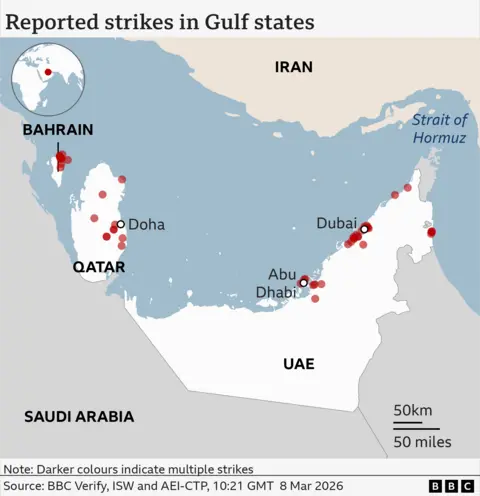
The United Arab Emirates (UAE) said it responded to a "missile threat" early on Sunday morning while Bahrain said a water desalination plant was struck. The reported attacks on the Gulf states come a day after Iran's president apologised to its neighbours for recent strikes against them.

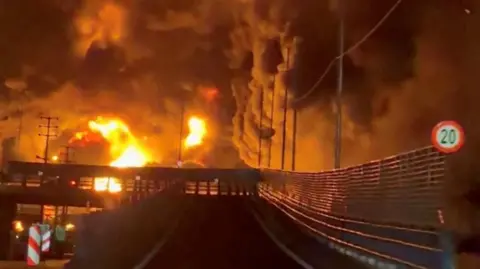
In the north-west of Tehran verified video showed flames spreading along a street in the Shahran area some 2km (1.2 miles) from where an oil facility was reportedly struck by the Israelis - it is not clear if the incidents were connected.

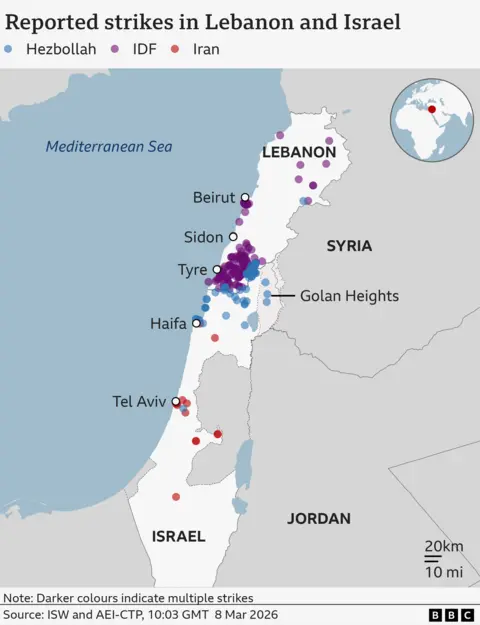
The Israeli military also carried out what it called a "precise strike" targeting commanders from Iran's Revolutionary Guard Corps in Lebanon. Lebanese officials said four people were killed.

The US-based Human Rights Activists News Agency (HRANA) says 1,205 civilians are reported to have been killed in Iran since 28 February. Six US service personnel were killed in a strike on a military base in Kuwait.

The first US-Israeli strikes on Iran began on 28 February with Israel's military saying it had targeted Iran's leadership and military infrastructure. The former Supreme Leader of Iran, Ayatollah Ali Khamenei, was killed in Tehran during the initial wave of strikes.

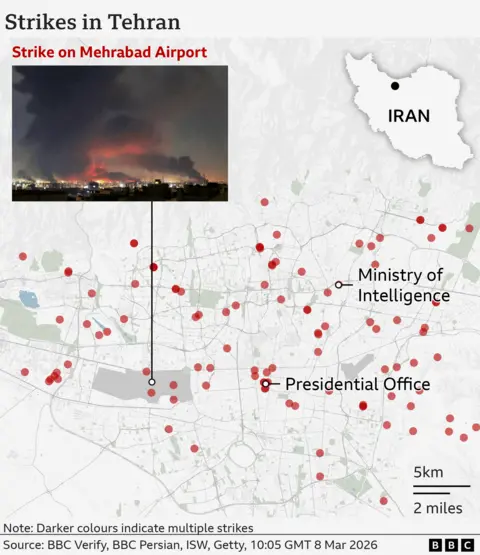
On Saturday, Mehrabad airport in Tehran was attacked after the IDF said it had completed "an additional wave of strikes" targeting Iran's infrastructure.

Satellite images analysed by BBC Verify show at least five damaged aircraft and large burn marks on the airport tarmac.

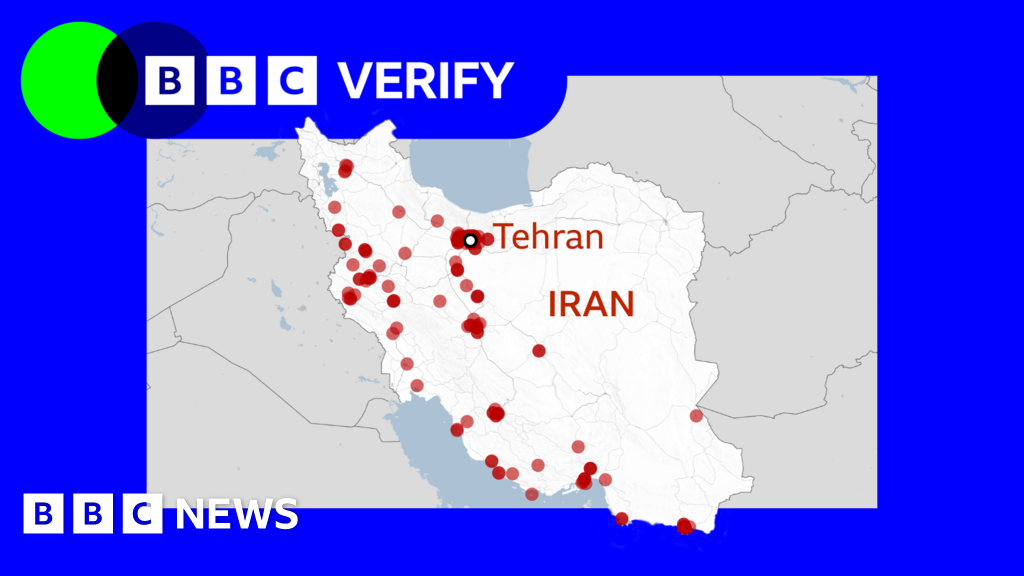
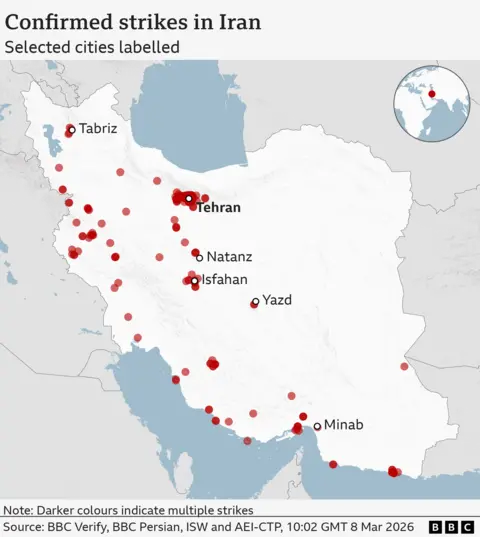
BBC Verify has so far confirmed visual evidence of more than 100 attacks across the whole of Iran, including at least 49 strikes in Tehran.

Satellite imagery reviewed by BBC Verify shows at least 11 Iranian naval vessels have been damaged or destroyed by US and Israeli strikes on the Konarak and Bandar Abbas naval bases since the war began. Other satellite imagery has revealed damage to at least three Iranian missile sites and the nuclear facility at Natanz.

In Minab, in the south of Iran, at least 168 people including children were killed at a girls' school when it was hit on 28 February, Iranian authorities said. Two buildings can be seen in satellite imagery - an Iranian Revolutionary Guard Corps base has been completely flattened and the school building has partially collapsed.

Analysis of the imagery reveals multiple strikes and burn marks around the school suggesting it was hit more than once.

Israeli forces have also carried out air strikes in Lebanon targeting Hezbollah, the militant group that has long been backed by Iran. Hezbollah launched missiles towards Israel on 2 March following the killing of Khamenei.

Tens of thousands of people evacuated their homes on Thursday after the IDF issued an evacuation warning for the southern suburbs of the Lebanese capital, Beirut.

Israel's military said on Friday it had hit a Hezbollah command centre and a drone depot in Lebanon.

A missile attack on 1 March, which Israel said came from Iran, killed at least nine people and injured 27 others in the city of Beit Shemesh, according to emergency services.

On Saturday, Hezbollah said it targeted Israel's Dado military base, north-east of the city of Safed, with a missile strike.

In a post on Telegram, it said the strike was in response to Israeli strikes on "dozens of Lebanese cities and towns, including the southern suburbs of Beirut".

Following an IDF evacuation order, the Lebanese town of Nabi Chit was targeted in the early hours of Saturday. Several people are reported to have been killed in the strike, with verified footage showing damage across a large area.

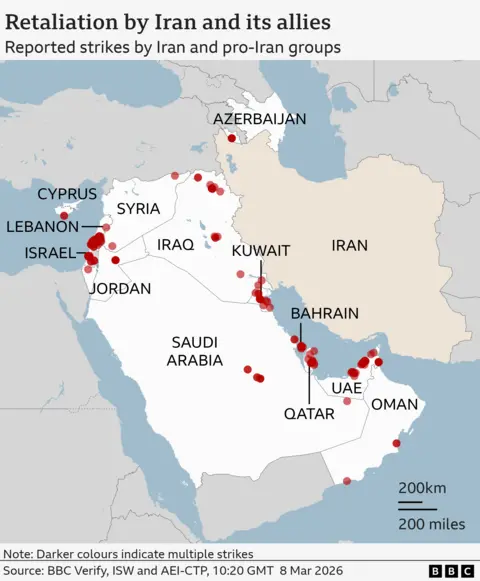
As well as launching missiles at Israel, Iran has mounted attacks on US bases and embassies in the Middle East. It has also been accused of attacking infrastructure and civilian sites in the Gulf states

In the UAE, an apparent drone strike hit Dubai International airport on Saturday. Verified video showed an explosion and a large plume of smoke near the terminal. The country has faced almost daily missile and drone attacks since 28 February.

Qatar, Bahrain, Kuwait and Saudi Arabia also reported coming under drone and missile attacks on Friday.

On 1 March, six US soldiers were killed after a drone "evaded air defences" and hit a command centre at Port Shuaiba in Kuwait, the Department of Defense confirmed.

Other incidents reported across the Middle East in recent days include:

The US-Israeli war with Iran has also spread beyond the Middle East.

On Thursday, Azerbaijan accused Iran of launching drones that injured two people in the western territory of Nakhchivan near the Iranian border. Iran denied the claim but Azerbaijan's President Ilham Aliyev called for Tehran to be held "accountable".

US Defense Secretary Hegseth said on Wednesday a US submarine had sunk an Iranian warship "in international waters".

The Iris Dena, which was thought to have around 130 people on board, was hit by a torpedo in the Indian Ocean off Sri Lanka. Eighty-seven sailors were killed, Sri Lankan officials said, while 32 were being treated for minor injuries.

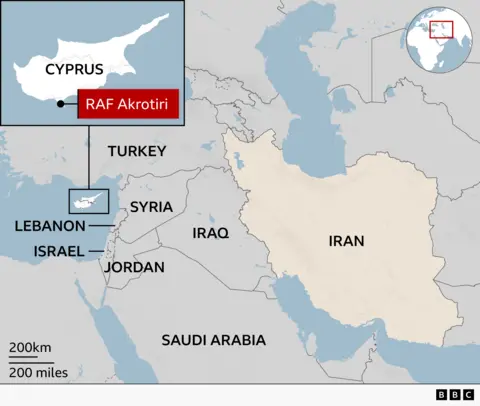
The UK has said a Royal Navy warship will sail to Cyprus after an Iranian drone hit the RAF base at Akrotiri on 1 March. Two more drones were intercepted on 2 March, the Cypriot government said.

This story is being updated daily by BBC Verify.

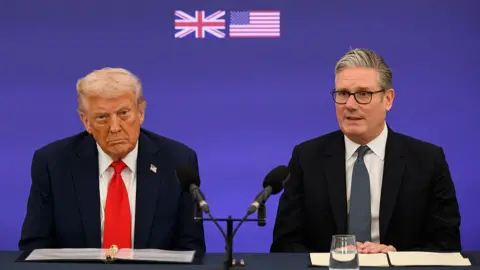
Foreign Secretary Yvette Cooper has hit back at President Trump's criticism of the UK response to the conflict in Iran.

The remarks come after a public back-and-forth between Trump and Sir Keir Starmer over UK involvement in the US's joint offensive with Israel against Iran.

UN Humanitarian Affairs Lead Tom Fletcher speaks to the BBC about the conflict in the Middle East.

The storms uprooted trees, downed power lines, damaged buildings and ripped the roofs off some houses.

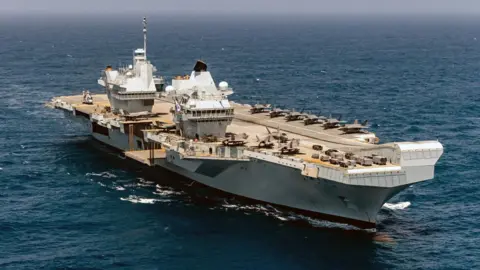
The move may raise speculation HMS Prince of Wales could be sent to defend British interests during the Middle East conflict.