Press
Swiss to vote on right-wing push to slash licence fee for public broadcaster
Images
1 / 10

2 / 10
3 / 10
4 / 10
5 / 10
6 / 10
7 / 10
8 / 10
9 / 10
10 / 10
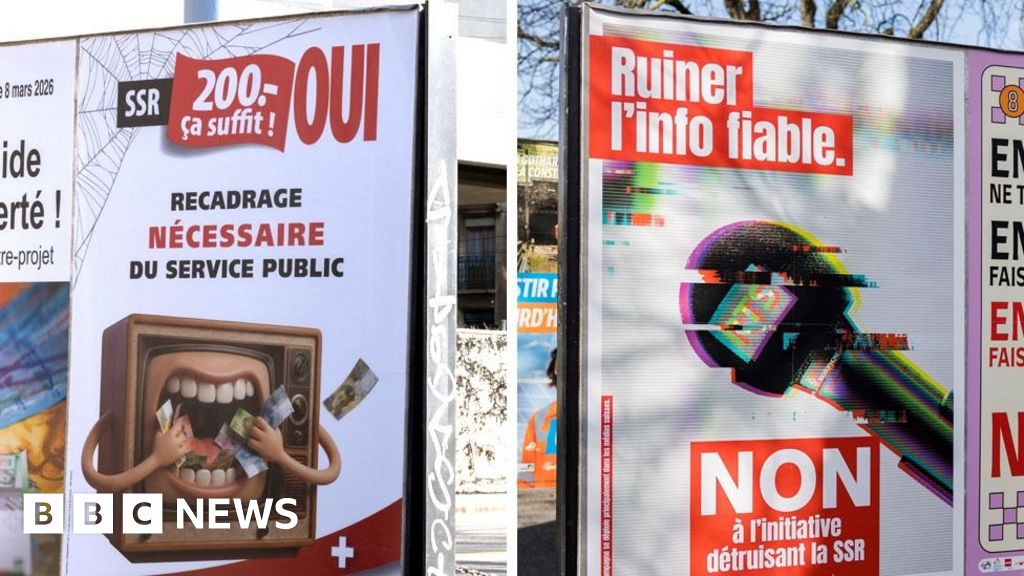
Swiss voters go to the polls this weekend to decide whether to reduce sharply the annual licence fee for their national broadcaster.

The fee for the Swiss Broadcasting Corporation has already been cut in recent years but currently costs 335 Swiss francs (£320; $435) per household a year. That is higher than in neighbouring Germany (£190) and Austria (£160).

If the proposal is passed, the Swiss fee would decrease to 200 francs (£190; $260), annually, and businesses would be exempt.

The move is backed by the right-wing Swiss People's Party, which argues the current cost is unjustified when Swiss citizens are struggling with the cost of living crisis.

The party also questions SBC's efficiency. "In the 21st Century, programmes can be produced much more cheaply than 30 or 40 years ago," People's Party member of parliament Manfred Bühler told Swiss media. "Two hundred francs really is enough."

With younger people in particular turning to streaming companies, early opinion polls pointed to a close vote, with many Swiss asking whether their national broadcaster needs to do as much as it does.

But opponents of the move say much of the licence fee goes on ensuring all four Swiss languages - German, French, Italian and Romantsch - are represented.

All four have their own radio and television channels, and each broadcasts national and local news daily.

Fabian Molina, member of parliament for the Social Democrats, fears cuts to the licence fee would undermine Switzerland's "national cohesion", where all regions and linguistic communities are supposed to be treated equally.

He also worries about the impact on SBC's coverage of foreign news. The broadcaster maintains correspondents in the US, Russia, China, the Middle East and Latin America, as well as in Brussels, Berlin, Paris, Rome and London.

"As a neutral country we have a unique perspective on the world, and only our correspondents can bring that back home to people," Molina said.

The SBC has warned of hundreds of job losses if a cut to the licence fee is approved, and said the organisation's coverage of news and sport would be reduced dramatically.

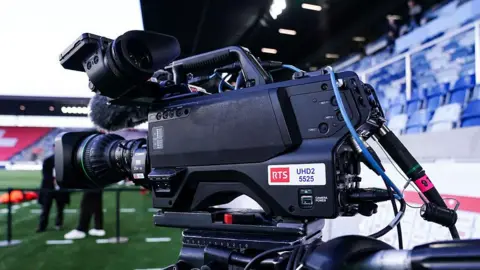
Unlike many other European countries, including the UK, where top league football has switched to private broadcasters requiring subscription fees, the SBC still broadcasts plenty of football, as well as all the winter sports at which the Swiss excel.

Until just a few weeks ago, it looked as if voters might be ready to back the cut.

Then came intervention from an unexpected source. Writing in the German version of Russian state-backed news outlet RT, someone calling himself Hans-Ueli Läppli called on the Swiss to back cutting the licence fee.  The name is so cliched as to be almost certainly a pseudonym.

The writer accused SBC of "Russophobia…  selective reporting, moralising on political issues and ignoring uncomfortable facts" and of "manipulating" the Swiss population.

For many voters, left and right, this was too much. Neutral Switzerland has backed Europe's sanctions against Russia, calling the invasion of Ukraine a violation of international law, prompting considerable criticism from Moscow.

Although Switzerland and its government have been the target of several Kremlin-backed disinformation campaigns, it has not joined the EU in banning RT, which remains available online here.

But the article telling the Swiss how to vote came across to many as blatant interference in their widely respected system of direct democracy, and has caused real anger.

Members of the committee leading the campaign to cut the licence fee say they had nothing to do with the RT piece, no contact with Russian media and do not agree with the accusation that SBC journalism is selective or manipulative.

Their focus, says committee member Susanne Brunner, is "to reduce the SBC licence fee to 200 Swiss francs, to ease the burden on households and businesses".

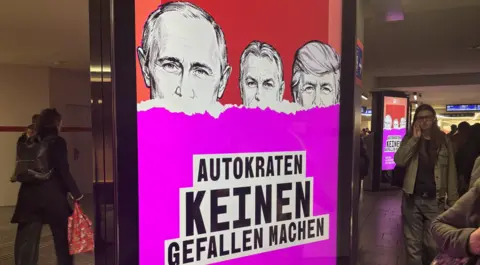
After the RT story was published, the debate over the SBC licence fee changed. Posters appeared from an anti-populist group urging voters not to "do the autocrats any favours", using images of Russia's Vladimir Putin, Hungary's Viktor Orban and US President Donald Trump.

Most of Hungary's independent media have been taken over by supporters of its nationalist-conservative prime minister, and the RT story came out at around the same time that the Washington Post announced mass redundancies.

The Swiss government and all political parties except the Swiss People's Party are urging a "No" vote. Many sporting associations and cultural groups are also campaigning for a no.

Recent opinion polls in the run-up to Sunday's referendum suggest 54-57% of voters will choose to keep the licence fee where it is.

"People understand the cost of living crisis will not be resolved by cutting a relatively small fee that each household has to pay just once a year," says Molina.

Also up for vote in Sunday's ballot are proposals to create a multi billion-dollar climate fund, to enshrine in the constitution a guarantee to keep cash payments with coins and banknotes, and to change how the income of married couples is taxed.

Young Sherlock will be a re-imagined origin story for famous detective Sherlock Holmes.

The Oscar-winning actor returns to play gangster Tommy Shelby in Peaky Blinders: The Immortal Man.

Locations in Bristol and Somerset have helped form the backdrop to the new period mystery thriller.

A court heard that an art consultant working for the TV hosts took "secret and unauthorised profits".

A court hears that an art consultant working for the TV hosts took "secret and unauthorised profits".